
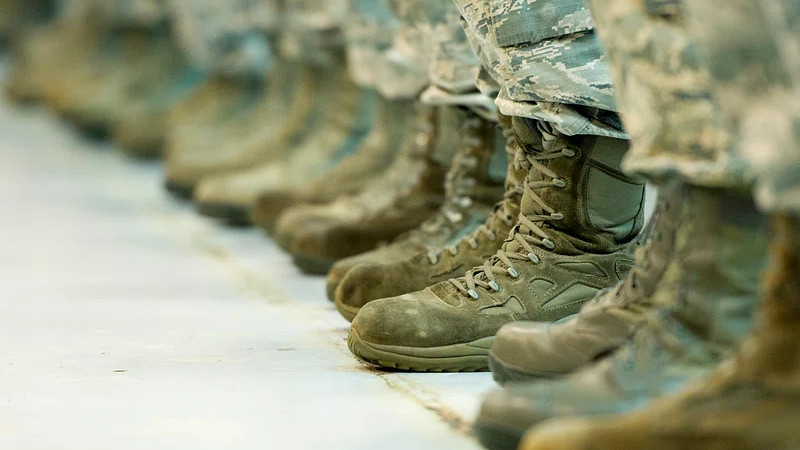
Because Law Enforcement Today’s mission is to support law enforcement agencies across the United States, from local police departments to DHS components operating on the front lines of homeland security, I am always looking for capabilities that help America’s men and women in uniform successfully complete the mission and make it home for dinner with their families.
Last month, during one of my routine stops in Washington, D.C., Modern Day Marine was taking place. That's where you'd expect to engage with the capabilities du jour: drones, artificial intelligence, and the other high-end technologies shaping the 21st-century battlefield that could also prove useful to our men and women in blue. Instead, I found myself orrying about something far less glamorous, yet just as essential: boots and uniforms.
“It should be no surprise to anybody in this room to hear that the American Defense Industrial Base is in trouble,” a Marine Corps representative said from the acquisition stage, with photos of boots with critical defects displayed on the screen behind him. “Apart from a failing industrial base, with multiple, single points of failure, we are also facing a legislative battle pushed forward by an aggressive lobby that has shown its willingness to put profits ahead of the warfighter.”
Nearly halfway through 2026, his warning sounds less like an acquisition complaint and more like a national security emergency.
America’s uniformed personnel are being asked to operate across a widening arc of instability abroad, while law enforcement agencies at home are being asked to shoulder a renewed homeland-security burden—from state and local departments to the U.S. Immigration and Customs Enforcement (ICE), which reported a whopping 120 percent manpower increase last year alone.
But can industry keep pace with what America’s military and law enforcement agencies will need to complete their missions without compromising quality standards? Unfortunately, the industry has already provided a troubling response.
In a Defense Logistics Agency-funded industrial-base wargame presented on Capitol Hill by the Warrior Protection & Readiness Coalition (WPRC), CNA found that the domestic boot base was already struggling to meet baseline demand of 525,000 pairs of combat boots per year and could not surge an additional 456,000 pairs in a crisis without major Defense Production Act support, or, simply put, taxpayer dollars.
That warning did not come from outsiders. CNA’s wargame was informed by discussions with representatives from Belleville Boot Company, Vibram Corporation, WPRC, the American Apparel & Footwear Association, W. L. Gore, and others tied directly to the same supply chain selling boots, components, materials, and equipment to the military.
Even though the Berry Amendment of 1941 already required the Department of Defense buy certain domestically produced goods to protect American industry, protectionists pushed forward with the Better Outfitting Our Troops (BOOTS) Act. The proposal would have extended Berry-style restrictions to “optional” certified combat boots, forcing servicemembers into a U.S.-only sourcing regime and cutting them off from Trade Agreements Act–compliant allied suppliers that often provide better performance at lower cost.
Writing in The Hill, Colin Grabow, associate director at the Cato Institute’s Herbert A. Stiefel Center for Trade Policy Studies, argued the legislation would “restrict the market under the guise of patriotism” while funneling troops toward a narrower set of politically favored vendors.
The politics behind it are no mystery. Every lawmaker who originally backed the BOOTS Act represents a district or state with a major boot company—and those companies are paying to play. What began as patriotic talk of supporting American jobs has become an influence campaign fueled by firms that admit they can’t meet demand without taxpayer bailouts and politicians looking to secure constituent votes with feel-good “Buy American” slogans.

Those who actually wear the boots know the warfighter has to come before profits and political favoritism. In Washington, that line can blur, since many of the people who once wore the boots now sit in lobbying firms or inside the halls of Congress, shaping the rules.
As retired Marine Corps Master Sergeant MacKay, a Marine Corps special operations veteran with eight overseas deployments, put it:
“If your feet are torn up and you’re halfway through a mission, you’re slower, more vulnerable to infection, and a liability. Why would we even consider taking away that kind of footwear flexibility, especially when the commercial market is willing and able to provide it?”
But the script being echoed from K Street to the Hill was written by a lobbyist without a service record—now leading the footwear lobby and presuming to tell troops what they can and cannot wear. That figure is David Costello, who runs three fronts behind the BOOTS Act: WPRC, the trade group he directs; Rising Tide Associates, his lobbying firm; and the American Combat Boot Alliance, the umbrella group that rallied manufacturers to sign a July 1, 2025, letter pressing Congress to give in to his cronyist tendencies.
Read Law Enforcement Today’s story about the BOOTS Act here.
Despite the millions spent on lobbying and political advocacy, the BOOTS Act failed to pass as originally written. Yet the protectionist machinery behind it kept moving. By February 2026, that machinery was already moving beyond boots. WPRC launched the congressional Berry Amendment Caucus, focused not only on footwear but on uniforms, body armor, load-bearing equipment, ballistic helmets, textiles, and related equipment. Meanwhile, the same procurement logic has been moving toward the homeland-security market as well, where American-made requirements for uniforms, footwear, and operational gear would affect DHS components and the law enforcement personnel they support. The 2023 HOPR Act was just the beginning – and the loopholes are closing fast.
To understand who benefits, follow the money. Since 2020, WPRC alone has paid Rising Tide Associates nearly one million dollars, part of which presumably comes from membership fees collected from members, some of whom did not sign the ACBA letter. Military boot providers have also paid Rising Tide directly: Danner, $250,000; Wolverine Worldwide, whose Bates brand sells military footwear, $500,000; and Belleville, which began working with Rising Tide in 2023, $280,000.
These companies were not chosen at random. Belleville, Danner, and Bates are familiar names across military exchanges and are issued to servicemembers across the joint force. And the money trail is not limited to ACBA signatories. Danner, which was acquired by the Japan-based conglomerate ABC-Mart in 2012, is a useful, albeit ironic example: even though it did not sign the ACBA letter, it still paid into the same lobbying ecosystem. When David Costello registered Danner through Rising Tide in 2020, the filing explicitly listed support for protectionist “buy American” measures such as the Berry Amendment and HOPR Act among its key lobbying priorities.
New Balance, which holds Department of Defense contracts, also maintained a significant federal lobbying presence through Strategic Marketing Innovations. From 2020 through the first quarter of 2026, New Balance Athletic Shoe reported $1.275 million in lobbying payments to that firm, listing both Berry and Kissel Amendments as key lobbying activities.
The ACBA signatory list suggests this was not a single-company effort. It included finished footwear manufacturers such as McRae, Meridian, New Balance, and Thorogood, alongside component, materials, and textile suppliers including Vibram, YKK, Milliken, Draper Knitting, W. L. Gore, Meramec, and others. Further review of signatories’ Senate lobbying disclosures shows that multiple firms backing the letter also retained Rising Tide or other lobbying shops.
Looking ahead, that should alarm anyone who cares about American readiness. As conflict abroad and insecurity at home continue to grow, the United States needs a strong, capable, and diverse defense industrial base more than ever. We should want to buy American and rebuild domestic capacity, especially for mission-essential gear. But “Buy American” cannot become a slogan used to justify monopoly-like markets, shield incumbents from competition, or shift higher costs and lower performance onto the men and women in uniform, whether military or law enforcement.
Many people within the WPRC community seem to agree with this. As former WPRC board member Scott Williams wrote in a since-deleted LinkedIn post:
“Legislation like this, pushed by manufacturers and lobbyists, does nothing but hurt our men and women in uniform. The state of readiness of the American footwear manufacturing base compared to the rest of the world is terrible! The U.S. has lacked investment in state-of-the-art manufacturing capability and development of the materials required to make the 'best' footwear. About 1% of footwear is made in the USA. If Congress is going [to] enact a mandate such as this, then fully fund Title III and invest in the industry before requiring a possibly ill-fitting/functioning product."

The people wearing these boots and uniforms deserve an industrial base built around lethality, durability, innovation, and trust. If Washington wants to strengthen American manufacturing, it should start by demanding performance and accountability, not by handing market control to companies already admitting they cannot meet the moment without a taxpayer bailout.

Comments