

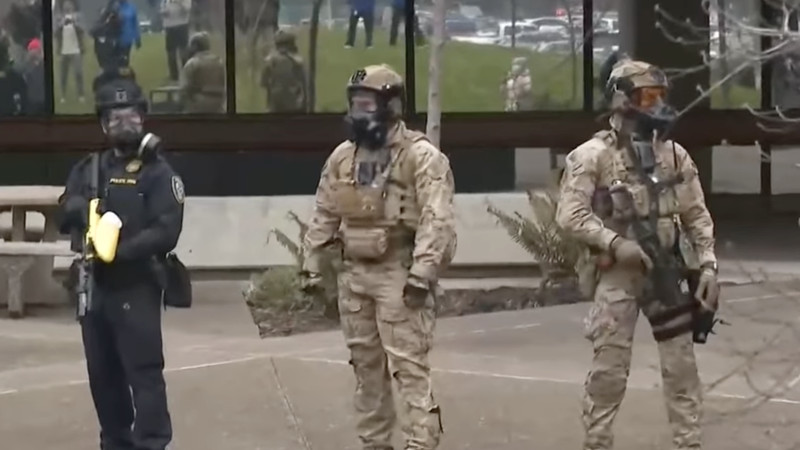
EUGENE, OR - During protests last Tueday evening, pepper spray, pepper balls, and flashbang grenades were reportedly used by police, and in response, KTMR decided to examine the use of force policies of the Department of Homeland Security (DHS) and local police.
The morning after those protests, KTMR requested a copy of the policies used by DHS agents, and while the department did not respond to that request yet, a policy letter posted online dated for September 2018, was reviewed.
In that policy, which is the latest one they could find, it stated that the primary principle for use of force is respect for human life and community. It also states that DHS agents should always work to de-escalate a situation and bring it under control. However, DHS agents, including border patrol agents and ICE agents, do not have a responsibility to retreat to avoid the use of force in performance of their duties.
They also do not have to wait for an attack before they can use a level of force they deem necessary, according to the 2018 policy reviewed by KTMR.
For lethal force, agents must have reasonable belief that the subject poses an imminent threat of death or serious injury to the agent or another person. The statement says while discharging a firearm is considered lethal force, gripping, drawing, or pointing a firearm at someone does not constitute lethal force.
The Eugene Police Department (EPD) sent us a copy of their entire policy manual, covering everything from traffic stops to the use of deadly and non-deadly force, who can use it and when.
EPD policy on deadly force states that it can only be used to protect the officer and other people from imminent threat a serious injury or death, or in the act of making an arrest of a violent suspect. It can also be used to stop a fleeing suspect, if the officer believes that person either committed a felony or presents an imminent threat to others.
Capsicum aerosol, better known as pepper spray, is specifically used to gain compliance of an individual. It can also be used to protect people, assist in arrests, or to subdue a particularly disorderly element in a crowd. It should never be used as punishment, crowd dispersal, or on people engaging in passive resistance, according to the policy.
Pepperballs are capsicum powder fired from a launcher. Those can be used to disperse crowds or assist in making an arrest. They should only be used at a distance, never targeted at individuals, and officers must be aware of the possibility of injury.
Officers cannot use pepperballs if there is a chance that it might affect innocent bystanders. The use of flash and sound diversion devices, commonly known as "flashbang grenades," is limited to use by SWAT team members only, and they must be specifically trained in their use.
Officers must also make sure the area where a flash bang will be used is free of people and flammable objects.
The morning after those protests, KTMR requested a copy of the policies used by DHS agents, and while the department did not respond to that request yet, a policy letter posted online dated for September 2018, was reviewed.
In that policy, which is the latest one they could find, it stated that the primary principle for use of force is respect for human life and community. It also states that DHS agents should always work to de-escalate a situation and bring it under control. However, DHS agents, including border patrol agents and ICE agents, do not have a responsibility to retreat to avoid the use of force in performance of their duties.
They also do not have to wait for an attack before they can use a level of force they deem necessary, according to the 2018 policy reviewed by KTMR.
For lethal force, agents must have reasonable belief that the subject poses an imminent threat of death or serious injury to the agent or another person. The statement says while discharging a firearm is considered lethal force, gripping, drawing, or pointing a firearm at someone does not constitute lethal force.
The Eugene Police Department (EPD) sent us a copy of their entire policy manual, covering everything from traffic stops to the use of deadly and non-deadly force, who can use it and when.
EPD policy on deadly force states that it can only be used to protect the officer and other people from imminent threat a serious injury or death, or in the act of making an arrest of a violent suspect. It can also be used to stop a fleeing suspect, if the officer believes that person either committed a felony or presents an imminent threat to others.
Capsicum aerosol, better known as pepper spray, is specifically used to gain compliance of an individual. It can also be used to protect people, assist in arrests, or to subdue a particularly disorderly element in a crowd. It should never be used as punishment, crowd dispersal, or on people engaging in passive resistance, according to the policy.
Pepperballs are capsicum powder fired from a launcher. Those can be used to disperse crowds or assist in making an arrest. They should only be used at a distance, never targeted at individuals, and officers must be aware of the possibility of injury.
Officers cannot use pepperballs if there is a chance that it might affect innocent bystanders. The use of flash and sound diversion devices, commonly known as "flashbang grenades," is limited to use by SWAT team members only, and they must be specifically trained in their use.
Officers must also make sure the area where a flash bang will be used is free of people and flammable objects.
For corrections or revisions, click here.
The opinions reflected in this article are not necessarily the opinions of LET

Comments