
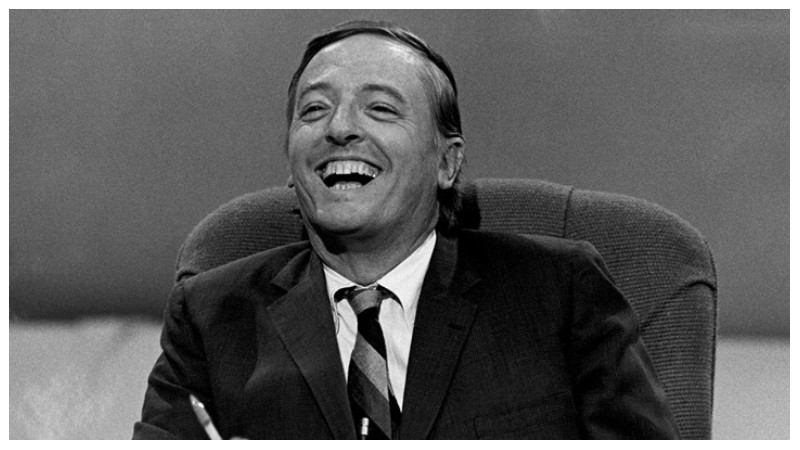
Few things sweeten my day more than getting the chance to put pen to paper (or, as it were, hand to keyboard) in service to the great William F Buckley, Jr.
Now is the time to do it, too. Not coincidentally, there was a triune treatment of Buckley that graced us on what would have been the year of the National Review founder’s 100th birthday, in 2025.
At the time of writing, there are no less than three books already released this past year on the venerated National Review founder, one of which happens to be my own, but more on that shortly.
Along with New York Times’ writer Sam Tanenhaus’ long awaited tome on Buckley, having been picked decades ago by the old man himself to tell the full, unvarnished story, my fellow Minnesotan Lawrence Perelman explores his personal friendship with the former Firing Line host in his own work, rather beautifully titled, American Impresario: William F. Buckley and the Elements of American Character.
It was back in 1995 when Perelman, then a 19-year-old classical music student, wrote to Buckley. As he was the son of Soviet Jewish immigrants, Perelman held Buckley in high esteem for his energetic fight against communism and antisemitism, both of which would become staples in Buckley’s litany of cultural grievances for the rest of his life.
To his surprise, Buckley wrote back and invited him to perform at his Manhattan home.
Their bond, as Perelman tells it, embodied Buckley’s remarkable ability to connect across generations, faiths, and life experiences.
Sam Tanenhaus’s long-awaited biography, Buckley: The Life and the Revolution That Changed America, delivers an expansive portrait of Buckley’s influence on American politics and culture.
Commissioned by Buckley himself decades ago, the book draws from archival research and personal correspondence to paint a nuanced portrait—sometimes admiring, sometimes critical.
Tanenhaus explores Buckley as both a cultural trailblazer and partisan combatant, tracing the paradoxes in his legacy with depth and detail. And the depth could indeed rival the Mariana Trench, and the detail could match the embroidery on a Byzantine robe—intricate, layered, and unmistakably deliberate.
Though less personal than Perelman’s memoir, Tanenhaus’s work adds essential context to the public and political Buckley who helped shape the modern Right.
Buckley was a man who lived several lifetimes in the span of one. His identities range from CIA agent, to Army Captain, to ideological trailblazer, celebrated commentator, best-selling spy novelist, and of course, founder of National Review, which still stands as a bastion of conservative thought 70 years later.
Tanenhaus’s portrait is neither a hagiography nor a hit job, but something rarer, a study of a man too large, too paradoxical, and too consequential to be reduced to a single frame. Perelman, on the other hand, aims the scope and gun barrel of his prose at the idea of friendship, specifically, Buckley’s immense capacity for it, unfazed by ideology or age. I join him in pulling the trigger, if you’ll forgive the phrasing, on that Firing Line. Even from the great beyond, Buckley acts as a bonding agent for all three of us humble authors.
My own book on Buckley, lovingly titled William F. Buckley Jr’s Guide To Friendship In A Polarized Era: Lessons in Civility from a Catholic Conservative Icon, similarly touches, rather grabs and holds dear, the ideal and importance of friendship in our day. It’s a showcase of Murray Kempton’s sweet and sentimental refrain of Buckley’s “genius” for friendship.
While Perelman’s is a wonderfully personal examination of his own friendship, mine takes the form of societal exploratory surgery, examining the devastation wrought by tribal vitriol and what we might adopt from Buckley's examples in raising the floor of our discourse.
I have described it as one-part Buckley biography and one-part cultural critique, tackling various institutions that have been corroded by the acidic element of polarization, such as journalism, the SPLC (which I am proud to say my book has been somewhat prescient on), and American college campuses, among others. But there are also various course corrections of our attitude that need to be redressed. For instance, I resuscitate an argument put forth by Buckley himself regarding America's relationship to gratitude.
My book includes exclusive interviews with current National Review Editor-in-Chief Rich Lowry as well as Buckley’s only son, the celebrated author in his own right, Christopher Buckley. There is also a surprise chapter covering a certain infamous writer whom I am proud to say is ground I do not believe other Buckley enthusiasts have written about. At least none I have seen thus far.
I give my best effort in prescribing Buckley’s Christianity-informed lessons for a divided America, doing so in the knowledge that Buckley was not merely a towering intellectual figure; he was a connector of people, a cultivator of discourse, and a model of civility and complexity in an age that sorely needs both.
As we whistle stridently past the centennial of his birth, these books invite us to reconsider not only the man himself but the very qualities of character and friendship that can help heal our polarized society.
Please consider picking up a copy of my book, proudly supplied with a wonderful foreword by the great Oliver North, today.

Comments