
Why Foreign Microchips, Closed-Source Code, and Wireless Modems Violate Every Rule Street Cops Rely On—And How Hand-Marked Paper Ballots Fix It
By Retired Asst. Chief Shawn Taylor
Every rookie patrol officer learns on day one that a criminal case lives or dies on chain of custody. When you bag evidence in the trunk of your cruiser, initial the tamper tape, and log it into the property room, every set of hands that touches it has to be accounted for. If the seal is broken or the bag went through an unmonitored back room and shows up opened, a defense attorney will get the case tossed before lunch. Nobody walks into court and tells a jury, "Just trust the label on the bag."
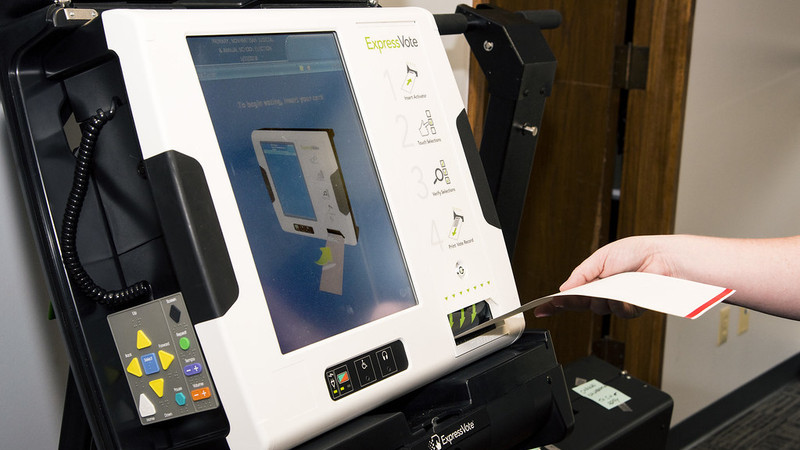
Contrast that with how we run elections: millions of ballots go into sealed electronic voting machines and tabulators where nobody—not the county clerk, not the poll workers, and not the voters—can see what is happening inside the chips or the software.
"Assembled in the USA" Doesn't Mean "Built Here"
In plain street terms, slapping an "Assembled in the USA" sticker on the outside plastic shell of a voting machine doesn't mean the guts inside were built here. The active parts that do the real work—microchips, circuit boards, flash memory, and touchscreen sensors—are made overseas across Asia, including in China.
When I was Assistant Chief, I ordered a full audit of the evidence room left by the previous administration. We discovered the security cameras and digital video recorders that had been installed were exactly the kinds of Chinese-made systems federal mandates under NDAA Section 889 and DHS security directives barred law enforcement from using because of backdoor and espionage risks. We had to rip them out and replace them. The federal government recognized that you can't protect sensitive evidence if a foreign adversary built the camera watching the room. Pre-election testing on voting machines ignores that exact same rule: election workers turn the machine on and run a small test stack of ballots to see if it boots up, while county election offices have neither FBI crime labs nor electron microscopes to tear open microchips and inspect microscopic circuits.
When the Hardware Lies, the Software Believes It
Think about an officer writing a supplemental report based entirely on CAD notes and details read out by dispatch—details the officer never saw firsthand on scene. The officer types up the report in good faith, signs it, and logs it into the system. If the information fed from dispatch was wrong, that bad data is now permanently baked into an official, "verified" police report. Vote-counting software works the exact same way: the program on top never actually sees the paper ballot—it has to ask the hardware chips underneath what is sitting in memory. If a compromised microchip feeds false numbers upward, the software writes down the lie, stamps it "all systems normal," and passes it straight through every diagnostic check.
- The Looped Security Camera (Stuxnet, 2010): Everyone has seen a heist movie where someone loops a security camera so the guard sees an empty hallway on the monitor while the vault is being cleaned out behind it. That is the exact principle the Stuxnet cyberweapon used in 2010 (though it looped industrial sensor readings rather than a literal video feed): it hijacked low-level hardware controllers and played back a 21-second loop of "normal" telemetry to operators' screens while physically destroying machinery underneath. A rigged microchip inside a scanner can do the exact same thing—changing vote totals in memory while showing a clean "all systems normal" screen during pre-election checks.
- Rigged Locks From the Factory (Operation Rubicon): From 1970 to 2018, over 100 countries bought encrypted communication machines from a Swiss company called Crypto AG, thinking the math made their messages unbreakable. What they didn't know was that THE CIA AND NSA secretly owned the company and rigged the hardware inside at the factory so they could read every message. Encryption and digital signatures are worthless if the people who built the chips rigged the lock before it ever left the factory.
The Software Layer: Closed Code, Foreign Contractors, and 20-Year-Old Programs
- "Trade Secret" Black Boxes: Voting companies treat their counting software as a proprietary trade secret. Local county clerks and independent investigators aren't allowed to look under the hood or read the code running on the machines.
- Global Teams & Legacy Code: Even when boxes are assembled here, software development across the industry has involved foreign engineers and outside contractors building on top of 20-year-old legacy code (old Windows, Embedded Linux, C/C++, and SQL databases) because rewriting a system from scratch costs millions and takes years to recertify.
- The "Trusted Build" Blind Spot: Federal labs review the vendor's main program and stamp it with a digital fingerprint (a hash) called a "Trusted Build." That proves the main program hasn't been swapped out—but it still has two huge holes: (1) third-party drivers and firmware get bundled in as pre-compiled black boxes without line-by-line inspection, and (2) even 100% clean software will still produce dirty numbers if the microchip running it is compromised.
Midnight Cellular Modems and Broke County Budgets
Even when machines aren't plugged into the internet during voting hours, many counties hook up cellular or landline modems after the polls close to shoot unofficial results over wireless networks to headquarters. In police terms, that's like locking the property room door all shift, then loading the evidence at midnight into a van with a busted lock.
Replacing old voting machines across the U.S. costs roughly $2.71 billion. Because county budgets are tight, thousands of local offices are running 10- to 15-year-old machines that don't have modern hardware security chips (like TPM 2.0) and are buying discontinued replacement parts off secondary markets where counterfeit or tampered chips are a known problem.
The Common-Sense Fix: Count It Like a Bank Teller
When you walk up to a bank teller with a stack of cash, they don't take your money into a back room, type a number into a terminal, and tell you to trust the receipt. They count every bill right on the counter in front of you. If there's a mistake, both of you see it and fix it on the spot.
Public trust works the exact same way as a solid criminal case: keep the evidence physical, keep the chain of custody unbroken, and do the work in plain sight. Instead of spending billions trying to secure black boxes packed with foreign microchips, closed-source code, and cellular modems, the answer is straightforward: hand-marked paper ballots counted by hand in open, bipartisan view.
Shawn Taylor is a retired Assistant Chief of Police, Lead Analyst for the Election Fairness Institute, and Owner of FTG Solutions, an Open-Source Intelligence firm.

Comments