
Submitted through partnership with Vita Bella.
Editor Note: After years of losing friends in law enforcement and the military to diseases, heart attacks, strokes and to the demons of PTSD, we've decided to fight back.
Law Enforcement Today has partnered with Vita Bella to bring you a regular series of information about topics that will help completely change this. We are NOT being paid to do this. It's about time we all get in the fight. You, your family and our community deserve to have strong, healthy warriors.
Repeated exposure is part of the profession. Understanding the cumulative effects, early warning signs, and available support can protect both officers and the people who depend on them.
The Scope of the Problem
Low back pain and joint discomfort are among the most frequent musculoskeletal complaints reported by law enforcement officers. In one NIOSH Health Hazard Evaluation of a U.S. police department, nearly half of officers reported low back pain in the previous three months. Other studies place the prevalence of regular lower-back symptoms even higher, with some international data showing 43% of active-duty officers experiencing pain one or more days per week. Lower-extremity joints (hips, knees, ankles) and shoulders also show elevated rates of strain and overuse injury compared with the general population.
These issues do not arise solely from single traumatic events. Much of the load is cumulative, stemming from the daily combination of body armor, duty belts, prolonged vehicle sitting, and the sudden physical demands of the job.
How Body Armor and Duty Belts Contribute
Body armor can add 10-20 pounds or more of distributed weight across the torso. This extra mass restricts torso rotation, shoulder mobility, and hip movement. Research measuring officers in full gear shows measurable reductions in range of motion at the low back, hips, and shoulders, along with changes in balance recovery. Over time, the restricted movement patterns and added compressive force increase mechanical stress on spinal discs and supporting musculature.
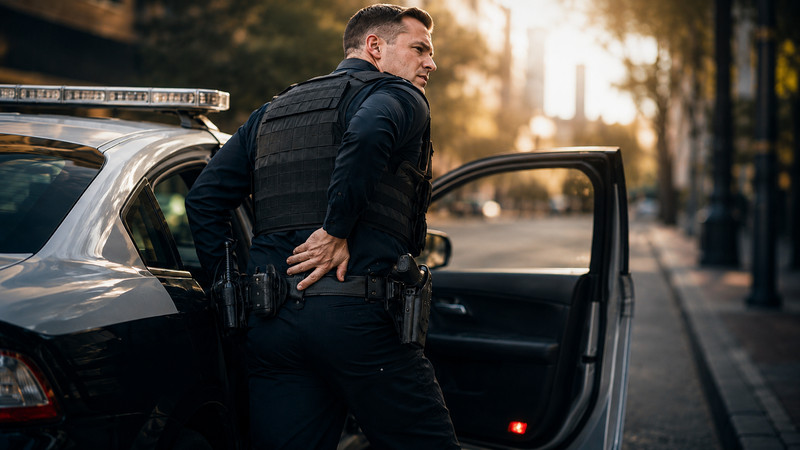
Duty belts concentrate even more load around the waist and hips. Fully loaded belts commonly weigh 15-30 pounds and place rigid objects (handcuffs, radio, weapon, baton) against the lumbar region and iliac crests. When officers sit in patrol vehicles for extended periods, these hard items force the pelvis into unnatural positions and create focal pressure points. Officers frequently report that the belt is a primary source of discomfort; in the NIOSH evaluation, more than half of those with low back pain attributed symptoms directly to the duty belt. The combination of armor weight and belt pressure amplifies shear and compressive forces on the lumbar spine during both sitting and dynamic movement.
The Broader Physical Demands of Patrol
Long shifts spent in vehicles, rapid exits and re-entries, foot pursuits, physical confrontations, and awkward lifting of people or objects compound the static load of the gear. These activities often occur when the spine is already under continuous compression and when core musculature is fatigued. The result is a pattern of both acute strains and progressive joint and disc irritation that can become chronic if left unaddressed.
Prevention Recommendations
Equipment configuration matters. Many departments now encourage or provide external load-bearing vests that shift some equipment off the waist and onto the torso, reducing focal pressure on the lumbar spine and hips. When a traditional belt is used, placing soft items (gloves, notebook) at the rear and harder items toward the sides can lessen pressure against the back while seated. Nylon belts with adjustable plastic buckles often conform better than rigid leather systems. Suspenders or load-distributing designs can further offload the waist.
Vehicle ergonomics also help. Adjusting seat position, lumbar support, and steering-wheel height at the start of each shift reduces sustained awkward postures. Taking brief standing or walking breaks when safe and feasible interrupts continuous sitting.
Mobility Routines
Consistent, short mobility work targets the areas most affected by gear and patrol demands. Prioritize the following movements, performed daily or after shifts:
- Hip flexor and glute stretches (kneeling lunge stretch and figure-4 stretch) to counteract prolonged sitting and belt pressure.
- Thoracic rotation and open-book stretches to restore torso mobility restricted by armor.
- Cat-camel and gentle lumbar flexion/extension sequences for spinal segmental movement.
- Hamstring and calf stretches to maintain lower-extremity chain length.
- Simple core activation (dead bugs, bird dogs, side planks) to improve spinal stability under load.
These can be completed in 8-12 minutes and require no equipment. Consistency outperforms intensity.
Recovery Protocols
Recovery begins with early attention to symptoms. Persistent low-back or joint pain that lasts more than a few days warrants evaluation rather than continued self-management alone. Soft-tissue work, progressive strengthening of the posterior chain and core, and graded return to full gear loads help rebuild capacity. Sleep quality and hydration support tissue repair between shifts.
Some officers find that addressing underlying factors such as chronic inflammation or hormonal shifts linked to shift work and physical stress improves recovery capacity. When hormone evaluation is indicated as part of a broader recovery plan, telehealth services such as those at VitaBella.com offer access to licensed providers who can review labs and discuss options.
For officers whose recovery from joint or soft-tissue stress is slower than expected, coordinated hormone assessment through platforms like Vita Bella can be considered alongside physical-therapy and strength-training efforts.
Putting It Into Practice
The combination of body armor, duty belts, and the physical realities of patrol creates a predictable mechanical load on the spine and joints. Officers who adjust equipment configuration where possible, maintain basic daily mobility, and address symptoms early reduce the accumulation of chronic pain. Small, consistent actions - rather than occasional intense efforts - produce the most reliable results over a career.
References
- Ramsey JG, Eisenberg J. Evaluation of low back pain and duty equipment wear configurations in police officers. Cincinnati, OH: U.S. Department of Health and Human Services, Centers for Disease Control and Prevention, National Institute for Occupational Safety and Health; 2020. Health Hazard Evaluation Report 2017-0049-3367.
- Frick KA, et al. Protective gear negatively impacts police officer mobility and physical capabilities. J Funct Morphol Kinesiol. 2025;10(3):344.
- Schram B, et al. The effects of body armour on mobility and postural control of police officers. J Sci Med Sport. 2020.
- Kearney JW, et al. Effect of the law enforcement duty belt on muscle activation and postural control. Int J Environ Res Public Health. 2023.
- Burton AK, et al. Occupational risk factors for the first onset of low back pain: a study of British and Northern Ireland police officers. Spine. 1996;21(22):2612-2620.

Comments