
Guest writer Kelly Rae Robertson spent more than 14 years working inside Allegheny County's criminal justice system as a pretrial investigator. She is a writer and political commentator whose work has appeared in The Washington Times, The Daily Caller, Law Enforcement Today, The American Spectator, and American Thinker.
People have found a new thing to destroy.
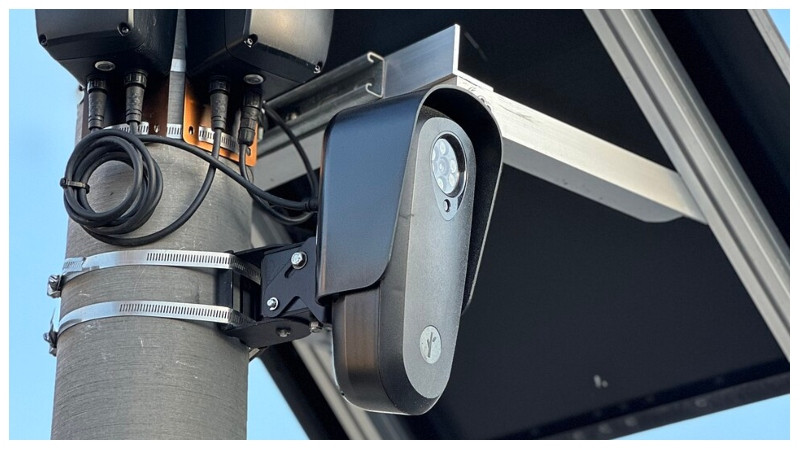
Across the country, Flock Safety cameras—those solar-powered automated license plate readers mounted on poles at intersections and neighborhood entrances—are being cut down, painted over, rammed with vehicles, and stolen.
The technology is straightforward. The cameras capture license plates along with vehicle make, model, color, and other distinguishing features. When a vehicle on a hot list — a stolen car, a vehicle connected to a wanted person, or an Amber Alert vehicle — passes, the system alerts law enforcement. Agencies using the technology report that it has assisted in hundreds of thousands of investigations.
Yet the cameras themselves have become targets in a growing campaign of vandalism.
I am not surprised.
I am also not interested in pretending the cameras are the real problem.
A commentator on Fox recently floated the idea of concentrating this technology in "blue" cities as a form of accountability for progressive bail and release policies that have turned many urban areas into open-air experiments in recidivism. I understand the impulse. I live in one of those cities.
I spent more than fourteen years inside Allegheny County's criminal justice system as a pretrial investigator. I left that career — and the salary, pension, and benefits that came with it — because of the same progressive policies that treated public safety as an afterthought while police and victims absorbed the consequences.
But concentrating the cameras exclusively in blue cities creates another problem. Regardless of the reasoning behind it, the move would immediately be framed as political retaliation. The cameras would become "MAGA cameras," opposition to them would become another political cause, and a legitimate investigative tool would get swallowed by the culture war. The debate would stop being about whether the technology helps law enforcement solve crimes and start being about who put the cameras there and why.
Another commentator on the same show offered a second suggestion: place the cameras only where crime statistics are highest. That sounds reasonable. It even sounds more neutral — until you tell someone outside the system just how easily those statistics can be manipulated.
My former agency provides a clear example. It published countless reports and journals proclaiming that cashless-bond and progressive-release policies were reducing recidivism. The message was polished, confident, and plastered across the internet for anyone to read.
Meanwhile, I was sitting in our office inside the intake department of the Allegheny County Jail, processing the people behind those statistics.
On a typical shift, I would handle roughly thirty cases. Twenty-eight of those defendants had already racked up more than five pending cases in a single month. Reoffending. Rearrested on new charges. Again, and again.
That is recidivism. Not an interpretation of the word, but its very definition.
Yet the official story being sold to the community, the state, and the country was that Pittsburgh was reducing crime through softer policies. It was a bold, flat-out lie.
I was offended at a level I had never experienced in my professional life.
When a system repeatedly tells officers that convicting and incarcerating dangerous people is an act of oppression and racism, something fundamental breaks. Cops begin to wonder whether their lives are worth more than the community and the courts claim to value.
When dangerous offenders are released again and again — often until someone is finally killed — the stage has been set, and the message is unmistakable: unless you are the criminal, your life carries less weight in this profession. The justice system no longer demonstrates a consistent interest in imposing real consequences.
Officers are turning in their guns and badges across the country. Departments are understaffed. Those who remain are asked to do more with less while being told that their work is somehow suspect.
Even a fully staffed department cannot be everywhere at once. No one can. That is the practical gap these cameras are meant to fill. And frankly, that is precisely why destroying them makes so little sense. A camera can be knocked down, run over, or cut from its pole and replaced the next day.
Do the same thing to a police officer, and replacement is not an option — especially not for the family left behind.
I am not a surveillance maximalist. I do not want cameras for the sake of watching people. But I also believe that if you aren't doing anything wrong, why do you care so much? If one of these cameras can help locate a kidnapped child before severe harm occurs, wouldn't that be worth it to you?
Because that is the kind of purpose these tools should serve. I want technology that helps catch perpetrators and a justice system willing to impose meaningful punishment once they are caught. After years of watching revolving-door policies put the same people back on the street, I will take effective tools over ideological ones any day of the week and twice on Sunday.
The vandalism of these cameras is not a principled stand for privacy. In too many cases, it is the predictable response of a culture that has spent years treating law enforcement as the problem and accountability as repression.
The real issue was never the camera on the pole. The real issue is a set of policies and cultural attitudes that made officers feel disposable while treating repeat violent offenders as victims of the system.
Cameras can be replaced. Officers cannot.
That should not be a controversial statement. It is simply the reality that too many people in positions of influence have refused to face.

Comments