
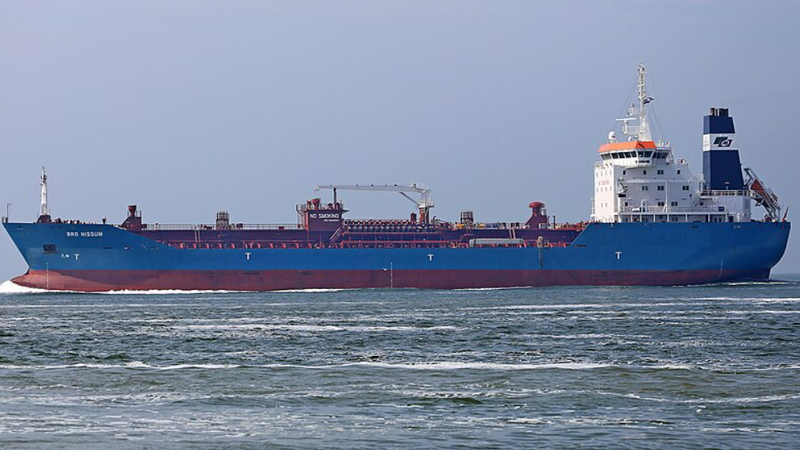
WASHINGTON, DC- Immigration and Customs Enforcement (ICE) disclosed in a news release the seizing of 90 fuel shipments valued at over $2.8 million headed to Cuba in violation of federal export laws.
The seizure was part of a joint investigation between Homeland Security Investigations (HSI) in Miami and Houston, working alongside Customs and Border Protection (CBP) and the Department of Commerce’s Bureau of Industry and Security (BIS). As a result, 90 biodiesel fuel shipments were seized with a value of $2.8 million, the agency wrote.
“These shipments were part of an attempt to unlawfully export fuel to Cuba in violation of federal export laws,” the release said.
“HSI Miami, HSI Houston, CBP and BIS developed information indicating that the Cuban government used ENETEC S.A. to receive fuel illegally exported from the United States,” the release said.
Using coordinated intelligence and trade data analysis, CBP identified shipments of biodiesel fuel being illegally sent from the United States, particularly from Port Everglades (PEV) and the Port of Houston to ENETEC S.A. in Cuba. The operation took place in early September 2026.
‘HSI Miami and HSI Houston, in coordination with CBP and BIS requested the detention of these shipments,” the release continued. “A total of 71 shipments containing approximately 469,000 gallons of biodiesel fuel at Port Everglades were seized and 19 additional shipments containing approximately 119,000 gallons at the Port of Houston are currently being detained.”
The shipments were seized based on suspected violation of federal export laws, among them exportation contrary to law, the International Emergency Economic Powers Act, and regulations governing merchandise subject to the Export Administration Regulations.
“This seizure underscores HSI Miami’s commitment to stopping fuel and other goods from the United States from being illegally exported to Cuba through sanctioned entities or deceptive commercial networks,” said HSI Miami Special Agent in Charge Jose R. Figueroa.
“Working with our federal partners, we will continue to identify, disrupt, and investigate efforts to evade U.S. sanctions, protect the integrity of U.S. export controls, and deny the Cuban government access to resources obtained in violation of U.S. law.”
“U.S. Customs and Border Protection is steadfast in enforcing the laws of the United States across all domains, encompassing both incoming commerce and outbound shipments,” said Daniel Alonso, Director of Field Operations.
“Through vigilant outbound operations, our officers successfully intercepted these shipments and took appropriate action. Trade enforcement is a collaborative mission; by working closely with the Office of Foreign Assets Control (OFAC), the Department of Commerce, Homeland Security Investigations (HSI), and our federal partners, we ensure that commercial shipments comply with U.S. sanctions and export laws, safeguarding our national security and foreign policy interests.”
“The Bureau of Industry and Security is aggressively enforcing our export control laws, including with respect to Cuba, and this will continue,” said Jeremy Shein, Special Agent in Charge for BIS, Miami.
Despite U.S. sanctions against Cuba, some Democrats have tried to undermine them by trying to get fuel to Cuba in violation of those sanctions. In April, far-left Rep. Pramila Jayapal (D-WA) visited Cuba along with Rep. Jonathan Jackson (D-IL) in a clear attempt to undermine U.S. policy.
Jayapal and Jackson criticized the ongoing blockade on fuel shipments to Cuba, calling it an “illegal blockade” and “economic bombing.” Jayapal suggested she had discussed ways to circumvent U.S. law by betting oil there from other countries, including Mexico.
In response to Jayapal’s questionable attempt to circumvent U.S. sanctions, Sen. Rick Scott (R-FL) slammed her for undermining U.S. policy, conducting private diplomacy against executive actions, or even “treasonous” activity. Many critics invoked the Logan Act, which restricts unauthorized private negotiations with foreign governments in certain circumstances.
The Logan Act was passed in 1798 and has only been used twice in U.S. history. Nobody has ever been convicted under the Act.


Comments