
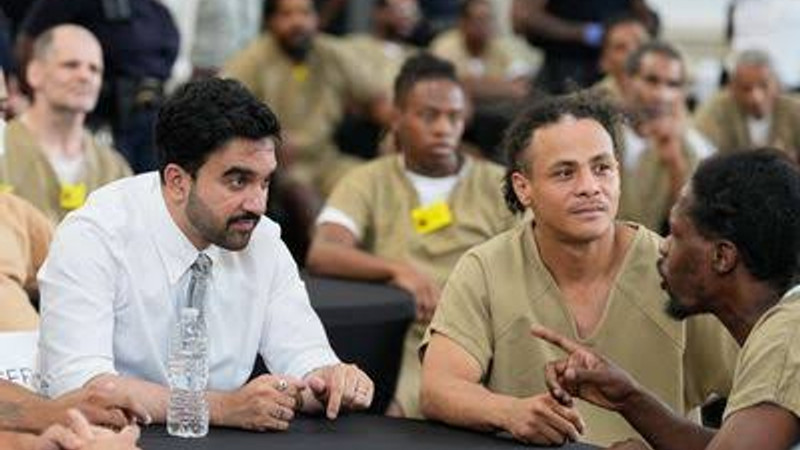
Well, Mayor Zohran Mamdani has had a big week in the Big Apple.
He put in some serious hours at his first real job doing what he does best: settling scores and performing for the cameras.
In the span of just a few days, Mamdani disbanded the NYPD’s Strategic Response Group—the same unit that once zip-tied him at a protest—then stood before the cameras to announce he was closing Rikers Island.
The SRG was established in 2015 for crowd control and counterterrorism. Its officers showed up in riot gear, used pepper spray, and made mass arrests when protests turned into street takeovers. Mamdani called that policing the First Amendment.
So, he killed the name. Clever of him. And sneaky. Running true to form.
In its place, he created a civilian “Community Dialogue and De-escalation Division” with no guns and no arrest powers, a token squad of about thirty officers rebranded as the First Amendment Support Team, and a Patrol Support Division that will still handle the actual work of stopping chaos. Counterterrorism simply moved to another bureau.
The officers who know how to control a riot did not vanish. They were reassigned under new letterhead so City Hall could claim a purge without ever having one.
Then he pivoted his performance to an even bigger applause cue. Drumroll, please… shutting down Rikers Island.
So brave of him. So, so brave. And what a spectacular display of political theater.
What New York City and the rest of the country still refuse to understand is what this performance actually buys. The same script already ran in my city. Pittsburgh. The city where I was born, where I was raised, and where I still live. Once a beautiful, wonderful city. Now a city I barely recognize, overrun by money, corruption, and evil.
Foundation money floods in under the banner of “reducing the jail population and pretrial detention.” Millions of dollars are handed out to make those numbers fall. That’s the first part of the game. The people running the system are expected to produce results, and those results are measured in numbers. Fewer inmates. Fewer people held on monetary bond. More defendants released back onto the streets.
Then comes the next part. Close the big jail, announce a victory, and collect millions more to build smaller jails, new facilities, and housing units where the same inmates will be transferred—often right next to your kid’s school. The money doesn’t stop when the jail closes. It changes hands, changes budgets, and keeps flowing through the people managing the grants, the construction, and the metrics. And while the politically connected stand to profit, the public is left asking where all that money went.
Everyone else lives with the bodies.
This is the Allegheny County story I’ve been writing about for over a year, and it is the only real answer to the question people keep asking: Why do they keep letting violent criminals walk?
Because that’s how you get your name written on the “Pay to the Order of” line of a big, million-dollar check.
The jail population drops. The check clears.
The numbers dropped. The money disappeared. The bosses took trips and worked even less.
That is the entire model.
Mamdani bragged about bringing down the numbers at Rikers. I’ve heard those exact words since 2016. It isn’t new. It’s just louder now.
My old office was paid millions of dollars to do the same thing. We did it.
We downplayed the danger posed by violent criminals, including defendants who had just shot someone, and recommended releasing them as though they posed no real threat to the public. Most came right back with a brand-new violent case, before the ink was even dry on the paperwork from the last one.
That’s how my bosses got paid.
Against my gut instinct and despite my pleas, a younger, less experienced supervisor who carried out the dirty work without question pushed through a recommendation for Matthew Darby’s non-monetary release.
Thirteen days later, he broke into 20-year-old Alina Sheykhet’s apartment again and beat her to death with a claw hammer. He sliced her face from one ear to the corner of her mouth. Her father found her.
Pittsburgh police somehow found the knife, like a needle in a haystack, and fished it out of a storm drain.
Those damn police, out there finding the actual murder weapons used to kill 20-year-old Pitt students. How dare they?
Markez Anger and Londell Falconer Jr. were also out on non-monetary bonds when they shot up a car near Market Square on a Sunday afternoon in May 2022. Both had long criminal records and pending cases.
They spotted a rival, opened fire in a crowded downtown full of families, and blew the head off 18-month-old De’Avry Thomas, who was strapped into his car seat.
The mother and her boyfriend walked away without a scratch.
The baby did not.
Then there is Dr. Idris Evans, the UPMC Children’s Hospital physician stabbed to death in his own bed while his wife lay next to him. She managed to scream for their children to run.
Elijah Hemingway, the man charged with his murder, had a long criminal record and was free on non-monetary bond at the time.
There are more. So many more.
The cemeteries are full of people who died while the grant recipients collected their awards and promoted their friends.
Mamdani did not mention at the podium that his plan still requires building four smaller jails across the boroughs, along with hospital units, and that enormous sums of money will continue flowing to manage the entire operation.
The same people who got rich off the Allegheny County grants will get rich off the New York ones.
The white activists who stage their little choreographed dances about a world without the NYPD remain too stupid or too high on their own self-image to notice the obvious.
Mamdani stands there talking about disbanding a unit and closing a jail while flanked by his own NYPD security detail the entire time.
How ironic.
Kelly Rae Robertson is a whistleblower and former Allegheny County Pretrial Services investigator who spent 14½ years at the Allegheny County Jail. She writes about criminal justice corruption, government accountability, victims’ rights, and law enforcement for Law Enforcement Today, The Daily Caller, and The Washington Times.

Comments