
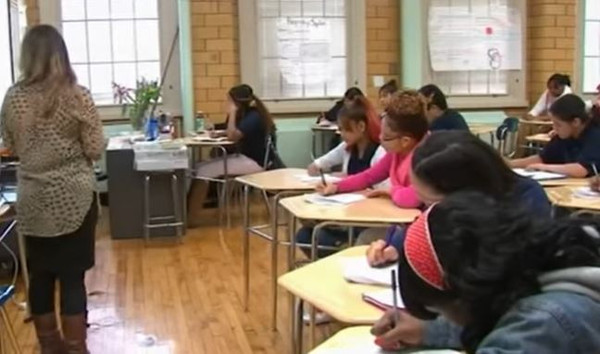
NEW YORK CITY, NY – An effort to implement a form of “restorative justice” in New York City’s public schools as it relates to disciplining students has apparently fallen flat, with new reports showing that police responses to public schools in the city have doubled in the past year.
According to the New York City Department of Education’s website detailing their restorative justice efforts, the webpage dubbed “Resilient Kids, Safer Schools” boasts that they’re, “doubling down on an approach that we know works,” and further claim that the key to addressing problematic behaviors with students is a social-emotional learning (SEL) approach rather than a traditional disciplinary system of bad behaviors render unpleasant consequences.
“Restorative Justice Practices de-emphasize the reliance on solely traditional discipline and punishment,” the webpage reads in regard to restructuring disciplinary methods in middle and high schools, adding, “Instead, students are also encouraged to activate SEL skills by focusing on emotion identification, conflict resolution and problem solving.”
Anyone who harbors even the vaguest of memories of attending public school in largely any part of the country amid or prior to the early 2000s could ostensibly recite the forms of discipline utilized by school staff when addressing disruptive or even violent students.
Things like detention, in-school or out-of-school suspension, and in some cases police intervention and expulsion have traditionally been used to address varying unacceptable student behaviors.
But the approach to youth discipline utilized by the New York City Department of Education is what the progressive-minded seem to swear is what is needed and works.
However, data coming out of the Big Apple appears to paint a different picture, with police incidents doubling to 4,200 reports during the current year and a report released this past March noting that 35% - approximately 300,000 - of NYC public school students were "chronically absent” during the 2024-2025 school year.
The origin of what some would refer to as the soft-handed approach to disruptive students in New York City dates back to 2015 under the guidance of then-Mayor Bill de Blasio’s administration, when school principles at the time were required to obtain special permission from the NYC DOE’s central office to suspend students in grades K-2.
Jennifer Weber, a researcher from the Manhattan Institute, wrote in a report released on July 24th that, “What began as an alternative became a mandate, forcing administrators to abandon exclusionary options regardless of school context. These policies tied the hands of school leaders and sent a clear message that exclusionary discipline was no longer acceptable.”
According to Weber, traditional approaches in discipline were the deciding factor in “the difference between order and chaos,” as it relates to public schools in the city, but former-Mayor de Blasio’s attempts to implement a more empathetic system of addressing disruptive students “was not a shift from punishment to compassion but the dismantling of the systems that had maintained basic classroom stability.”
Delving into the long-term consequences of restorative justice being the go-to discipline model in schools, Weber referenced incidents where the approach was utilized without resulting in the desired outcomes.
“Early last year, at Brooklyn’s Origins High School, a Jewish teacher was subjected to Nazi salutes and threats,” Weber noted in the report, adding, “The school’s response - parental calls and time spent in a ‘meditation room’ - did not stop the harassment. The teacher filed a lawsuit, showing how RJ without consequences can leave staff vulnerable.”
In a more alarming case depicted in the report, Weber recalled the recent protests held in response to a stabbing reportedly enacted by an eight-year-old student where the “meditation room” was again utilized to address the violent student.
“In May 2025, parents at PS 8 on Staten Island protested after an eight-year-old allegedly stabbed a staff member with a pencil and threatened classmates,” Weber noted, mentioning the lackluster disciplinary approach as striking “many families as inadequate.”
In the conclusion reached in Weber’s report, she claims the experiment of restorative justice in the classroom is a failed one, emphasizing how “recent federal calls to return discipline decisions to the people closest to the classroom: principals and teachers,” is the true answer to the problem.
According to the New York City Department of Education’s website detailing their restorative justice efforts, the webpage dubbed “Resilient Kids, Safer Schools” boasts that they’re, “doubling down on an approach that we know works,” and further claim that the key to addressing problematic behaviors with students is a social-emotional learning (SEL) approach rather than a traditional disciplinary system of bad behaviors render unpleasant consequences.
“Restorative Justice Practices de-emphasize the reliance on solely traditional discipline and punishment,” the webpage reads in regard to restructuring disciplinary methods in middle and high schools, adding, “Instead, students are also encouraged to activate SEL skills by focusing on emotion identification, conflict resolution and problem solving.”
Anyone who harbors even the vaguest of memories of attending public school in largely any part of the country amid or prior to the early 2000s could ostensibly recite the forms of discipline utilized by school staff when addressing disruptive or even violent students.
Things like detention, in-school or out-of-school suspension, and in some cases police intervention and expulsion have traditionally been used to address varying unacceptable student behaviors.
But the approach to youth discipline utilized by the New York City Department of Education is what the progressive-minded seem to swear is what is needed and works.
However, data coming out of the Big Apple appears to paint a different picture, with police incidents doubling to 4,200 reports during the current year and a report released this past March noting that 35% - approximately 300,000 - of NYC public school students were "chronically absent” during the 2024-2025 school year.
The origin of what some would refer to as the soft-handed approach to disruptive students in New York City dates back to 2015 under the guidance of then-Mayor Bill de Blasio’s administration, when school principles at the time were required to obtain special permission from the NYC DOE’s central office to suspend students in grades K-2.
Jennifer Weber, a researcher from the Manhattan Institute, wrote in a report released on July 24th that, “What began as an alternative became a mandate, forcing administrators to abandon exclusionary options regardless of school context. These policies tied the hands of school leaders and sent a clear message that exclusionary discipline was no longer acceptable.”
According to Weber, traditional approaches in discipline were the deciding factor in “the difference between order and chaos,” as it relates to public schools in the city, but former-Mayor de Blasio’s attempts to implement a more empathetic system of addressing disruptive students “was not a shift from punishment to compassion but the dismantling of the systems that had maintained basic classroom stability.”
Delving into the long-term consequences of restorative justice being the go-to discipline model in schools, Weber referenced incidents where the approach was utilized without resulting in the desired outcomes.
“Early last year, at Brooklyn’s Origins High School, a Jewish teacher was subjected to Nazi salutes and threats,” Weber noted in the report, adding, “The school’s response - parental calls and time spent in a ‘meditation room’ - did not stop the harassment. The teacher filed a lawsuit, showing how RJ without consequences can leave staff vulnerable.”
In a more alarming case depicted in the report, Weber recalled the recent protests held in response to a stabbing reportedly enacted by an eight-year-old student where the “meditation room” was again utilized to address the violent student.
“In May 2025, parents at PS 8 on Staten Island protested after an eight-year-old allegedly stabbed a staff member with a pencil and threatened classmates,” Weber noted, mentioning the lackluster disciplinary approach as striking “many families as inadequate.”
In the conclusion reached in Weber’s report, she claims the experiment of restorative justice in the classroom is a failed one, emphasizing how “recent federal calls to return discipline decisions to the people closest to the classroom: principals and teachers,” is the true answer to the problem.
For corrections or revisions, click here.
The opinions reflected in this article are not necessarily the opinions of LET

Comments