
Editor’s Disclaimer: This article is an opinion piece and reflects the views of the author. The views expressed do not necessarily represent those of LET. The perspectives presented here may differ from those of certain entities that struggle with understanding the differences between news reporting and editorial commentary. Also,PolitiFact notes here that two different autopsies came to the conclusion that George Floyd's death was a homicide.
At one time, police departments encouraged their officers to pursue college degrees, with the belief that more educated officers were better equipped to handle the complex duties of being a police officer.
In fact, many towns put education incentives inside collective bargaining agreements to either provide tuition assistance or degree incentives…or both.
That isn’t to say that officers who do not have college degrees are any less qualified…they often are just as or more skilled because they possess the “street smarts” frequently required of cops.
According to States Newsroom, however, many police departments are lowering education standards for new recruits.
This likely reflects a two-fold problem–one, it is becoming increasingly challenging to recruit new officers due to the widespread anti-police sentiment, much of it being fomented by liberal lawmakers; and two, cities and towns are lowering their standards because…equity.
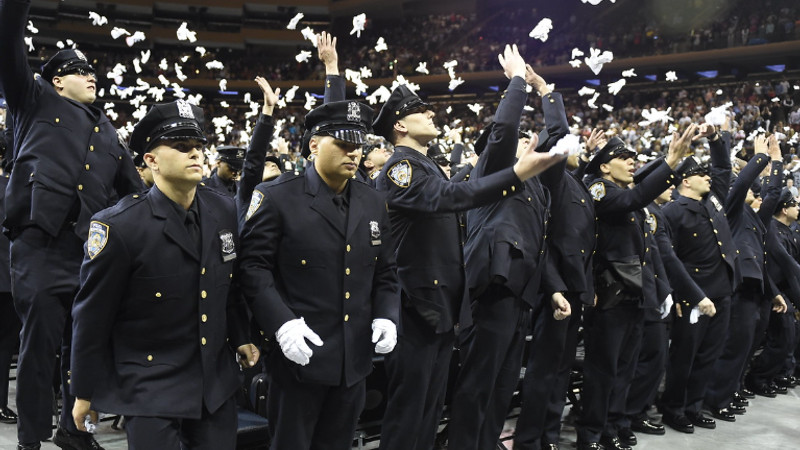
According to the report, two major police agencies–the New York City Police Department and the Dallas Police Department–have lowered education standards for recruits.
For example, in February, the NYPD lowered its college credit requirement for police academy from 60 credits–equivalent to an associate's degree–to 24. Meanwhile, in Dallas, a new policy approved in June allows recruits with only a high school diploma or GED to qualify as long as they have three consecutive years of full-time work experience.
It isn’t just New York and Dallas, as departments nationwide have lowered education requirements to attract men and women to law enforcement to fill staffing shortages.
Crime has come to the forefront in the first eight months of the Trump administration, as the president has taken steps in cities from Washington, D.C. to Los Angeles to supplement local law enforcement with the National Guard and federal law enforcement agencies.
The president has also signaled using federal law enforcement in Chicago, where 58 people were shot, eight fatally, over the Labor Day weekend. The Chicago Sun-Times had a higher number, reporting 52 wounded and nine killed over the period.
Despite crime declining nationwide since 2022, it remains higher than in 2019, before the COVID-19 pandemic.
Other cities lowering their education requirements besides New York and Dallas include Boise, ID., Chicago, Louisville, KY., New Orleans, LA., Philadelphia and Pittsburgh in PA., Memphis, TN., and Bellingham, WA. State agencies that have likewise lowered their requirements are the Pennsylvania State Police and the Kentucky State Police.
Even the nation’s preeminent law enforcement agency, the FBI, which has long required possession of a four-year degree, no longer mandates one for recruits. In addition, the training academy has been reduced from 18 to 8, The New York Times reported.
Immigration and Customs Enforcement has also lowered standards as the administration steps up recruitment to increase border enforcement efforts. At one time, the agency required a five-week Spanish language training block, however, they are going to transition to using “unspecified technology,” according to The Intercept.
ICE has also implemented incentives, including a signing bonus of up to $50,000 and up to $60,000 in student loan repayment, as well as retirement benefits.
“The demand exceeds the supply, and what’s happened is the environment for being a police officer has changed,” said Chuck Wexler, executive director of the Police Executive Research Forum, a nonprofit think tank on policing standards. “The expectations have never been higher.”
In 2020, resignations and retirements in police agencies spiked after law enforcement was repeatedly attacked in the post-George Floyd overdose death era.
From coast to coast, police officers were brutally attacked, including being shot, assaulted with clubs and bats, and having commercial-grade fireworks shot at them, all with the not always tacit approval of Democrats and the mainstream media.
Many officers also left larger departments behind and joined smaller agencies, while policing in general faces stiff competition from jobs with regular hours, higher pay and benefits, and remote work options.
Despite studies showing that college graduates are less likely to use force and generally perform better, some city officials believe that shrinking the applicant pool to the detriment of minorities and women, and despite those studies, do not believe education should play a significant role in the hiring process.
“College education, in the greater scheme of things, is advantageous. It’s necessary, but not sufficient,” Wexler said, noting other factors should also play a role in hiring, including work history, maturity, judgment, and other characteristics.
Aside from lowering the education standards, some agencies have also raised or lowered maximum and minimum age limits, loosened tattoo policies, scaled back on physical fitness tests, and waived exam fees.
In cities where those changes resulted in a surge in applications, they haven’t necessarily translated into higher staffing levels.
An example of this is in New Orleans, where in 2015, they eliminated the college education requirement, resulting in a surge of 7,440 applications two years later.
However, hiring didn’t keep pace. The department only hired about 100 recruits a year, and much less after 2020, according to the city’s hiring dashboard. Last year, the department received nearly 1,600 applications, but hired only 35 new officers.
Meanwhile, a report from the Louisiana Legislative Auditor’s office released last year showed that between 2019 and 2023, the department saw a 27% reduction in its policing staff.
Staffing trends nationwide are uneven, however.
Large departments experienced modest growth last year, but still employ 6% fewer officers than in 202, while medium and small agencies have not only recovered but exceeded 2020 levels.
“This period we’re in now, and we have been in for the last few years, is the most challenging time to hire a police officer,” Wexler said.
Despite some agencies lowering their hiring standards, some state legislatures have been working to raise the educational requirements, including those in Oregon and California.
In 2023, Oregon lawmakers considered a proposal that would have mandated two years of higher education for departments with fewer than 50 officers, while larger departments would require a bachelor’s degree.
The bill, which would have applied to police, corrections, parole, probation, and reserve officers, stalled in a Senate committee.
Meanwhile, in California, state lawmakers are looking at a bill that would, beginning in 2031, require incoming officers to obtain a policing certificate, associate degree, or bachelor’s degree within 36 months of graduating from a police academy.
Officers could also meet the standards via prior military service or out-of-state law enforcement experience.
That bill is popular among state law enforcement agencies and other groups, including the California Police Chiefs’ Association, California State Sheriffs’ Association, and the Peace Officers Research Association of California.
Educational requirements for police officers vary nationwide, with most agencies only requiring a high school diploma or GED.
“Educational standards across law enforcement agencies vary considerably,” said Nancy La Vigne, a criminal justice researcher and dean of the School of Criminal Justice at Rutgers University.
While education plays a significant role in developing a well-rounded officer, La Vigne believes other factors also play a role.
She said that in-service training, organizational structure, leadership, and accountability mechanisms also play a role in that development.
“Those factors, I think, override anything as simple as, ‘We’re requiring or removing education as a threshold for employment,” La Vigne said. “Educational requirements alone are not the biggest factor.”
Some argue that instead of lowering educational requirements, departments should focus on community involvement, especially since law enforcement is no longer as attractive a career choice as it once was, in order to improve public perception.
“It’s trying to fix the problem, assuming that the way things work now is the way things are supposed to be,” said Jim Nolan, a sociology professor at West Virginia University and a speaker with the nonprofit Law Enforcement Action Partnership. He previously served as a police officer and FBI unit chief. “It’s the approach to policing that’s wrong.”
Studies show that better-educated officers use force less often, are subject to fewer internal affairs complaints, and are disciplined less frequently than peers without a college degree. Some experts argue that college enhances critical thinking and teamwork skills.
College-educated officers also tend to be better writers, an important asset that leads to cleaner investigations and casework, a 2017 report on higher education in policing stated, according to States Newsroom.
Wexler, however, argues that while education is important, it isn’t enough to determine what makes a good police officer.
“Having a college education by itself doesn’t mean you will be a better police officer,” he said.

Comments