
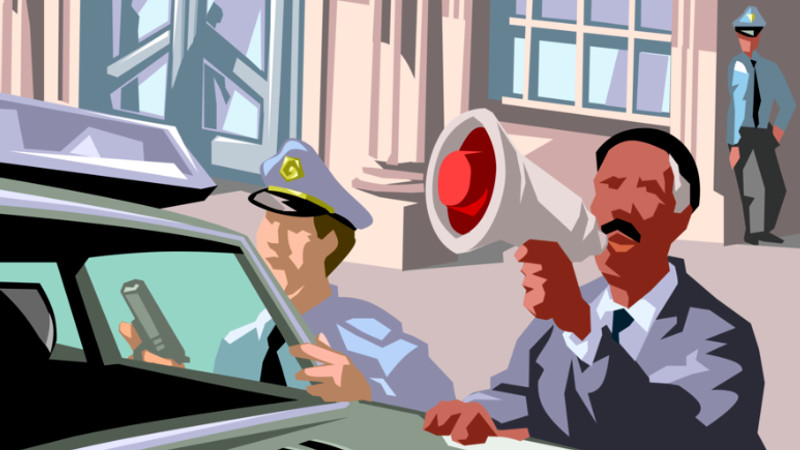
The definition of “hypervigilance” is: a heightened state of constant alertness and threat scanning. For police officers, remaining vigilant is extremely important; however, it must be channeled appropriately so it doesn’t morph into something more serious, such as paranoia or post-traumatic stress disorder (PTSD).
From a psychological perspective, hypervigilance mimics the body’s stress-response system, sometimes called “fight or flight.” Hypervigilance often triggers stress hormones such as cortisol and adrenaline. For some individuals, constantly being in a state of readiness can lead to physical maladies, such as ulcers, headaches, and so on.
Police officers are taught to look at situations faced by everyday men and women differently. On duty, officer safety is one of the primary skills or tactics officers see emphasized by academy instructors. Recruits are told that their head must “be on a swivel,” always looking out for danger that could be hiding around any corner.
In interactions with people on the streetba, that hypervigilance means that officers have it hammered into their brains to “watch the hands.” On live-action police programs such as “COPS,” police are constantly telling suspects to “show me your hands.” That isn’t being paranoid–it’s being hypervigilant. Any potential danger faced by police officers will come from the hands–firearms, edged weapons, or physical assaults. While the eyes are the “mirror into someone’s soul,” the hands are what officers need to be concerned about.
Situational awareness is another part of being hypervigilant. There are some who say that officers need to “have eyes in the back” of their heads, and that is not too much of an exaggeration. There is a saying that, “while someone is holding something in their right hand, you need to watch out for what they're doing with their left.” That is part of having situational awareness. Just because an officer has one suspect in front of them doesn’t mean there aren’t additional ones. Being aware of your environment is a key part of hypervigilance.
Finally, being able to rapidly process the circumstances is another component of hypervigilance. Being able to quickly determine if “something isn’t right” and if the individual you’re speaking to poses a threat to you or others should always be front of mind.
Officer safety, situational awareness, and rapid threat assessment do not occur in a vacuum…they are usually applied simultaneously.
Hypervigilance comes into play in even the most “routine” of calls. For example, traffic stops, even though they appear “minor” in nature, are one of the most dangerous calls police officers encounter. The reason for this is that one of the individuals in the scenario, the person being stopped, knows what they intend to do. The police officer does not. Law enforcement, by its nature, is unpredictable. Police officers will tell you that out of a five-day work week, no two days are exactly the same. That unpredictability is powerful and helps facilitate hypervigilance.
That unpredictability teaches a police officer that any situation, even the most mundane, can escalate. That means that police officers, even when they are off duty, automatically assess their environment and scan for signs of danger.
Ask most police officers, and that hypervigilance means that when they go to a restaurant with their better half or their family, they always sit where they can see the entrance/exit. It means that they automatically scan other people’s hands, waistbands, and movements. Unfortunately, depending on what kind of environment they work in, they may profile people based on race or ethnicity. They will have difficulty relaxing in public spaces, and may display a startle response to sudden noises or movements.
Vigilance is an important component of police work, both on and off-duty. However, when vigilance turns to obsession, it can be unhealthy. That obsession can manifest itself in a number of ways, some physical, some emotional, and some psychological.
For example, hypervigilance left unchecked can lead to difficulty “winding down” after shifts, trouble sleeping or relaxing, or overprotectiveness of family or loved ones. It can lead to relationship strain, where officers refuse to confide in loved ones, thereby maintaining emotional distance. They may become irritable and lose control of their emotions easily, or may misinterpret harmless situations as threats.
Finally, unchecked hypervigilance can lead to cognitive distortions, where officers develop “threat bias,” where they see danger where it is unlikely or doesn’t exist, or a negative worldview where they believe most people are dangerous or deceptive.
Unchecked hypervigilance can lead to chronic stress, burnout, anxiety, depression, alcohol and/or substance abuse, and finally, PTSD.
One factor that plays into the development of hypervigilance, especially in rookie officers, is when their entire social circle consists of other police officers. While sometimes it can prove cathartic to talk about situations in an “after action debrief” over a few drinks, having no other social contacts other than other cops can be a “perfect storm,” where one can confirm through groupthink that “everybody’s a bad guy.” While having friends within your chosen career path is expected, having others with a less distorted world view can be helpful as well.
Don’t get the wrong idea–we are not criticizing being hypervigilant, particularly in the times we live in, where police officers are placed under a microscope for everything they do, where people with the benefit of 20/20 hindsight and two weeks to examine a situation bloviate about how they would have handled it, and where some politicians want to defund the police.
Hypervigilance is not a defect. Police work is an extremely dangerous job, sometimes described as hours of sheer boredom interspersed with ten minutes of sheer terror. Sometimes it is extremely difficult, if not impossible, to downshift quickly. Where hypervigilance becomes an issue is when it transforms into an obsession and becomes chronic.
Unfortunately, hypervigilance can become something much more serious, such as PTSD, if a police officer combines that with a traumatic event or other factors. PTSD encompasses much more serious responses, including flashbacks, nightmares, avoidance of reminders, emotional numbness/detachment, or persistent guilt, fear, or anger.
While hypervigilance develops through training and repetition, PTSD typically requires exposure to actual or threatened death, serious injury, or violence, usually more than one. Hypervigilance is easier to channel or control and may fade with time off or rest.
Conversely, PTSD is much more persistent, often lasting more than a month or so. It has a much more negative effect on work performance, relationships, and emotional stability.
That is why it is important to channel hypervigilance, because over the long term, it can turn into PTSD with a triggering event. The good news is that most officers can experience hypervigilance without ever developing PTSD. And in law enforcement, properly channeling hypervigilance is a good thing and can make sure officers go home to their families or keep them safe when out in the community.

Comments