
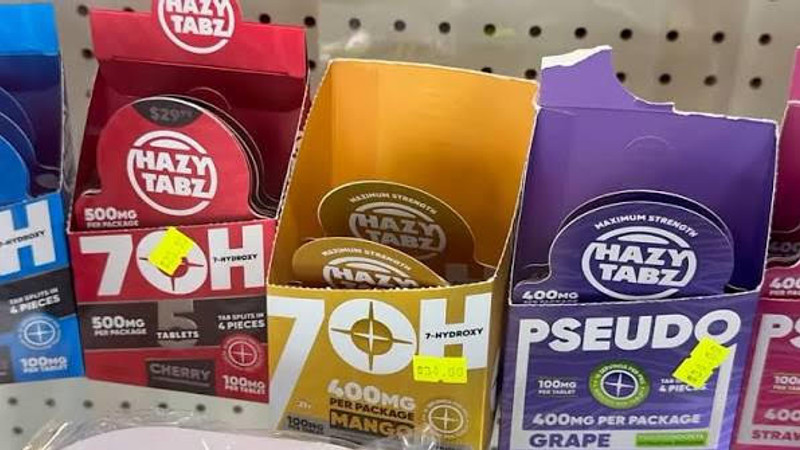
A pair of identical bills now before Congress, known as the End Gas Station Heroin Act, would pull synthetic and highly concentrated kratom-derived opioids off store shelves while leaving natural kratom alone. Sen. Bernie Moreno introduced the Senate version, S. 5383, on August 8, 2026, and Rep. Lance Gooden followed with the House companion, H.R. 10272, on September 3. The Senate bill sits before the Senate Judiciary Committee, while the House version has been referred to the Energy and Commerce and Judiciary committees.
The legislation adds 7-hydroxymitragynine (7-OH) and mitragynine pseudoindoxyl to Schedule I of the Controlled Substances Act, along with their salts, isomers, and synthetic analogs. Both compounds occur naturally in kratom in small amounts, and the bill protects that natural presence with a specific exemption: kratom leaf and finished kratom products remain legal as long as they contain no more than 1 milligram of these compounds per gram for solid, powdered, or encapsulated products, no more than 1 milligram per milliliter for liquids, and no more than 1 part 7-OH and mitragynine pseudoindoxyl combined per 100 parts mitragynine by mass. That exemption disappears when the compounds have been synthesized, chemically converted, concentrated, enriched, isolated, or otherwise produced through manufacturing. A product cannot borrow the protection meant for the natural plant once it has been engineered into something else.
The Senate bill's path runs through Sen. Chuck Grassley, the Judiciary Committee's chairman, who recently declared on X that all kratom is deadly, that it should not be sold anywhere, and that it is killing children. Grassley is right to be alarmed about 7-OH and right to want it off the market. But his blanket condemnation of kratom is shortsighted.
As Blue Lives Matter pointed out in response, 7-OH and similar products are NOT kratom, and banning synthetics will only make honest consumers safer. Treating them as one and the same aims at the wrong target and ignores the very distinction this legislation was written to draw.
That confusion did not emerge from nowhere. For years, the name kratom has carried an ugly reputation in the United States, evoking smoke shops, gas-station counters, and questionable legal status. Products sold under the kratom umbrella have increasingly chemically manipulated compounds capable of producing effects far removed from what consumers would expect from traditional kratom leaf, which many consumers use for energy, discomfort, and mood. As a result, instead of being viewed as a natural and legal alternative, kratom became guilty by association.
The bill is also built to keep pace with the next wave of products. Manufacturers have repeatedly stayed one step ahead of the law by tweaking a molecule just enough to fall outside existing schedules, and newer compounds such as MGM-15 and MGM-16, named in the bill's title, are part of that pattern. To close the gap, the legislation creates a category of "covered emerging synthetic opioids": substances produced through chemical synthesis or semisynthesis, intended for human consumption and commercial sale, not FDA-approved, not already scheduled, and shown by scientifically reliable evidence to be more potent than morphine. These substances would be treated as Schedule I for purposes of enforcement against their manufacture, import, export, and distribution. That enforcement is aimed squarely at the supply chain. The bill explicitly bars investigating, arresting, or prosecuting anyone under these provisions solely for purchasing, possessing, or personally using such a substance, and it excludes substances handled for legitimate scientific, medical, forensic, analytical, or law-enforcement purposes.
That approach mirrors what the American Kratom Association has been pushing for. The organization has worked to separate natural kratom from synthetic and highly concentrated 7-OH products, warning that these products are marketed in ways that let them trade on kratom's name while exposing consumers to substantially different risks. In September, AKA publicly backed federal legislation aimed at removing synthetic 7-OH, mitragynine pseudoindoxyl, MGM-15, and MGM-16 products from the marketplace. The FDA has drawn the same line, stating that its recent actions targeting 7-OH are meant to address concentrated and synthetic products, not natural kratom leaf containing the trace levels of 7-OH that occur naturally in the plant. The End Gas Station Heroin Act would write that distinction into federal law.
For AKA, getting these products off store shelves is about more than enforcement. It is an opportunity to reclaim what the word "kratom" means. Natural kratom does not need to be marketed as a knockoff intoxicant or saddled with the low-rent image of "gas station heroin." Responsible regulation can strip away the synthetic products driving much of that stigma and allow natural kratom to stand on its own as a distinct botanical product, with clear standards, honest labeling, and far less room for consumers to wonder what they are really buying.
Law Enforcement Today supports the American Kratom Association's push to clean up the marketplace and protect consumers from synthetic and highly concentrated products that can carry far more unpredictable and potentially severe effects than traditional kratom.
Promoting safer, more natural alternatives means little if consumers cannot trust what is actually sitting on store shelves. Making sure legitimate kratom products are clearly separated from dangerous synthetic compounds is an important part of preventing future problems, protecting consumers, and ensuring that the worst products no longer define the industry.

Comments