
Editor Note: We believe some of the most important stories in America are the ones that rarely make the headlines.
We are proud to announce the launch of Untold Stories, a new video series produced in partnership with the Federal Law Enforcement Officers Association (FLEOA) and sponsored by the Federal Law Enforcement Officers Foundation. Over the coming months, this two-dozen-episode series will take viewers inside federal law enforcement agencies across the nation, highlighting the men and women who serve, the missions they carry out, and the partnerships that help keep our communities and country safe.
Through exclusive interviews, behind-the-scenes access, and firsthand accounts, Untold Stories will showcase success stories, innovative initiatives, and unique perspectives on national security and public safety.
Join us for the latest episode here, as Untold Stories takes you inside the agencies, missions, and people working every day to protect our nation. This episode gives you a preview of what is to come in this series.
Before the bullet hits the ground, the shooter is already planning his escape. When police arrive, he's long gone, but the shell casing tells the whole story.
“Every shell casing is a witness.”
That is the philosophy behind the National Integrated Ballistic Information Network, better known as NIBIN, and the federal agents working alongside local law enforcement to turn ballistic evidence into leads that can take violent offenders off the streets.
For the men and women of the Bureau of Alcohol, Tobacco, Firearms and Explosives, the technology has transformed the way shootings are investigated.
Every time a gun is fired, it leaves microscopic markings on the spent casing that act almost like that gun's fingerprint. In many ways, NIBIN works similarly to the fingerprint databases that have long helped law enforcement identify suspects.
When fingerprinting first emerged as a method of identifying suspects, one of the biggest challenges was establishing a network expansive enough to reliably connect a print recovered at a crime scene with someone whose prints were already on file. As technology advanced, massive searchable databases revolutionized law enforcement's ability to make those connections across jurisdictions, and even across states.
NIBIN brings that same advantage to firearm identification.
A shell casing recovered from one shooting may not mean much by itself. But when its unique markings can be compared against ballistic evidence collected by law enforcement elsewhere, investigators suddenly have the ability to connect firearms to crimes committed months apart and miles away.
In Tennessee, those connections have produced results.
A firearm recovered by Lebanon police in 2023 was entered into NIBIN and linked to a 2022 Shelbyville homicide, helping investigators build a case that ultimately resulted in a murder conviction.
In Nashville, a Glock recovered during a traffic stop was entered into the system. Within 48 hours, investigators learned it was connected not only to another shooting, but to a previously unsolved homicide.
“If that traffic stop doesn't happen, this case probably goes nowhere.”
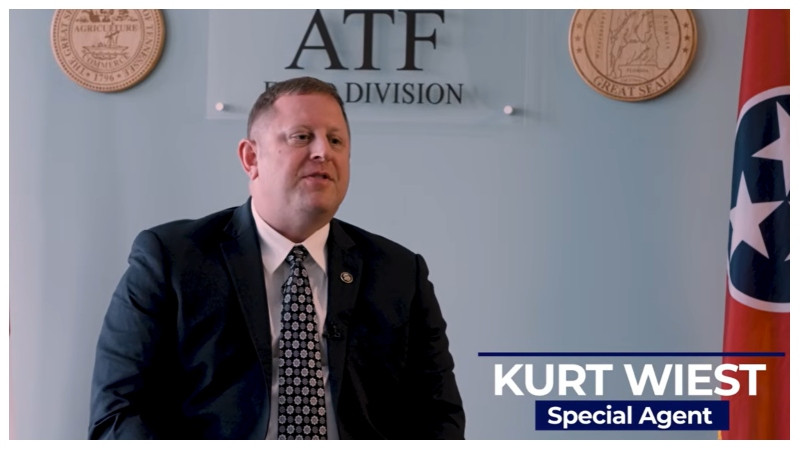
For one ATF official featured in the video, that mission is deeply personal. During his first year with ATF in 2005, he had a gun put to his head in his own Nashville driveway. The experience cemented what pursuing violent offenders meant to him.
“This isn't just a job for us. This really is a mission.”
These are the investigations most Americans never see and the federal law enforcement officers working behind the scenes to make sure the evidence left on the street does not stay silent.
Watch the full Untold Stories episode to see how ATF agents and their law enforcement partners are using NIBIN to connect the dots, identify violent offenders and solve cases that might otherwise have gone cold.

Comments