
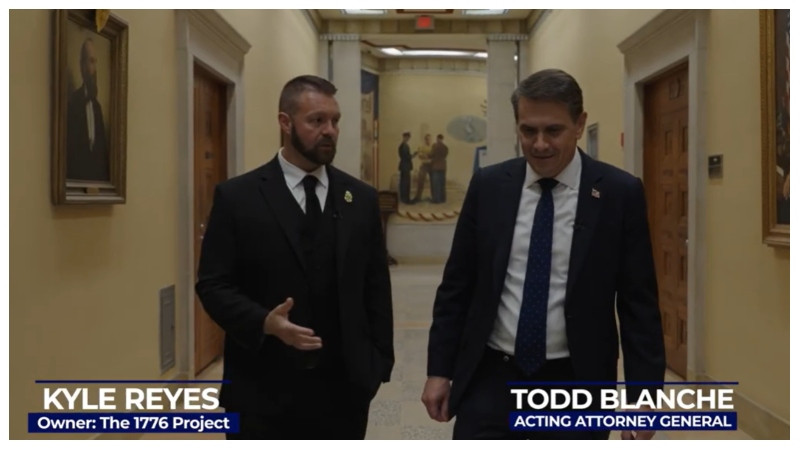
Editor Note: We believe some of the most important stories in America are the ones that rarely make the headlines.
We are proud to announce the launch of Untold Stories, a new video series produced in partnership with the Federal Law Enforcement Officers Association (FLEOA) and sponsored by the Federal Law Enforcement Officers Foundation. Over the coming months, this two-dozen-episode series will take viewers inside federal law enforcement agencies across the nation, highlighting the men and women who serve, the missions they carry out, and the partnerships that help keep our communities and country safe.
Through exclusive interviews, behind-the-scenes access, and firsthand accounts, Untold Stories will showcase success stories, innovative initiatives, and unique perspectives on national security and public safety.
Join us for the latest episode here, as Untold Stories takes you inside the agencies, missions, and people working every day to protect our nation. This episode gives you a preview of what is to come in this series.
This article was written and published pending Todd Blanche's pending confirmation to Attorney General.
Murders down. Violent crime arrests up. Child predators and human traffickers taken off the streets. Millions of dollars delivered to the families of fallen public safety officers.
The numbers flash by quickly.
Then the story rewinds.
Before Todd Blanche was helping lead the Department of Justice, he was standing beside Donald Trump as the future president faced an unprecedented barrage of criminal prosecutions.
Now, Blanche finds himself on the opposite side of the courtroom.
He is no longer simply defending one man from a justice system he believes was weaponized against him. He is helping steer that same massive institution while thousands of federal agents, prosecutors, state and local officers, and partner agencies work to keep Americans safe.
For Blanche, changing that direction is not something that happens overnight.
“We are turning around an aircraft carrier.”
In this edition of FLEOA’s Untold Stories, Todd Blanche takes viewers inside the effort to reshape the Department of Justice, restore public trust, support the men and women doing the work on the ground, and confront a question that has hung over the country for years:
What happens when Americans stop trusting the institution responsible for administering justice?
Blanche is no stranger to the Department of Justice.
Long before becoming one of the most recognizable attorneys in the country, he spent nearly 15 years working within the department, ultimately serving as an Assistant U.S. Attorney and supervisor in the Southern District of New York.
He eventually left government service and entered private practice.
Then came Donald Trump.
Blanche represented Trump as the former president faced multiple criminal cases during his campaign to return to the White House. It put Blanche on the front lines of one of the most politically explosive legal battles in modern American history.
Days after Trump won the 2024 presidential election, he announced Blanche as his choice for Deputy Attorney General.
The attorney who had defended Trump against prosecutors was heading back inside the Department of Justice.
But running an organization of that scale meant confronting an immediate reality.
There was no switch Blanche could flip.
There was no single directive capable of instantly changing the culture, priorities, investigations, and operations of a sprawling federal law enforcement apparatus.
Asked how he manages a constant flood of competing priorities, Blanche offered a simple answer.
“You can’t do it alone.”
That may be one of the central themes of his mission.
The Department of Justice encompasses the FBI, Drug Enforcement Administration, U.S. Marshals Service, Bureau of Alcohol, Tobacco, Firearms and Explosives, U.S. Attorneys’ Offices, and thousands of employees across the country.
But Blanche’s definition of the team goes well beyond DOJ.
He points to Homeland Security Investigations, Border Patrol, Customs and Border Protection, state agencies, local police departments, sheriffs, investigators, and countless other officers whose work ultimately produces the results announced from Washington.
“I get to sit up here and take credit for things, but it’s really the work of thousands and thousands of men and women.”
That partnership is producing results.
Blanche has pointed to falling murder rates, dramatically increased violent-crime arrests, thousands of arrests involving child predators and human traffickers, and aggressive federal efforts targeting gangs, illegal immigration, fraud, and other threats to public safety.
The Department of Justice has also placed renewed focus on a group too often remembered only after tragedy: the families of fallen public safety officers.
In July, DOJ announced that its Office of Justice Programs had finalized more than three times as many Public Safety Officers’ Benefits death-claim determinations during a four-week period as it had during the previous nine months, providing more than $96 million to eligible surviving families.
For Blanche, those figures are not simply another line on an accomplishments sheet.
They represent officers who made it home and families whose loved ones did not.
That distinction becomes impossible to ignore when the discussion turns to the dangers faced by law enforcement.
“We live in a dangerous world,” Blanche said, “and we ask men and women like you and like the fallen to run into danger when many of us would not.”
It is one of the quieter moments in a presentation filled with politics, prosecutions, violent crime, and institutional reform.
And it cuts directly to FLEOA’s mission.
Blanche believes that when an officer pays the ultimate price, the responsibility of the law enforcement community does not end at the funeral.
“I think that there’s fewer things that we can do as a law enforcement community than wrapping our arms around the families and the loved ones of the men and women who paid the ultimate price to keep us safe.”
But rebuilding DOJ is about more than enforcement statistics.
It is also about trust.
Blanche acknowledges what millions of Americans already watched unfold during the previous administration: investigations and prosecutions that became inseparable from the country’s political divisions.
Trump himself became the most visible example.
Blanche was there.
He watched his client face prosecutions in multiple jurisdictions while campaigning for president. He watched Trump’s family and businesses become targets of investigations and litigation. And he now works for a president who has made rooting out what he describes as the weaponization of government a major priority of his second administration.
For Americans demanding immediate accountability, however, Blanche offers a dose of reality.
Complicated investigations take time.
“Your normal complicated case, they take oftentimes seven, eight, nine months, a year, two years, three years sometimes to build.”
That presents the administration with a difficult balancing act.
Supporters who watched the previous four years unfold want answers.
They want investigations.
They want accountability.
They want it yesterday.
But Blanche argues that fixing a justice system accused of abusing its power cannot mean simply abusing that power in the opposite direction.
“We didn’t rewrite the laws,” he said.
Instead, Blanche describes the task as rebuilding the institution while operating under the same legal framework that existed before the administration arrived.
“It’s now a team effort to try to do justice and to try to make sure that what happened that shouldn’t have happened never happens again.”
That aircraft carrier may be turning, but President Trump is apparently not interested in waiting around for it.
Blanche describes an administration moving at a relentless pace, driven by a president who expects promises made to voters to become actions taken by government.
When Trump calls, “I’ll get around to that” is not an acceptable answer.
Blanche seems to relish the pressure.
“You wake up every day saying, ‘What can I do? What am I going to do that can help further the President’s agenda and, for me, make this country safe?’”
That means targeting violent criminals.
It means confronting fraud.
It means enforcing immigration law.
It means protecting civil rights.
And it means pushing an enormous bureaucracy to move considerably faster than bureaucracies generally enjoy moving.
The video also offers a more personal glimpse into the relationship between Blanche and the president he once represented.
Blanche describes Trump as a man whose public image rarely captures the interactions taking place when cameras are absent.
He recalls being in the Oval Office as Trump was working on remarks when someone informed the president that an injured agent was in the hospital and available by phone.
Trump stopped what he was doing.
“Absolutely.”
He took the call.
According to Blanche, the president spoke with the injured agent, had him laughing, and made clear that the man’s sacrifice mattered.
Blanche argues those moments happen repeatedly but rarely become the stories Americans read about the president.
“The media will never write a... You will get no exposé on that.”
It is precisely the kind of moment Untold Stories exists to capture.
Not simply the speeches.
Not merely the statistics.
Not the political caricatures.
The people behind them.
For Blanche, the story of the Department of Justice ultimately comes back to those people as well.
The agents making arrests.
The officers entering dangerous buildings.
The investigators assembling cases piece by piece.
The prosecutors preparing evidence that may take years to reach a courtroom.
The families waiting at home.
And the families whose loved ones never return.
Those are the people doing the work while Washington fights over the institution surrounding them.
Blanche believes DOJ is moving back toward what its name should have demanded all along.
Justice.
“Look, I hope that time heals wounds, and I hope that we move forward as a country, and we will, back to where the Department of Justice is doing justice.”
The turnaround is not finished.
Perhaps no institution the size of the Department of Justice ever truly finishes changing course.
But Blanche is clear about where he believes it should be heading.
“We have a very defined mission that we’ve been trying to execute and will continue to execute.”
And while political battles continue in Washington, thousands of men and women across federal, state, and local law enforcement will continue carrying out that mission on streets, at borders, inside courtrooms, and behind the scenes.
The aircraft carrier is turning.
Watch the full Untold Stories presentation to hear Todd Blanche explain where he believes it is headed, the people responsible for moving it, and what it will take to restore Americans’ faith in the Department of Justice.

Comments
2026-08-08T17:34-0400 | Comment by: Ethan
Thank you for this article and video - so inspiring, giving us great hope and confidence. Godspeed Todd Blanche.