
On a daily basis, police offices are faced with ever-changing situations, many of which require the innate ability to understand when to use force and the level of force needed to neutralize a threat.
Officers are expected to follow the principle of objective reasonableness — using only the level of force that a reasonable officer would use under the same circumstances. Officers are also encouraged to always use their interpersonal communication skills first, and always look to de-escalate any and all situations.
Modern Department of Justice (DOJ) policies state that officers should use force only when no reasonably effective, safe, and feasible alternative appears to exist, and that they should use de-escalation when it is objectively feasible and does not increase danger.
The use of force continuum is a guide that officers use when faced with situations where an individual could turn violent. For example, a traffic stop or placing someone under arrest. The use of force continuum is not a rigid staircase; it is meant to showcase how officers often move up or down quickly depending on the subject's behavior.
Agencies often emphasize decision-making, proportionality, and de-escalation rather than a simple "one-step-at-a-time" ladder. Below is a step-by-step explanation of police use of force and how the use of force continuum plays a role:
1. Officer presence: This is the lowest level on the continuum and at this stage, the officer's presence alone is the intervention. This often looks like professional posture with a visible badge and a calm demeanor. Officers often strategically position themself so they are able to observe a subject's behavior. Common de-escalation techniques at this level would be non-threatening body language, calm tone of voice, creating space and slowing the interaction down, and introducing oneself and explaining why police are there.
2. Verbalization or tactical communication: This is the next step on the continuum and still involves no physical force. The officer uses communication to gain compliance. This often looks like giving clear directions, repeated lawful commands, warnings about consequences, and efforts to persuade the subject to comply. De-escalation techniques at this stage are very important and include active listening, giving one command at a time, avoiding sarcasm, and reassuring the subject about next steps.
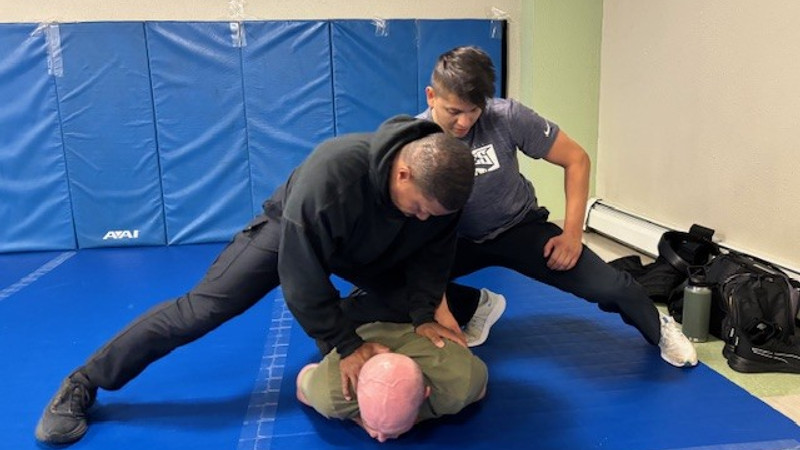
3. Hand control or physical control: The third step on the continuum involves the officer using physical contact without weapons. This level can be divided into two parts — soft empty hand control and hard empty hand control. Soft empty hand control are lower impact physical techniques that include escort holds, wrist locks, joint manipulation or nerve compressions. Hard empty hand control are stronger physical tactics used when resistance becomes more aggressive. This can look like strikes, kicks, takedowns, and defensive physical blows.
It is important to remember at even when force states, de-escalation and communication does not end. Officers should always still be giving clear verbal commands during restraint, pausing when resistance stops, and reducing force once control is gained.
4. Less-lethal methods: When hand control or physical control is not working and the subject still is not complying, officers can use less-lethal tools. These weapons include a baton, pepper spray or chemical agents, projectile impact tools, and Tasers. The purpose of these tools are to incapacitate or gain control when a subject is combative, assaultive, or poses a significant safety risk. De-escalation at this stage on the continuum is important and includes giving warnings before deployment (when feasible), allowing the person a final chance to comply, and immediately stopping additional force when compliance is achieved.
5. Deadly or lethal force: This is the highest level of force and is reserved for the most serious and dangerous of situations. It should always be considered a last resort and happens when a subject puts officers' and civilians' lives in jeopardy.
The use of force continuum helps officers best handle an aggressor under certain circumstances; they cannot account for unknown factors that an officer must process in a split second. Sometimes, an officer will encounter a situation that is immediately lethal and in order to protect themselves and others, they have to respond with deadly force.
Other times, officers will respond to a situation that starts out with verbal commands for a subject to obey and will escalate further. For example, if an officer responds to a person who is yelling outside of a store, the officer would begin with presence and verbal communication.
The officer is calm and verbally asks the subject to stop yelling. The subject refuses commands and steps toward the officer aggressively. The officer uses more direct verbal commands and creates distance. The subject closes the distance and grabs the officer's arm.
The officer, still giving verbal commands, moves to soft empty-hand control. The subject does not comply and starts punching and kicking the officer. The officer continues to verbally communicate, but may decide to escalate to hard empty-hand techniques or a less-lethal option.
If the subject complies, then the officer will cease his physical contact and attempt to place the individual in handcuffs. If the subject refuses to camly, and suddenly produces a knife or other weapon and advances in a way that creates an imminent threat or serious harm to the officer, the situation may escalate to deadly force.
The officer's response is tied to the subject's behavior and the threat presented. Police use of force is a continuous assessment of threat and resistance as well as safety and available alternatives.
Officers are expected to follow the principle of objective reasonableness — using only the level of force that a reasonable officer would use under the same circumstances. Officers are also encouraged to always use their interpersonal communication skills first, and always look to de-escalate any and all situations.
Modern Department of Justice (DOJ) policies state that officers should use force only when no reasonably effective, safe, and feasible alternative appears to exist, and that they should use de-escalation when it is objectively feasible and does not increase danger.
The use of force continuum is a guide that officers use when faced with situations where an individual could turn violent. For example, a traffic stop or placing someone under arrest. The use of force continuum is not a rigid staircase; it is meant to showcase how officers often move up or down quickly depending on the subject's behavior.
Agencies often emphasize decision-making, proportionality, and de-escalation rather than a simple "one-step-at-a-time" ladder. Below is a step-by-step explanation of police use of force and how the use of force continuum plays a role:
1. Officer presence: This is the lowest level on the continuum and at this stage, the officer's presence alone is the intervention. This often looks like professional posture with a visible badge and a calm demeanor. Officers often strategically position themself so they are able to observe a subject's behavior. Common de-escalation techniques at this level would be non-threatening body language, calm tone of voice, creating space and slowing the interaction down, and introducing oneself and explaining why police are there.
2. Verbalization or tactical communication: This is the next step on the continuum and still involves no physical force. The officer uses communication to gain compliance. This often looks like giving clear directions, repeated lawful commands, warnings about consequences, and efforts to persuade the subject to comply. De-escalation techniques at this stage are very important and include active listening, giving one command at a time, avoiding sarcasm, and reassuring the subject about next steps.
3. Hand control or physical control: The third step on the continuum involves the officer using physical contact without weapons. This level can be divided into two parts — soft empty hand control and hard empty hand control. Soft empty hand control are lower impact physical techniques that include escort holds, wrist locks, joint manipulation or nerve compressions. Hard empty hand control are stronger physical tactics used when resistance becomes more aggressive. This can look like strikes, kicks, takedowns, and defensive physical blows.
It is important to remember at even when force states, de-escalation and communication does not end. Officers should always still be giving clear verbal commands during restraint, pausing when resistance stops, and reducing force once control is gained.
4. Less-lethal methods: When hand control or physical control is not working and the subject still is not complying, officers can use less-lethal tools. These weapons include a baton, pepper spray or chemical agents, projectile impact tools, and Tasers. The purpose of these tools are to incapacitate or gain control when a subject is combative, assaultive, or poses a significant safety risk. De-escalation at this stage on the continuum is important and includes giving warnings before deployment (when feasible), allowing the person a final chance to comply, and immediately stopping additional force when compliance is achieved.
5. Deadly or lethal force: This is the highest level of force and is reserved for the most serious and dangerous of situations. It should always be considered a last resort and happens when a subject puts officers' and civilians' lives in jeopardy.
The use of force continuum helps officers best handle an aggressor under certain circumstances; they cannot account for unknown factors that an officer must process in a split second. Sometimes, an officer will encounter a situation that is immediately lethal and in order to protect themselves and others, they have to respond with deadly force.
Other times, officers will respond to a situation that starts out with verbal commands for a subject to obey and will escalate further. For example, if an officer responds to a person who is yelling outside of a store, the officer would begin with presence and verbal communication.
The officer is calm and verbally asks the subject to stop yelling. The subject refuses commands and steps toward the officer aggressively. The officer uses more direct verbal commands and creates distance. The subject closes the distance and grabs the officer's arm.
The officer, still giving verbal commands, moves to soft empty-hand control. The subject does not comply and starts punching and kicking the officer. The officer continues to verbally communicate, but may decide to escalate to hard empty-hand techniques or a less-lethal option.
If the subject complies, then the officer will cease his physical contact and attempt to place the individual in handcuffs. If the subject refuses to camly, and suddenly produces a knife or other weapon and advances in a way that creates an imminent threat or serious harm to the officer, the situation may escalate to deadly force.
The officer's response is tied to the subject's behavior and the threat presented. Police use of force is a continuous assessment of threat and resistance as well as safety and available alternatives.
For corrections or revisions, click here.
The opinions reflected in this article are not necessarily the opinions of LET

Comments