
WASHINGTON, DC- A case decided this week will end up tying the hands of police officers and will force them to operate under a different set of rules for racial minorities, Fox News Digital reports.
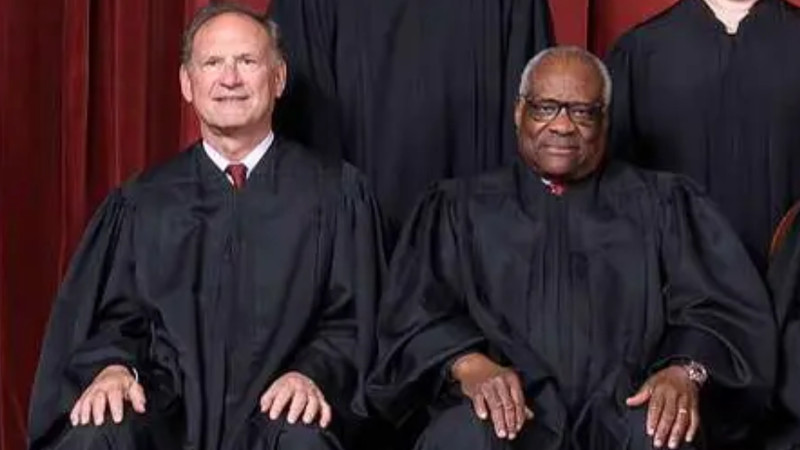
In a blistering dissent over the high court's refusal of certiorari, Justices Samuel Alito and Clarence Thomas admonished the high court for seemingly creating a situation where individuals of certain minority groups must be treated differently than others.
“It is dangerous to allow an individual to be treated differently based on statistics, studies, or expert testimony that purports to show that members of the racial or ethnic group to which he belongs are more likely to act in a certain way than are members of other groups,” Alito wrote on behalf of him and Thomas. “Here, the special treatment helped the individual; in other situations, it will not.”
The case before the high court, U.S. v. Donte J. Carter, involved a black man, carter, whose firearm and theft convictions were vacated when the D.C. Court of Appeals ruled that police “seized” him before they had reasonable suspicion. Police later recovered a .40-caliber pistol from Carter’s pants, and the government said the gun had been stolen from an FBI agent’s vehicle.
In a bizarre ruling, the D.C. court held that, “black Americans like [Carter] are ‘especially distrustful of law enforcement’” and therefore “‘less likely’ than other people ‘to terminate a police encounter’ due to skepticism that any attempt to exercise their constitutional rights will be respected.”
The appeals court claimed that Carter’s race was relevant to whether a reasonable person in his position would have felt free to end the police encounter, then ruled the encounter therefore became a “seizure” and that such a “seizure” was unlawful because police officers hadn’t established reasonable suspicion before subjecting him to it. Good luck following that circular reasoning.
The two conservative justices wrote that the D.C. court’s ruling forces police officers to treat people differently based on race, which Supreme Court precedent clearly prohibits, therefore sending mixed messages to law enforcement.
“Under the test, officers will need to quickly assess a person’s race, and if officers and courts must craft special rules for black persons, what about dark-skinned Latinos, other Latinos, and members of other minority groups?” Alito reasoned. “We have said that our ‘Constitution is color-blind.’ It ‘almost never’ allows government actors to treat persons differently based on their race.”
As part of his reasoning, Justice Alito cited two cases, Students for Fair Admissions v. Harvard, Louisiana v. Callais, and Shaw v. Reno.
“And we have rejected the proposition that the Constitution permits an individual to be treated differently based on a ‘perception that members of the same racial group–regardless of their age, education, economic status, or the community in which they live–think alike,’” Alito wrote, citing Shaw v. Reno.
Alito’s dissent appears to slam the D.C. Court of Appeals, with lawyers representing the United States arguing that it forced police officers to assume that all blacks have the same attitudes toward police officers and would therefore feel uncomfortable exercising constitutional rights in their presence, which seems to be a bizarre leap.
In Carter’s case, he initially allied to police officers by answering no when asked if he was carrying a weapon. Police then asked Carter to pull his pants up, whereby they noticed an L-shaped bulge appearing to be a firearm which was later identified as the .40-caliber pistol stolen from the FBI agent’s vehicle.
By refusing certiorari, the Supreme Court in essence let the DC Appeals court ruling stand.

Comments