
HOUSTON, TX- In 2017, a team of Texas Christian University researchers decided to investigate how busy illicit massage parlors were in Houston and used the international spy community to gather data, the Houston Chronicle reports.
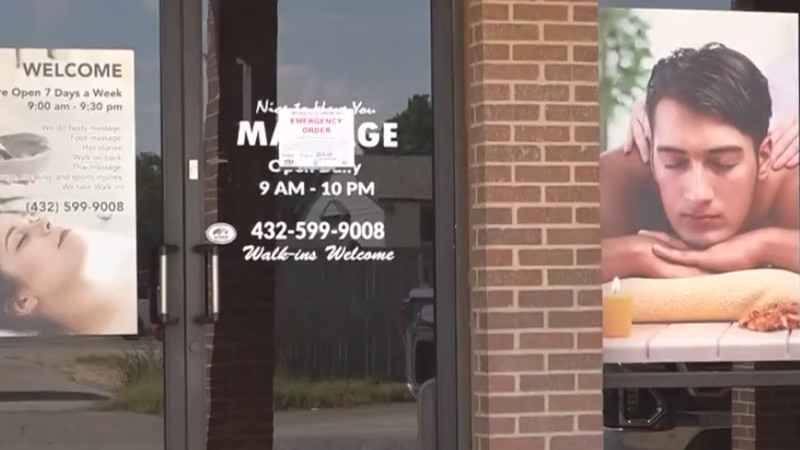
At one time, massage parlors were primarily located in “seedy” neighborhoods, such as 42nd Street in New York and the Mission District in San Francisco. However, the Texas Christian researchers found that today such businesses are located in seemingly innocent settings, such as strip malls, medical buildings, and office parks. In fact, they are so common that they don’t stand out to the point they “are practically invisible,” the Chronicle reported.
According to recent data, Texas has more massage parlors than all but one state, and in Houston, there are roughly five for every McDonald’s restaurant located in the city.
To gather data, the TCU researchers placed hidden cameras outside over 30 locations, according to Sean Crotty, an urban geography professor. They determined that the businesses served about 120 men every hour of every day. In the years since, that number has skyrocketed.
In 2024, Crotty utilized location data from cell phones to track the johns from massage sex parlors to their homes and jobs. He was able to determine “shame buffers,” otherwise known as the distance customers would travel to not get caught. He found men will patronize a sex worker close to work, but not near their home.
Crotty used “a small and secretive collection of organizations formed to surveil and combat human trafficking” to carry out his research.
Crotty relied on entities that work outside government and “under the radar” to conduct his research instead of large, public advocates that “promote awareness and court publicity.”
These entities use sophisticated technology to monitor and analyze the modern illegal sex market, the Chronicle reported.
While these entities assist academics such as the TCU team, Texas police, and regulatory authorities likewise use them. For example, the Texas Department of Licensing and Regulation has sought them out in a recent push to shut down the illicit sex massage parlor trade.
Texas Attorney General Ken Paxton’s office has also used them to target landlords who rent to sex parlors.
Crotty was assisted in his research by a small nonprofit founded by former military intelligence officials and CIA officers.
The Network gathers information from illicit massage parlor advertisements, customer reviews, and owner and property records. A Texas assistant attorney general sits on its board, the Chronicle reported.
Staffers built and installed hidden cameras to record massage customers, and required special construction to include battery-powered fans so they could operate in the heat of Houston, Crotty recalled.
Elizabeth Wiggins, director of the state licensing agency’s Anti-Human Trafficking Division, called the Network “a game changer” and is “instrumental in identifying many of these establishments.”
A subsequent study involved using cell phone data that traced customers’ movements with the help of the SIGHT Foundation, “a mysterious company that procured and analyzed the massage parlor customers’ digital tracks, and was able to pinpoint each man’s location within only a few feet, Crotty said.
Another organization, TraffikCam, crowdsources millions of pictures of individual hotel rooms and uses machine learning to help police identify specific locations of online ads published by suspected human traffickers based on visual clues in the backgrounds, the Chronicle reported.
For example, a particular pattern on a bedspread or a series of objects can direct law enforcement to a specific hotel.
Another company that utilizes artificial intelligence and facial recognition to index and analyze missing children photos, sex ads, and information contained therein, such as phone numbers.
Traffic Jam’s algorithm can dig through the data and draw connections between traffickers, suspects, and locations.
Another product, Spotlight, combs through hundreds of thousands of commercial sex ads posted daily, including identifying information such as phone numbers, emails, and locations.
Developed by a nonprofit called Thorn, Spotlight “applies artificial intelligence and facial recognition technology to create profiles of girls under the age of 18 to help law enforcement trace their movements and locations,” the Chronicle reported.
Paxton’s office recently filed a lawsuit against several central Texas massage businesses and gave a shoutout to Spotlight.
“During the investigation, (the Human Trafficking Unit) used Spotlight…to assist law enforcement in prioritizing leads when addressing sex trafficking,” court documents read.
One complication in investigating massage business sex trafficking is that quantifying it is imprecise. There are 3,500 licensed establishments in Texas, and researchers must zero in on the illegal operations.
For example, some illicit businesses may advertise massages, but are not licensed. Likewise, not all sex workers are victims of human trafficking and therefore voluntarily participate in the trade.
Researchers search websites advertising sex services at massage businesses, and those where customers post candid reviews. They are then matched with phone numbers and addresses of state-licensed establishments.
They also look for keywords or other clues indicating possible sex trafficking.
It was determined that between 2020 and 2025, the number of massage parlors in the Lone Star State grew by 47%, according to Paxton’s office, which obtains its information from The Network and other private intelligence organizations.
Last spring, 1,650 illegal massage businesses were identified statewide, which amounts to three times the number of Walmarts in the state. Most are in large cities, such as Dallas and Houston, which have roughly 600 each, The Network says.
They are not, however, only found in large cities. Per capita, Odessa, Beaumont, Killen, and Plano all have higher concentrations of parlors per capita than large metropolitan areas, the Chronicle reported.
One city, Lewiston, located northeast of Dallas, sent local lawmakers to Austin to lobby state lawmakers for stricter laws to fight the trend, with the police chief testifying that one-third of the city’s massage businesses were illicit.
“I don’t know what’s going on in our districts,” said State Rep. Ben Bumgarner, a Republican, who sponsored the legislation. “But we have a serious human trafficking issue going on in the city of Lewisville.”
Experts say that massage operations are a near-perfect vehicle for those looking to avoid scrutiny and engage in illicit operations.
Massage therapists and massage parlor owners are licensed by the State of Texas, much like electricians, plumbers, and others, which lends them an air of respectability. They also tend to operate at commercial sites alongside legitimate businesses and adopt names that include words such as “health” and “wellness.”
Children at Risk, a nonprofit, conducted an analysis that found a large number of such businesses are located near schools.
There is also a fallacy that massage therapists offering sex are doing it voluntarily and is therefore “victimless.” However, while in some cases that is true, Wiggins said, “We have not seen an instance in which prostitution was happening at a massage business, and there were no signs of human trafficking.”
Research shows that human trafficking victims working in massage parlors are predominantly Chinese, with smaller numbers from Korea and Thailand. Most came to the US due to financial situations at home, and many are older women with families. Debt and fear of deportation are used as cudgels by managers to prevent them from leaving.
Due to the large number of Chinese nationals taking the Texas massage exams, Texas began offering the test in Chinese in 2023.
However, many of those taking the exam are from out of state, including last year, when 1,200 out-of-state residents took the exam, 99% of whom were Chinese.
The state licensing agency said that the pattern “suggests coordinated activity, not applicant behavior.” As a result, Texas stopped offering the exam in Chinese.
Four massage schools have been shut down in the past six months by the Department of Licensing and Regulation, three in the Dallas metro and one in Austin, due to suspicion of acting as diploma mills feeding the illicit massage sex business. Court documents showed that the schools had graduated students working at illicit parlors.
In the past, police would conduct “vice” busts on massage sex businesses, with cops posing as customers. Those arrests focused on individual massage workers, often charged with low-level prostitution offenses, and many were victims themselves. Those running the operations often got off scot-free, claiming they didn’t know about the workers’ illegal activities.
Such operations often ran afoul of legal requirements. For example, between 2022 and 2024, the Lewisville Police conducted an operation targeting massage parlors, resulting in dozens of criminal charges. However, the Denton County DA’s Office rejected all of them after it was found that police engaged in “inappropriate physical contact.”
Those raids and lengthy investigations often had little or no impact. “If you close down one location, it’s not uncommon for it to pop up in a different location in a few days,” said Kirsta Melton, who led the Texas AG’s human trafficking section before founding the Institute to Combat Trafficking.
Administrative investigators have a much lower threshold to meet. Unlike police who must prove a case “beyond a reasonable doubt,’ administrative investigators need only show “reasonable cause” to take action.
Much of the enforcement action doesn’t even involve police. The Texas Department of Licensing and Regulation has obtained some 60 emergency orders to shut down massage businesses because of signs of illicit activity. It has also revoked nearly 70 licenses.
“I know TDLR has found good evidence of human trafficking and turned it over to law enforcement, and nothing happened,” Melton said.
Ian Hassell, who founded The Network, said that Texas has led the way in fighting the illicit massage parlor trade. Hassell, who worked in operations for the CIA in the Middle East for a decade, said, “I loved it; I would still be there today.”
However, his life turned after he attended a talk from a human trafficking advocate at his Virginia church. “That’s what I’m going to do for the rest of my life,” he remembers thinking. He also realized, “I would do this totally differently.”
That led him to collaborate with a friend who was a West Point graduate working in military intelligence to form The Network to focus exclusively on illicit massage businesses. “The goal was to rescue victims and arrest traffickers,” he said.
The pair decided to approach investigating such businesses differently, by mapping the businesses’ digital footprints, hiring software engineers, data analysts, and staffers, which included more former CIA and FBI officials, to start creating a profile of every massage sex business in the U.S.
The Network makes its illicit massage business data available to regulators and the police, and they have worked directly with local and state agencies nationwide.
“We’ll never arrest our way out of it,” Hassell said. “We’ll never rescue our way out of it.”

Comments