
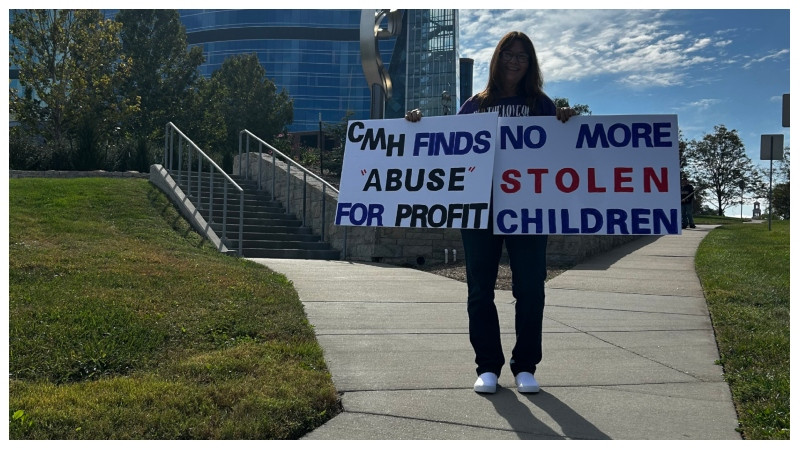
Op-ed written by Sarah Goble, Founder of The Honest Diagnosis Project
A few years ago, I never imagined I would need to learn how child abuse investigations work or rely on law enforcement to protect my family from a medical error. Like most mothers, I believed the system existed to protect children from real harm. I believed that if I rushed my baby to the hospital, I would be met with help, answers, and care.
Instead, I was met with suspicion.
After running my infant son to a children’s hospital due to a viral infection, doctors jumped to abuse first, and my family entered a system that moved faster than the truth. One moment, I was a mother of two trying to help my infant son, and the next, I was treated like a monster who had hurt him.
Within hours, our lives were irreparably upended. No evidence. Only dangerous, irresponsible assumptions made after a medical misdiagnosis was accepted at face value by everyone involved.
One critical step could have saved my family, but it never happened: a true investigation.
There was no warning about the pain that was coming next.
After being held in the hospital for a week under the threat of arrest if I left with my son, who was medically discharged by day three, a child welfare investigator who never even bothered to perform the most important task of her job delivered me a text message telling me to be at a courthouse in 48 hours, with no additional context as to why we were meant to be there in the first place. We were left in the dark, and it was completely intentional.
I’ll never forget the moment I walked out of the hospital without my son. No mother can ever prepare for that. There’s no instinct for how to hand over your baby to strangers while they cry for you and you’re powerless to comfort them.
I made it to the car before I melted into a puddle of panic and pain. Pain I’ve never felt before. Pain that I wish on no other human, even the humans that did this to my family.
My husband and I arrived at a courthouse still believing in due process and the justice system I had been taught about my entire life. Innocent until proven guilty would set us free from this nightmare.
We had early medical opinions saying my son’s bones looked weak, a stack of letters from our community saying we were amazing people, and my 9-year-old daughter, who had told them she was safe in her home. The worst we had ever done to her was remove her iPad.
The shock that came with learning that our family wasn’t going to be afforded our civil rights sent a shock wave through my entire being. Everything I had learned about American civil liberties was proven to be a lie.
Within 10 minutes, a judge removed my children while the family court attorney we hired silently sat aside, watching my public execution.
This was the moment I saw our system cross from a promise of protection to a weaponized assault on my entire family. A tool of death, wiping out my entire family in one fell swoop.
I made it to the parking lot before my soul left my body, and I collapsed. The person I was died that day, and with it, any faith I ever had in our justice system.
What I have since learned is deeply unsettling: families across the country are experiencing similar patterns, where complex or unexplained medical findings are rapidly labeled as abuse, triggering a cascade of legal and social consequences that are nearly impossible to stop.
This is not just a medical issue. It is a structural failure, and it’s failing our children the most.
A System Built on Acceleration, Not Verification
In suspected abuse cases, hospitals are often the starting point. Once a hotline report is made, the process quickly leaves the realm of medicine and enters a system driven by urgency and fear of liability.
Children can be removed from their homes with little notice. Parents may have only days to respond in court. And the standard used to justify removal, “preponderance of the evidence,” requires far less certainty than most people realize.
In practice, this means families can be separated not on proof, but on probability. Once that process begins, it is incredibly difficult, if not impossible, to reverse.
Law enforcement plays one of the most important roles in the entire system: the independent checkpoint.
Medical professionals are required by law to raise concerns. Social services can act to ensure safety. But only law enforcement is positioned to ask the core question: What actually happened?
Too often, that question is never fully explored in these cases. When a child abuse pediatrician decides something could be abuse, it carries weight and effectively becomes the conclusion before an investigation even begins, if it happens at all.
From there, medical opinions are accepted at face value. Alternative explanations may go unexamined or ignored altogether. Caregiver statements are discounted rather than tested, and guilt is presumed.
Cases move forward based on medical opinion, not investigative findings or actual evidence.
That is not how any other serious allegation is handled, so how can families be ripped apart without that level of investigation?
No single discipline, medicine, social work, or law enforcement, can carry these cases alone.
Medical findings can be complex. There are over 100 conditions that share symptoms with those claimed to be indicative of abuse. Some are rare, but they do exist.
It’s also rare, if not completely unfounded, for good parents to attack their own children and then run them straight to the hospital for help.
Reasonable experts can and do disagree, but are often silenced for speaking out and labeled as abuse denialists because the consequences of missing true abuse are so serious.
Because of these factors, police truly are the checks and balances in place now to avoid premature closure, removal, and tunnel vision.
It’s incredibly important to understand something the system often minimizes: removing a child from a safe, loving home is not a neutral act. It is a traumatic event, most notably for a child.
Research consistently shows that removing children from their homes can have lasting consequences, including higher rates of trauma, mental health struggles, and instability later in life.
It disrupts attachment, creates fear, and can leave lasting psychological harm, especially for infants and young children who cannot understand why their parent is suddenly gone.
That reality makes one thing clear: removal should only happen after rigorous, independent investigation, not assumption.
Law enforcement is not there to validate a diagnosis, but instead to pressure test it.
Do the facts align with the medical theory? Are there inconsistencies that need explanation? Are there alternative causes of presenting symptoms that haven’t been ruled out by a differential diagnosis?
And has this been noted as part of the ongoing investigation?
Without that process, the system risks confusing assumptions with evidence.
What makes this concern even more urgent is that law enforcement professionals themselves are beginning to speak out about this issue.
In the case of Robert Roberson, a man currently sitting on death row in Texas after a medical misdiagnosis of child abuse, the original lead detective, Brian Wharton, has publicly acknowledged that the system failed and he had a hand in that failure.
“I testified for the prosecution and helped send Roberson to death row...I have thought that something went very wrong...and feared that justice was not served.”
This is not a defense attorney raising doubt. This is the investigator who helped secure the conviction.
Wharton was also quoted in an interview with PEOPLE Magazine saying, “I will be forever haunted by my participation...He is an innocent man.”
His change of heart underscores something critical: when investigations rely too heavily on medical conclusions without independent verification, even experienced law enforcement professionals can be led to the wrong outcome.
And what a devastating responsibility that is to have on your shoulders.
With one misstep, you have the power to fracture an entire bloodline. Reputations are dismantled in the community, life savings are lost in the fight for children, and the lives families once knew are completely ruined in the blink of an eye.
When Financial Incentives and Diagnoses Intersect
Hospitals, like the one that harmed my family, do not operate in a vacuum. They are part of a broader, heavily funded child protection infrastructure supported by federal and state dollars designed to identify and respond to child abuse.
These programs serve an important purpose. But like any system tied to funding and performance metrics, they can create pressure to increase case identification.
In 2024 alone, Children’s Mercy in Kansas City, Missouri, reported more than $38 million in grant funding within a system generating over $2 billion in annual revenue.
Its affiliated foundation holds more than $300 million in assets and distributes millions annually to support hospital programs. It also operates as a nonprofit, so paying Uncle Sam isn’t a worry for this billion-dollar business.
At the same time, federal and state governments invest millions more into child abuse prevention and response systems.
For example, Missouri alone received over $1.1 million in federal child abuse prevention funding through the Community-Based Child Abuse Prevention program, funding that supports statewide networks, partnerships, and clinical programs like those Children’s Mercy participates in.
Individually, these funding streams serve important purposes. But collectively, they create a system where significant financial resources are tied to the identification, investigation, and expansion of child abuse programs.
And in any system, healthcare, law enforcement, or federal contracting, we recognize a fundamental truth: incentives, even well-intentioned ones, shape behavior.
That’s why oversight exists, or should.
Given the stakes in child abuse cases, the same principle should apply here, but for some reason it’s missing from the picture.
And it does raise an important question: what safeguards exist when the same institutions responsible for finding and diagnosing abuse receive funding directly correlated to the amount of abuse they find and almost complete federal immunity under mandated reporting laws?
Across healthcare, we recognize the importance of managing conflicts of interest. We require transparency in pharmaceutical research. We scrutinize billing practices in federal programs.
Child abuse pediatrics should not be exempt from that same level of oversight, especially given the stakes.
Removing a child from a safe home is abuse. This isn’t a “better safe than sorry” measure when stacks of research exist showing how traumatizing removal is to a child.
Take my daughter, for example. At just 9 years old, she was made to be her infant brother’s protector overnight and was passed through four homes in a single month.
This was after she had told everyone she wanted to go home. She will never trust law enforcement, doctors, or anyone who calls themselves “child protection” again.
This alone should motivate every single medical professional to do their due diligence before making a hotline report, but that’s not what is happening.
When the system works, it protects vulnerable children. But when it doesn’t, the consequences are profound.
Children are separated from safe, loving parents and thrust into a system not equipped to protect them. Families can be separated without a full evidentiary review.
Critical exculpatory evidence may never be pursued. Families face financial devastation from legal fees and mandated services.
Innocent caregivers can face criminal charges. Parents can be placed on abuse registries even without a criminal conviction.
Reputations, careers, and communities are permanently affected.
Even in cases where families are ultimately cleared, there is often no mechanism for accountability, restitution, or repair.
My son was taken when he was 2 months old. My daughter was 9 and told them she was safe and happy in her home.
The damage caused to my children and family is irreparable. And in the eyes of the hospital, it didn’t even warrant an apology.
The Need for Independent Review
Through my work in building The Honest Diagnosis Project, I have connected families, physicians, and legal experts who are asking reasonable, evidence-based questions.
Are all possible medical explanations being fully evaluated before abuse is concluded? Is there sufficient room for scientific disagreement within pediatric medicine?
Are existing financial and institutional incentives influencing how cases are handled?
Are CPS and police jumping too quickly to believe a doctor who might have only seen a child once, if at all? And do they understand the pivotal role they hold in cases where true investigations often stop once a child abuse pediatrician weighs in?
If every medical professional is a mandated reporter, why is there even a need for a pediatric subspecialty with an error rate over 50%?
These are not fringe concerns. They are fundamental to ensuring both child safety and justice.
Protecting children and protecting families should not be opposing goals. We can, and must, do both.
But that starts with transparency: independent review of diagnostic standards and protocols, clear separation between medical evaluation and legal escalation, oversight of funding structures tied to abuse reporting, and protection for medical professionals who raise good-faith scientific questions.
No system that holds this much power should operate without scrutiny.
And for law enforcement, there is an additional cost: cases built on incomplete or untested assumptions are weaker cases. They are more vulnerable to challenge, more difficult to prosecute, and ultimately risk undermining confidence in the system as a whole.
Dr. Ignaz Semmelweis was a physician who realized mothers were dying because medical professionals refused to wash their hands after handling dead bodies and before delivering babies.
Semmelweis begged his peers to change their methods due to the preventable harm they were causing patients. Instead of following the evidence-based logic, he was pushed out of medicine.
Why? Because admitting he was right also meant admitting they were wrong, and that wasn’t something they could swallow, even if it meant killing patients.
There is no better analogy for what’s happening in child abuse pediatrics today.
This system, with every intention of protecting children, is instead harming children. And the same system would rather protect itself from the risk of implication than protect innocent children from the abuse of wrongful removal after a medical misdiagnosis.
This is not a call to ignore medical expertise. It is a call to balance it with investigation.
Law enforcement officers and investigators should feel empowered and expected to independently verify claims made in medical reports, seek second opinions from experts outside the hospital involved, fully document timelines and witness statements, and consider alternative explanations alongside allegations.
Because this role is not just to respond. It is to determine the truth. To protect and to serve.
Child protection depends on strong collaboration between medicine, social services, and law enforcement. But collaboration only works when each part of the system fulfills its role.
When investigation is replaced by deference, the system becomes fragile, and families, most notably innocent children, pay the price.
Law enforcement is not the final step in this process. It’s the safeguard that ensures it is done right.
Because when the system gets it wrong, the damage doesn’t end when a case is closed. For many families, it’s only the beginning, and for children, the impact can be lifelong.
After six long months, we were reintegrated with our children after a medical misdiagnosis of child abuse.
Milestones were missed. My entire family was diagnosed with PTSD, and our faith that the American justice system will ever truly protect us has been shattered.
The legal bills are never-ending, and our life savings are gone. The destruction done to my family remains immeasurable.

Comments