

JACKSONVILLE, FL- A rare genetic disorder many of us have never heard of has become a bureaucratic nightmare for a Florida mother and father as they fight to get life-saving medication to their 4-year-old daughter, First Coast News reports.
Pyruvate Dehydrogenase Complex Deficiency is a disorder in which the affected person cannot process carbohydrates, as in the case of Rick Higbee, Harlow's father. “Instead, her body basically metabolizes it into lactic acid.”
Harlow has been taking dichloroacetate (DCA) to treat the disorder, however, her parents fear that access to that treatment may soon be cut off.
Law Enforcement Today reached out to the Higbees to learn more about Harlow’s story. We became aware of the family’s plight through Greg Farah, chaplain with the Jacksonville Sheriff’s Office. The Higbees and Farah belong to the Church of Eleven22 in Jacksonville, where LET’s CEO Kyle Reyes is also a member.
LET spoke with Kim Higbee, who told us of Harlow’s genetic disorder. They knew shortly after birth that something wasn’t right with Harlow.
“And we found that, well, at birth, we found something was wrong, and went on a diagnostic odyssey for nine months before we got our diagnosis…they gave us a packet full of stuff. And one of the things was this clinical trial,” Kim said.
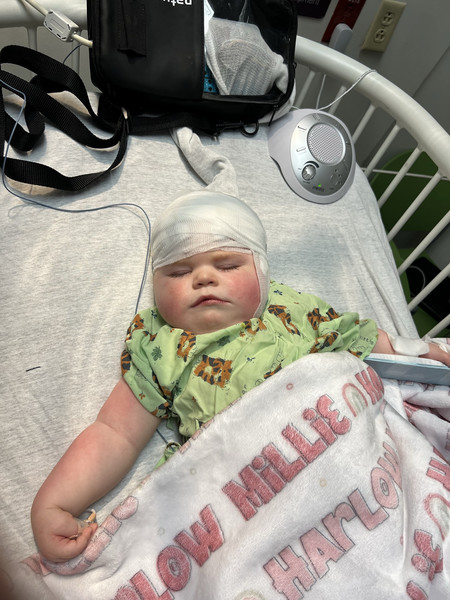
“90% [of children diagnosed with PDCD] pass by their fourth birthday. So every day we get with Harlow is a gift.”
Kim told First Coast News that Harlow has made some progress using DCA as part of the clinical trial. Kim told the outlet that Harlow now has energy, she has a sharp mind, and is now able to play with toys.
‘I remember her first birthday, we told people don’t buy toys because she doesn’t play with toys. Now she has a room full of toys–everything is her playground,” Kim said.

Kim told us they went to the University of Florida in Gainesville, where the researcher was based out of.
“He’s been studying this drug [DCA] for either 12 or 15 years. And I think this is the second or the third clinical trial they’ve done. And Harlow was the last, I think there was a total of 32 patients in this one, and she was either 31 or 32,” Kim said. “So we immediately said we were interested, and we drove down to Gainesville and got her enrolled when she was 10 months old.
“It was a double-blind trial, which means at some point she got the drug and at some point she didn’t. So it was a total of eight months; four months on it, four months she wasn’t,” Kim continued. “We still don’t know at what point was which during the trial period, but once the trial was up, she was able to go on the open label of the medicine because we completed the trial. So she’s been on it now since April of 2023, I think it is.”
Kim then told us the family has reached a roadblock because DCA has been with the FDA for approval, and the process was actually fast-tracked. However, in September, they received a so-called complete response letter, which is not a denial; instead, it asks the pharmaceutical company, Saol Therapeutics, to provide additional information on the drug.
“I mean, most of these drug companies that represent rare disease drugs, they’re not your Pfizer, it’s not your Johnson & Johnson, you know, the billion-dollar companies. So they don’t have the funds to put up for, you know, another clinical trial, nor do we have the time, nor do we have the patient population,” Kim said.
What Kim told LET next was a complete surprise. We asked her if this disorder is pretty prevalent or is it extremely rare.
“So, crazy enough, though, it is more common than ALS (amyotrophic lateral sclerosis, or Lou Gehrig’s Disease). I always tell people that the reason [for lack of awareness] is because it’s pediatric. I mean, it mostly affects children. And the mortality rate is…they say 90% will pass before their first birthday. So these kids don’t get a chance to become famous where people hear about the disease they face.
“I think it’s one in 40,000 live births contract this disease. And like I said, it's more common than ALS. It’s not the smallest patient population…I mean, there’s some out there in the same boat as us, and there’s about 12 patients.”
The disease, however, is not limited to children. Kim said PDCD presents differently for everyone, saying it is “very much on a spectrum.” Sadly, Harlow has the more aggressive form of it.
PCDC also appears to be passed on by mothers to their children, because it’s on the X chromosome. Kim related a story about a mother who is on the board of their nonprofit, who has had health problems her entire life. She was tested and found to have the affliction.
“We also have a Facebook group for patients or parents and caregivers, and a handful of adults that came through lately have tested for it, while some can be a carrier for it,” Kim said.
Rick said it is possible that children who die from SIDS (Sudden Infant Death Syndrome) could actually have PCDC.
“[B]eing from law enforcement, you would go to a scene and a kid would die of SIDS; yeah SIDS is just a general catch…you know we don’t know how the child died, so if they went to a medical examiner and they were tested, they may have said, ‘Oh, they had lactic acidosis which killed them” and wouldn’t tie that into the possibility that they had PCDC.
“So what we’ve realized is that, because it took us…When I say it took nine months of testing, the worst part about it was that we were killing our child without even knowing it. We were giving her carbohydrates, unbeknownst to us that was the disorder,” Rick said. “We thought she had colic really bad, and came to find out it was not. The thing with this disorder is it’s a very underreported disorder because the morbidity rate and mortality rate is so high in females and children that you don’t know.

“But the key is so Harlow’s on a ketogenic diet, and that’s the only thing that can treat the disease,” Rick said.
“Other than the drug,” Kim added.
“So, the earlier, and I mean, the earlier these kids can get on keto, the better,” Rick added.
“The awareness of this disorder needs to be out there because the sooner it can be diagnosed, the better the outcomes may be,” Rick continued.
Law Enforcement Today asked about a nonprofit the Higbees are involved with. Kim said she is on the board of the nonprofit Hope for PCDC Foundation, a 501(c)(3) formed in November 2022.
“Rick and I have a fundraiser every year here in Jacksonville, a clay shoot,” Kim said, that’s heavily supported by the Sheriff’s office and the fraternal order of police. Our family has probably contributed over $100,000 to the foundation, but as a whole over three years, we’ve raised over one million dollars.
“The ultimate goal is to go for gene replacement therapy,” she added.
“So two years ago, we traveled to Dallas, where UTSW is doing gene replacement therapy. How they started was a mice model, where they breed mice with the disorder, then they inject them with the gene replacement,” Rick said.
“The general gene replacement therapy of them taking a virus that’s not harmful to us and then injecting it with the proper genetic code to replace your bad cells, it’s unreal. You cannot say it is not God’s work.”
That is why Rick and Kim are fighting to get the drug Harlow is currently on approved by the FDA.
“That opens the door. We’ll have an FDA-approved drug, when the gene replacement therapy comes to clinical trial, in who knows how many years…we’re in year three now of our mice model…they’re still building on the efficacy of that to present to the FDA, but the way things are going, we’re holding off presenting that because we’d like this to pass first,” Kim added.
“To make this disorder a known disorder, really pushes it forward. The biggest thing with us is we don’t want to see other parents suffer and have to go through the process of knowing you were harming your child without knowing it…but to not have anyone else ultimately, far down the road, for this disorder not to be the death sentence we got from a counselor at an office,” Rick said.
Harlow has been making progress since she started on keto to the point where she can now stand in her playpen, crawling, saying mama and dada, which is, of course, late for a four-year-old; however, it is a better prognosis than her peers with the affliction.
The next battle for Kim and Rick is to fight for FDA approval for DCA, which was recently denied because data from the two clinical trials completed thus far isn’t strong enough to prove the efficacy for PCDC patients. The agency is asking for yet another clinical trial.
“Many drugs for rare diseases are supported by small companies that have limited funds. If this drug is not approved the next time we try, it’s unlikely that Saol Therapeutics will have the resources to continue providing DCA, which means that the provision of clinically grade DCA will stop–not only for the Higbee family, but also for other families currently relying on Saol’s supply,” Dr. Peter Stacpoole of the University of Florida, who led the clinical trial, told First Coast News.
Stacpoole, along with over 80 scientific and medical leaders, signed a letter urging the FDA to act urgently on DCA approval for PDCD.
“In those children who had very severe muscle weakness, the drug was statistically significantly effective in improving muscle function,’ Stacpoole said. “We found DCA was totally safe and well-tolerated by these children. There were no serious adverse events associated with the drug. And all of the children survived.”
With nowhere else to turn, Rick and Kim have turned to lawmakers to help not only Harlow but also all the children relying on this vital treatment.
“We’re asking Congress and legislators to push back on the FDA, just ask them for more flexibility. What we want as parents and caregivers is to meet with the FDA–to hear from us. Clinical trials are spreadsheets, data–black and white on paper,” Kim said. “Our kids, you know, come see them in color. Let us tell you the story of what the drug has done for them.”
While Harlow has time–for now–the Higbees are asking for the FDA to act quickly.
“We’re just asking for them to look at rare diseases differently. We can’t go back to the drawing board. We can’t have another clinical trial. We don’t have millions of dollars to come up with a whole other trial. We don’t have time. Our kids don’t have time, unfortunately.”
The Higbees have been speaking to US Rep. John Rutherford (R-FL).
“As any parent knows, when there is something wrong with your child, you would move heaven and earth to get answers and provide them with the care they need,” Rutherford said. “My office has been in contact with the Higbee family and Soal Therapeutics about the FDA’s complete response letter for dichloroacetate to treat PDCD. I look forward to working with them to promote compassion and regulatory flexibility at the FDA.”
On Sept. 18, 2023, Rep. Rutherford spoke about the Higbee’s plight from the floor of the House of Representatives. His speech can be seen here.
An online petition has also been launched asking the FDA to approve this vital treatment.
Here is a YouTube feature featuring Harlow, Rick, Kim, and Harlow’s big sister, Cassidy. The family also has a Facebook page where they share Harlow’s journey.
The following is part of an op-ed Kim recently wrote:
“For me, this isn’t about policy. It’s about Harlow. She is four years old. She loves to laugh at her big sister Cassidy, to explore, and to surprise us with her determination. She is not just a number in a regulatory filing. She is my daughter, and DCA has given her the chance to live more fully.
“The FDA’s denial doesn’t just block a drug. It takes away hope from Harlow, from us, and from every family fighting PDCD. And that is something no parent should ever have to accept. That’s why I am asking the FDA, publicly and directly, to meet with PDCD families like mine. Hear our voices. See our children. We want a seat at the table to help shape a path forward. A path that values real-world evidence, patient experience, and the unique challenges of ultra-rare diseases.”
Hopefully, Dr. Marty Makary, head of the FDA, and Robert F. Kennedy Jr., Health and Human Services Secretary, will see this and do the right thing.

Comments
2025-11-06T16:39-0500 | Comment by: Steven
This is one of the reasons to support "right to try" rules for "experimental" treatments. When faced with a condition not readily treated by proven treatments, there should be no significant barriers to using less proven treatments with full knowledge they have not received the approval of a the government. Even a 5% chance of surviving over a 0% chance is a choice the person, or in this case the parents, should be permitted to make,