
ST. PAUL, MN - A controversial piece of Minnesota’s more than half-century-old election laws has surfaced with newfound controversy following an investigative dive into election integrity by political commentator Cam Higby, where the state’s voter “vouching” practice was put to the test.
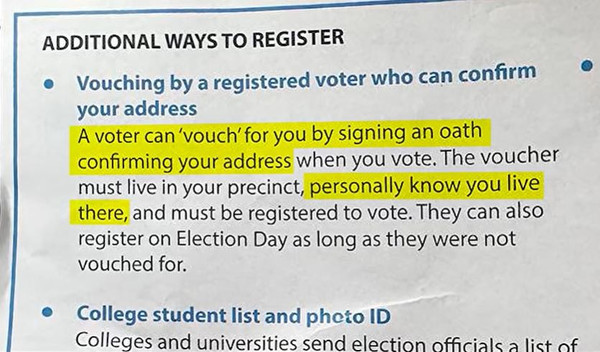
According to Minnesota’s Secretary of State website, which delves into details on registering to vote on Election Day, “proof of residence” is needed in order for would-be voters to get registered. Among the accepted examples of proof of residency, like driver’s licenses or a recent utility bill, one particular form stands out: a registered voter vouching on someone’s behalf.
“A registered voter from your precinct can go with you to the polling place to sign an oath confirming your address,” the Minnesota Secretary of State website reads, further adding, “This is known as 'vouching.' A registered voter can vouch for up to eight voters. You cannot vouch for others if someone vouched for you.”
Earlier in August, Higby, alongside investigative journalist James O'Keefe, visited a number of polling locations across Minnesota to put this specific element of voter registration to the test, resulting in renewed speculation over election integrity and condemnation from Minnesota officials who have likened the investigation to an “outrageous and totally unacceptable” stunt.
While some may be first learning of Minnesota’s voter vouching in light of the Higby exposé, the not-so-widely adopted practice, in a national sense, has been on the books since 1973. Yet, a law having been on the books for over fifty years doesn’t mean said law isn’t concerning, or at the very least ripe for exploitation. Which raises the question: Why is such a law on the books in today’s political and social climate?
On its face, it seems incredibly short-sighted to reduce proof of residency to a simple vouching system, where one malefactor can effectively mobilize eight miscreants to shoehorn illegal votes. Multiply that scenario by ten and you have a scandal; multiply it by a hundred and you risk a local election producing an illegitimate official.
It doesn’t matter whether there is or isn’t a history of documented abuse of Minnesota’s voter vouching practice either, which critics who defend the aforesaid practice would likely cite when concerns are raised, because such a vulnerability shouldn’t exist in the first place. There is no reasonable scenario where a would-be voter couldn’t produce a form of identification when registering to vote, as the threshold is already fairly meager considering something as common as a phone bill can be accepted as proof of residency.
Voting is a privilege that is already extended graciously to Americans of varying backgrounds, from the inept to the well-read and from the lower economic spectrum to the wealthy. Every vote is treated as equal. All that is being asked during these politically tumultuous times is that common-sense voter identification standards be put into place.

Comments