
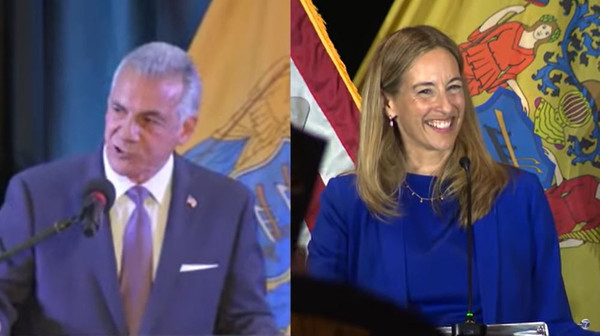
NEW JERSEY – Two candidates aspiring to become New Jersey’s next governor, one on the Republican side and the other Democrat, have somewhat delved into their positions regarding police transparency. While both candidates’ stated positions on police transparency mirror numerous states and cities standing policies, even the Democratic hopeful’s more liberal-leaning policies isn’t enough to satiate progressive stalwarts.
With current Democratic New Jersey Governor Phil Murphy wrapping up his second and final term in office, a new mayor for the state will be decided come November 4th. With as close as the race is being projected between Republican Jack Ciattarelli and Democrat Mikie Sherrill, one of the many issues on voters’ minds that could serve as a deciding factor is police transparency.
Ciattarelli’s police transparency platform is one that won’t be unfamiliar nor unwelcome with most Republican-leaning voters, taking a commonsense approach to standard methods of transparency like the use of bodycams while also trying to mitigate degrading police morale. The Republican candidate has openly opposed the concept of civilian review boards regarding allegations of police misconduct as well as saying he’ll be taking guidance from his attorney general if elected to office.
“I’m going to go by the way of my attorney general. I’m going to sit and talk with the attorney general about these things. But let me say this - we are not going to demoralize these men and women in blue,” Ciattarelli stated, adding, “They’re trained professionals. We’re going to let them do their job. I don’t know how much more transparency you can have when somebody’s wearing a bodycam.”
Meanwhile, Democrat hopeful Sherrill, who voted in favor of the George Floyd Justice in Policing Act which would upend qualified immunity, differs with Ciattarelli’s opposition to civilian review boards, saying she supports their existence so long as they don’t have any kind of subpoena powers.
Yet, despite the liberal-leaning policies on police transparency outlined in Sherrill’s plans for office if elected, progressives have expressed that her agenda doesn’t go far enough. Jason Williams, a professor at Montclair State University, is critical of Sherrill’s agenda because she hasn’t outwardly stated she’d be in favor of personnel files of officers’ alleged misconduct being publicly available.
“Mikie Sherrill…has rolled out a broad ‘transparency’ platform, but her proposals focus mainly on fiscal and budgetary disclosure rather than on police discipline or use-of-force records,” Williams noted.
Lauren Bonds, executive director of the National Police Accountability Project, is also among those critical of Sherrill’s transparency proposals, asserting that at a minimum the public should have access to things like verified and even unverified civilian complaints against police officers.
“It hurts the public by depriving them of information, by leaving them in the dark about what happened to people they care about,” Bonds stated, adding, “It takes away information they need to advocate for policy changes.”
With current Democratic New Jersey Governor Phil Murphy wrapping up his second and final term in office, a new mayor for the state will be decided come November 4th. With as close as the race is being projected between Republican Jack Ciattarelli and Democrat Mikie Sherrill, one of the many issues on voters’ minds that could serve as a deciding factor is police transparency.
Ciattarelli’s police transparency platform is one that won’t be unfamiliar nor unwelcome with most Republican-leaning voters, taking a commonsense approach to standard methods of transparency like the use of bodycams while also trying to mitigate degrading police morale. The Republican candidate has openly opposed the concept of civilian review boards regarding allegations of police misconduct as well as saying he’ll be taking guidance from his attorney general if elected to office.
“I’m going to go by the way of my attorney general. I’m going to sit and talk with the attorney general about these things. But let me say this - we are not going to demoralize these men and women in blue,” Ciattarelli stated, adding, “They’re trained professionals. We’re going to let them do their job. I don’t know how much more transparency you can have when somebody’s wearing a bodycam.”
Meanwhile, Democrat hopeful Sherrill, who voted in favor of the George Floyd Justice in Policing Act which would upend qualified immunity, differs with Ciattarelli’s opposition to civilian review boards, saying she supports their existence so long as they don’t have any kind of subpoena powers.
Yet, despite the liberal-leaning policies on police transparency outlined in Sherrill’s plans for office if elected, progressives have expressed that her agenda doesn’t go far enough. Jason Williams, a professor at Montclair State University, is critical of Sherrill’s agenda because she hasn’t outwardly stated she’d be in favor of personnel files of officers’ alleged misconduct being publicly available.
“Mikie Sherrill…has rolled out a broad ‘transparency’ platform, but her proposals focus mainly on fiscal and budgetary disclosure rather than on police discipline or use-of-force records,” Williams noted.
Lauren Bonds, executive director of the National Police Accountability Project, is also among those critical of Sherrill’s transparency proposals, asserting that at a minimum the public should have access to things like verified and even unverified civilian complaints against police officers.
“It hurts the public by depriving them of information, by leaving them in the dark about what happened to people they care about,” Bonds stated, adding, “It takes away information they need to advocate for policy changes.”
For corrections or revisions, click here.
The opinions reflected in this article are not necessarily the opinions of LET

Comments