
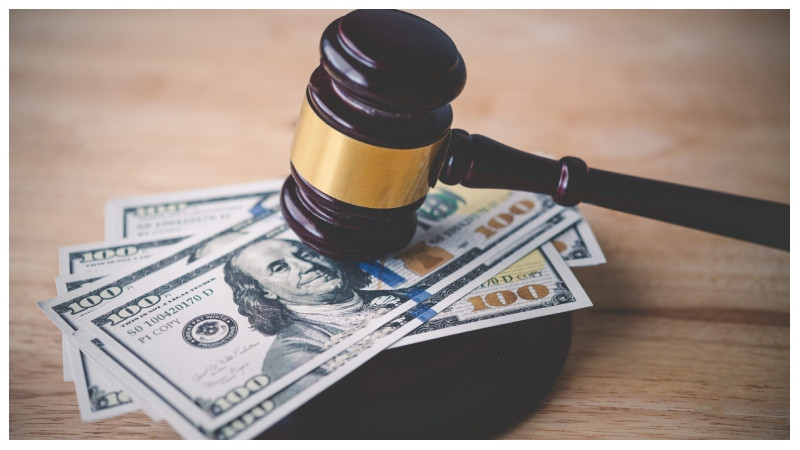
Recent Headline: New report puts outstanding Oregon criminal court sanctions at more than $1B.
This article supports National Crime Victims' Rights Week. Since 1981, National Crime Victims' Rights Week (NCVRW) has challenged the nation to confront and remove barriers to achieve justice for all victims of crime. One of those barriers is the fact that court and parole commission-ordered victim restitution is rarely enforced by states.
First, when it comes to supervising criminal offenders, understand that it's all about the money allocated to criminal justice agencies. An agency head once told me that the fastest thing in the universe is not the speed of light, it's government analysts when they discover that you have overspent your budget.
Agencies get creative when it comes to managing offender populations.
Fines, victim restitution, and court fees are designed as alternatives to incarceration or to lessen the time incarcerated. Theoretically, it holds offenders accountable while saving jail or prison beds for violent offenders. Per the Bureau of Justice Statistics, sixty-six percent of state prison male inmates are serving time for a violent crime. It's higher than that if you include criminal histories.
There are numerous strategies to lessen the fiscal burden on courts and the rest of the justice system. Prosecutors routinely choose not to charge 20 to 30 percent of criminal cases in many jurisdictions based on older data from the Bureau of Justice Statistics (BJS). In one report from the Bureau of Justice Statistics, the federal non-charge rate exceeds 50 percent for some categories of crime.
Well over 90 percent of charged criminal cases involve plea bargaining, meaning that offenders plead guilty to aggravated assault, from armed robbery to obtain a reduced sentence. Per BJS, the time served in prison had a median of 1 to 3 years. Per BJS, most convicted of felonies do not result in prison time. Bail reform causes many offenders to be released after an arrest, often returning home before victims are released from the hospital, especially for domestic violence cases.
All of this leaves out the fact that most crimes are not reported to law enforcement, and crimes solved, and arrests are at considerable lows.
Collectively, all of this indicates that we have a justice system that statistically favors criminal offenders in a multitude of ways, including not collecting their court or parole commission-ordered financial obligations.
A Justice System That's Too Harsh?
We have endless proposals from progressives insisting that the justice system is too heavy-handed, too aggressive, and endlessly harsh. They insist that even when an offender is subject to court-ordered fines, victim restitution, or other monetary obligations instead of incarceration, it's simply too burdensome for participants.
As the senior spokesperson for national and state justice organizations, I encountered countless people on parole or probation who left community supervision as "successful" completions, yet who owed money to victims or chose not to pay other ordered fines.
Throughout my career, I repeatedly encountered a concerning reality: most people on probation or parole simply did not pay their full court-ordered financial obligations.
I Can't Pay
Offenders will routinely say that they are unable to pay their financial obligations for an endless variety of reasons, and some offer legitimate concerns. But to the parole and probation agents I spoke to, many offenders stating that they cannot afford to pay their obligations have the latest smartphones, and have tested positive for costly drugs.
The issue for many is not an inability to pay, but an unwillingness, because they know the justice system will not hold them accountable.
That observation is not unique. A growing body of research—along with state audits and national data—confirms that full payment of restitution, fines, and court fees is the exception, not the rule.
The Research Is Clear: Full Payment Is Rare
Academic research has long reached the same conclusion.
A study published in the International Journal of Offender Therapy and Comparative Criminology states plainly: "Restitution to victims is rarely paid in full."
Evaluations of probation populations have also found that only a fraction of financial obligations are paid, often in the range of one-quarter to one-third of what is owed.
Even in structured restitution programs, detailed case reviews show that a majority of offenders fail to complete payment obligations.
Massive Unpaid Balances Tell the Story
If most offenders paid what they owed, states would not be carrying billions in unpaid court debt. But they are.
- Oregon reports more than $1.4 billion in outstanding criminal court debt
- A national estimate from the Fines and Fees Justice Center puts total unpaid court debt at $27.6 billion or more. Researchers note that this figure is likely a significant undercount because many states cannot fully track what is owed versus collected.
Additional State Examples: A Consistent Pattern
The problem is not isolated. Across the country, audits and reports reveal similar patterns.
California: Even Tracking Payments Is a Problem
A 2026 report from the California State Auditor found:
- The state cannot reliably determine how much court debt is owed or collected
- Responsibility is spread across multiple agencies, leading to inefficiencies
- When a system cannot measure collections, it raises serious doubts about overall compliance.
Washington State: Wide Variation, Often Low Collection
A performance audit found:
- Some courts collect high percentages
- Others collect only about half of the assessed fines
- This inconsistency suggests that full payment is not typical across jurisdictions.
Texas: Billions in Outstanding Court Debt
Texas has reported billions in unpaid fines and fees in statewide assessments of court costs and collections. As in other states, large unpaid balances persist year after year.
Pennsylvania: Low Collection Rates in Some Jurisdictions
Studies of court collections in Pennsylvania have found:
- Significant variation across counties
- In many cases, only partial payments are made, or balances remain outstanding for years.
Federal System: Some Debt Considered Uncollectible
At the federal level, the U.S. Department of Justice acknowledges that:
- Some restitution and fines are classified as not collectible. This is a formal recognition that full payment cannot be expected in many cases.
Even "Best Case" Programs Show Limits
Programs designed specifically to improve restitution collection still struggle.
Research from the Office of Justice Programs shows:
- Better monitoring increases compliance
- But larger financial obligations sharply reduce the likelihood of full payment. In other words, even when systems work well, nonpayment remains common.
Why Most Offenders Don't Pay
The reasons are consistent across decades of research:
Most people under supervision have:
- Low income
- Unstable employment
- Limited savings
Court-ordered payments can include:
- Restitution
- Fines
- Fees and surcharges
These often total thousands—or tens of thousands—of dollars.
Responsibility is often divided among:
- Courts
- Probation agencies
- Collection units
This fragmentation reduces accountability and efficiency.
Competing Financial Priorities
Offenders must also pay for:
- Housing
- Food
- Transportation
- Family obligations
Court debt competes with their ability to pay in some cases.
Conclusions
Across research, audits, and real-world experience, the conclusion is straightforward:
- Most offenders do not fully pay court-ordered fines and restitution
- Partial payment is common
- Full compliance is relatively rare.
A reasonable, evidence-based summary is this: Most jurisdictions collect only a fraction of court-ordered financial obligations, and the majority of offenders never fully satisfy their obligations.
But there's a harsh reality: There is probably not a governor in the country who wants to spend more on corrections. States are "celebrating" lower rates of recidivism, and one of the techniques states use is to ignore technical violations like not paying fines and victim restitution. Short of committing a new violent crime while on community supervision, that offender is not going to be reincarcerated or held accountable in many jurisdictions.
Does that send a message to criminal offenders that the system will not hold them accountable and they are free to continue transgressions? According to the Bureau of Justice Statistics, most offenders are rearrested, reincarcerated over time, or have technical violations that range from escape to disobeying stay-away orders to complaints from the community for threatening behavior.
All of this raises the question of whether we are being honest with the public or crime victims. The victim may feel vindicated that the judge ordered full restitution for a stolen item or damage done or medical expenses, when judges know that the victim will not be compensated.
So progressives may say that we should do away with fines or restitutions because the offender cannot pay; the burden is simply too great and hampers his reintegration into society.
But in the final analysis, we add additional harm to victims, and we mislead society because the government cannot afford to do otherwise. I have no idea as to an answer because states are fiscally capable of limited interventions. Yes, some jurisdictions send the unpaid amount to a collection agency, which will also be ignored.
As someone who spent a lifetime in the justice system, the biggest mistake government administrators can make is to run afoul of fiscal bean counters for overspending and a call from the mayor's or governor's office asking for a meeting. It's fiscally easier for agencies to declare an offender a "successful" completion and move on.
For states, removing barriers to achieve justice for all victims of crime is simply not a financial priority.
Should courts impose financial penalties that are unlikely to be paid? Does the current system create unrealistic expectations for victims? Would smaller, more realistic obligations produce better outcomes?
Until those questions are addressed, the gap between what courts order and what offenders actually pay will likely remain.

Comments
2026-04-30T16:51-0400 | Comment by: Laurence
Classic bureaucratic incompetence and inefficiency, especially in DemoSocialist states, which favor criminals. By utilizing modern computer accounting programs, the courts could keep track of every penny owed - if they wanted to.