
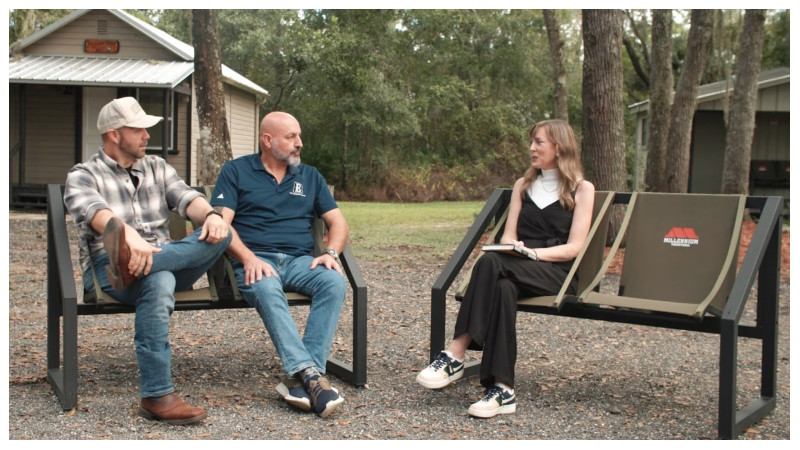
Editor note: Law Enforcement Today proudly launched a brand new channel on Pray.com - the largest faith-based app in the world. On that channel is this new series - Sheepdog and Shepherd - where we talk all about God's hand in law enforcement. It's free to watch... but subscribers get all sorts of bonus content - and every single penny donated to our channel gets fully reinvested into telling stories like this one. Thanks for checking it out and helping us to continue to show how God is on the move. Watch the latest episode here.
--
The latest episode of “Sheepdog and Shepherd” takes viewers to Brawler Creek Ranch in Florida for a conversation about faith, justice, and what it looks like to endure when the system feels stacked against you. Host Kyle Reyes and Pastor Greg are joined by Christin Slough, who describes herself as “one of the wives of the guys that were described as having committed the Blackwater massacre back in 2007.”
Slough says public perception hardened quickly after the 2007 Iraq incident, but she insists “what happened is completely, completely different than what the government made out to be over the course of, you know, 13 years until they were actually eventually pardoned by President Trump in December of 2020.” She calls the pardon outcome a matter of clarity, saying it happened “because he is a right and wrong kind of guy.”
Slough describes a life that was supposed to be ordinary. “We got married in 2004,” she says, recalling plans for graduate school, a law degree, and “a white picket fence and 2.5 kids.” Then came deployment orders right after the honeymoon. “I actually thought it was his friends playing a joke on us,” she says. “I was like, There’s no way. And yeah, yes, way.”
She explains that her husband later took a job with Blackwater, which provided diplomatic security in Iraq. “So instead of re-upping, you know, for years and years with the military, you can sign year-long contracts with Blackwater,” she says, describing a cycle of 90-day deployments and time at home.
When the 2007 incident occurred, Slough says it became entangled in politics and jurisdiction fights, leaving little room for what she believes would have been a fair process. “There was never an option to have a fair trial,” she says, “because a fair trial wasn’t what anybody was looking for.”
She points to a long legal road: “The actual incident itself happened in 2007 and they didn’t actually go to trial until 2014.” She says the case was dismissed early on, but the case continued, she says, as appeals pushed it back toward trial.
When the trial finally came, Slough says the family believed facts would win the day. Instead, she describes a courtroom experience that left her alarmed. “We went into that situation believing that, okay, it’s all right, because once we get in front of a jury, then the facts come out,” she says. “And that is just not the system that we find ourselves in.”
Pastor Greg and Reyes connect the discussion to a broader theme of moral clarity, arguing that legality, constitutionality, and ethics do not always align. Slough says her family experienced that tension firsthand, claiming the court process was shaped by politics and pressure. “He would not let them hang,” she says of the judge, describing jury deliberations that lasted “eight weeks.”
In the middle of it, Slough says her faith shifted from cultural familiarity to personal surrender. “I grew up in a Christian household, Presbyterian, you know, was baptized as a kid, but I’m not sure that I had really taken Jesus into my heart at that time,” she says. “So I really consider myself being saved at about 2009.”
She recalls the moment with striking detail: “God just met me on a hay bale in a cowboy church in Texas.”
As trial approached in 2014, Slough says she and her husband made a conscious decision about how they would endure. “I guess we just kind of have a choice here,” she remembers telling him. “And I feel like God has selected us for something extraordinary.” She contrasts two paths: “We can either go about this like we have been selected for something extraordinary, and be leaders and be part of God’s army in this,” or “we could just, like, grit our teeth and white knuckle it.”
“I don’t want to just survive,” she says. “I want to be the person that God wants us to be through this situation, because something good is going to come from it, and we don’t know when.”
That “when” became central, she says, on the day of conviction. Standing in the aftermath, she describes sobbing in the shower and confronting God with anger. “I was like, you said it would be okay,” she recalls. “And he just said, I didn’t say when.”
Slough describes the years that followed as both exhausting and deeply formative, including long drives for prison visits and raising their daughter while her husband was incarcerated. “My husband was gone from the time my daughter was one and a half to eight,” she says.
She says the only way through was God’s presence and the prayers of others. “I couldn’t even pray for myself for a while,” she admits. “It was other people’s prayers for us at that time that carried us through, because I had run out of words for myself.”
Even now, Slough says her purpose is less about relitigating the case and more about giving hope to others in their own battles. “My whole point is hope,” she says.
Her family’s phrase, she says, became a lifeline: “Just keep the faith. Keep the faith.” She says it was “our battle cry the entire time.”
This episode was brought to you by our friends at Clear Armor - a company that holds a patent and is a proven armor security solution that transforms your glass into armor.
It seems as though every day when you turn on the news, there’s a story where lives could have been saved if security measures like the ones provided by Clear Armor had been utilized. The holidays could have shone much brighter for the families of the victims killed and wounded at the Brown University shooting had there been more protection. Check them out today.

Comments