
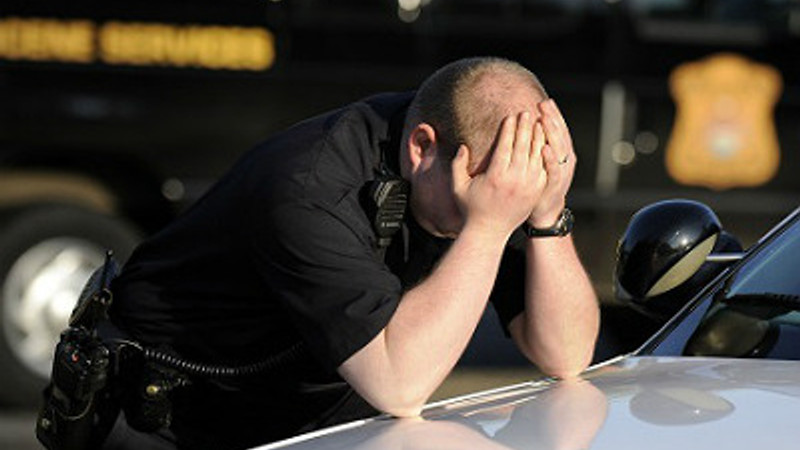
There is a level of emotional exhaustion in law enforcement that most civilians will never fully understand. It is not just stress. It is not just trauma. It is something deeper — a condition author Dr. Gad Saad calls “suicidal empathy”.
It is also the title of his new book, Suicidal Empathy: Dying to Be Kind. Saad argues that Western civilization is in decline because its elite have been hijacked by a maladaptive form of compassion. It is the dangerous collision between caring too much and being forced to survive in a system that punishes compassion, rewards politics, and treats police officers as disposable targets. By prioritizing the very forces that erode Western values (e.g., displacing biological women in sports, punishing victims to coddle violent offenders), society is effectively choosing its own demise in the name of political correctness
I spent years as a Chicago police officer in one of the toughest cities in America. I saw murder scenes before sunrise. I saw children neglected, mothers broken, fathers vacant for blocks, and neighborhoods trapped in cycles of violence that politicians discussed in press conferences but rarely walked through after dark. Over time, cynicism becomes survival equipment. You cannot witness humanity at its worst every day and remain emotionally untouched.
The public often imagines police officers as emotionally hardened robots. The truth is far more complicated. Most officers begin their careers wanting to help people. They want to protect communities, stop predators, and create order where chaos exists. But eventually many officers learn that the system itself is often working against them.
The modern police officer stands in the middle of a battlefield created by politics, media narratives, public outrage, broken courts, and departmental bureaucracy. Every decision can become a headline. Every use of force can become a political debate. Every arrest can be second-guessed by people who have never walked into a domestic disturbance at 2 a.m. wondering if they are about to die.
That constant pressure creates emotional isolation. Officers stop talking about what they see because nobody wants to hear it. Departments often preach mental health awareness publicly while privately rewarding silence and emotional suppression. Showing vulnerability can make an officer appear weak, unstable, or unreliable in a profession built on control.
This is where suicidal empathy begins.
Police officers absorb the pain of society while simultaneously becoming society’s easiest target. They carry the suicides, overdoses, abused children, gang shootings, fatal crashes, and mental health crises home with them. Yet when public frustration erupts, officers become the face blamed for decades of failed political leadership and social collapse.
Many officers begin to feel trapped between two impossible worlds. Citizens often distrust them. Politicians use them as campaign talking points. Administrators protect public image over officer morale. Meanwhile officers continue answering radio calls knowing one bad encounter could destroy their careers, finances, marriages, or freedom.
Over time, empathy becomes psychologically dangerous. Officers care deeply about victims, children, and communities, but repeated exposure to violence without meaningful societal change creates hopelessness. You begin realizing the same criminals return to the streets repeatedly. The same juveniles cycle through detention systems with little accountability. The same neighborhoods remain abandoned by leadership except during election years.
Eventually many officers stop believing the system can be fixed.
America’s juvenile court system is one of the clearest examples of institutional failure. Young violent offenders are too often treated as permanent children / victims without accountability for the damage they inflict on communities. Judges, prosecutors, and politicians frequently prioritize statistical reform over neighborhood safety. Officers arrest juveniles carrying guns, committing carjackings, robbing citizens, or participating in gang violence, only to watch them return to the streets almost immediately.
The message this sends to police is devastating: your work does not matter.
The same dysfunction exists in felony court systems across major cities. Violent repeat offenders are processed through overcrowded courts where plea bargains replace consequences and political pressure influences sentencing. Officers spend countless hours building cases, completing reports, testifying in court, and risking their lives making arrests, only to watch dangerous individuals receive reduced charges or early release.
Citizens wonder why morale in policing continues collapsing. The answer is simple: officers are repeatedly asked to fight crime inside systems that no longer consistently support accountability.
This creates a dangerous psychological contradiction. Officers are expected to maintain empathy toward everyone — victims, suspects, mentally ill individuals, addicts, gang members, angry citizens, and political critics — while receiving little empathy themselves. The emotional burden becomes cumulative. Every dead child, every suicide call, every officer funeral, every public backlash incident adds another layer of invisible weight.
Many officers become cynical not because they are cruel, but because cynicism becomes armor. It protects them from emotional collapse. Dark humor, emotional detachment, and hypervigilance are often survival mechanisms developed after years of witnessing trauma that most people cannot imagine.
Yet beneath that cynicism often exists tremendous compassion.
The public rarely sees the officer buying food for a homeless veteran, comforting a child after a shooting, talking someone out of suicide, or checking on elderly residents during winter storms. Those moments rarely trend online. Controversy sells. Humanity does not.
The tragedy is that many officers begin feeling guilty for caring at all. They internalize the belief that no matter how much sacrifice they give, society will eventually turn against them. Some lose marriages. Some lose physical health. Some self-medicate with alcohol. Some emotionally withdraw from their families. And tragically, some officers lose the battle entirely and take their own lives.
Police suicide rates continue reflecting a profession under enormous psychological strain. Officers are trained to run toward danger while suppressing fear, grief, and vulnerability. Eventually that emotional debt comes due.
America cannot continue demanding perfection from police officers while ignoring the broken institutions surrounding them. Reform cannot focus solely on criticizing law enforcement while refusing to address failed courts, weak prosecution policies, political hypocrisy, fatherless homes, gang culture, addiction, mental illness, and collapsing public trust.
Police officers are not superheroes. They are human beings carrying extraordinary psychological burdens inside deeply flawed systems.
Suicidal empathy is real. It is the exhaustion of caring in environments that often seem beyond repair. It is the silent pain of officers who still want to protect communities while increasingly questioning whether those communities, leaders, or systems truly support them in return.
Until America honestly confronts the failures within its courts, politics, and institutional culture, the emotional crisis inside law enforcement will continue growing — quietly, painfully, and too often invisibly.
---
Brian T. McVey, MAPP
Proud dad, author and former Chicago Police Officer injured in the line of duty in 2012.
Brian writes on health and wellbeing for the law enforcement community. Brian can be reached at btmcvey77@gmail.com.

Comments
2026-06-17T17:56-0400 | Comment by: Laurence
Alas, police officers have some of the highest rates of heart attacks, divorce and suicides of any professional group, because of both stress and frustration. And in addition, in some cities they have to deal with the hostility of the Socialist politicians, who should be supporting them. Look at the NYPD under Mamdani.
2026-06-17T18:34-0400 | Comment by: Matthew
In 36 years of LE, this is as succinct and on-point a read as I have ever read. It gets straight to the point and is not disputable, amongst thinking intelligent people, that is.
2026-06-17T18:39-0400 | Comment by: Larry
Everyone I know prays for our LEO's every day. We will probably never know what they suffer through.