
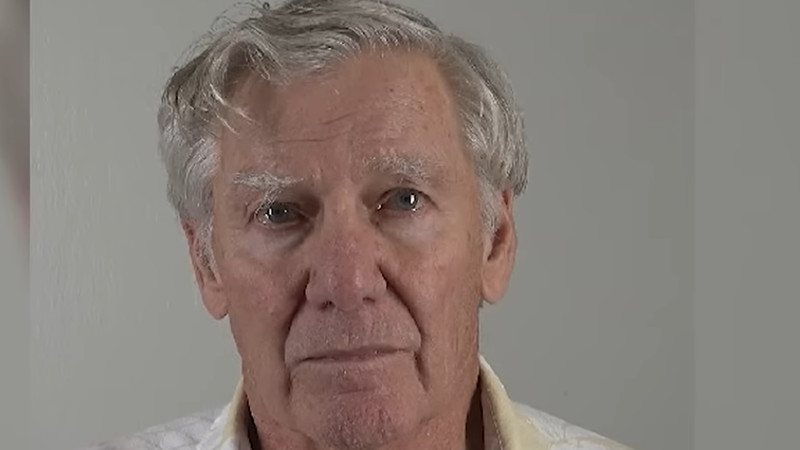
GRAPEVINE, TX - There are cold cases and then there are cold cases. It took over 45 years but police in Texas have indicted a 79-year-old man for murder in connection with the 1981 strangulation death of Braniff Airlines flight attendant Beverly Bruneau in Grapevine, Texas, after DNA evidence obtained from bloodstains found on the victim matched the suspect.
The Star-Telegram reports that Larry Dean Brown was extradited from Colorado to Texas and was booked into the Tarrant County Jail on Tuesday, court records showed.
According to an arrest warrant affidavit supporting his arrest, Brown’s wife, also a flight attendant for Braniff, was best friends with Bruneau, 35. Brown was arrested in Colorado last month and was held as a fugitive from justice pending his extradition.
“The arrest follows an extensive investigation by detectives and represents a significant development in the case,” the Grapevine Police Department said in a news release Thursday. “As part of the ongoing investigation, additional forensic testing, including confirmatory DNA analysis, is pending. Investigators are awaiting those results before releasing further details.”
The release emphasized that the Grapevine Police Department is “committed to pursuing justice for victims, regardless of how much time has passed.”
On Feb. 13, 1981, Bruneau was found dead inside her Grapevine apartment with an electrical cord wrapped around her neck and blood on her face and nightgown. According to Bruneau’s boyfriend, he left for work at the airline that morning while Bruneau was asleep. He tried calling her that afternoon, but the calls went unanswered. When he returned home from work at around 3 p.m., he found her dead. The front door was closed, but not locked.
Evidence recovered at the scene and a search of the apartment showed that Bruneau apparently tried to fight off her attacker, the arrest affidavit said.
Police interviewed Bruneau’s boyfriend on the day of the killing and learned that Brown’s wife, her best friend, also lived in Grapevine. They went to the house to try to interview her and first made contact with Brown, the affidavit stated.
Brown’s wife was away on an international flight; however, detectives spoke with Brown, who told them that his wife and Bruneau owned a home in Dallas that had been badly damaged in an arson fire in November 1980, the affidavit read.
“Detective Wilkins described Larry as evasive in his answering of questions related to Beverly and noted that Larry continually repeated himself,” the affidavit stated. “The interview was short, but most notably, detectives notated that Larry had a fresh wound to his right thumbnail where the top layer of skin had been torn/ripped off.”
An autopsy determined that Bruneau had been strangled sometime during the midmorning hours on Feb. 13, 1981.
In December 2010, as DNA testing became more advanced, detectives sent Bruneau’s blood-stained nightgown to a University of North Texas lab for additional testing. That led to an unknown male DNA profile being identified on the nightgown. The profile was uploaded to CODIS, the National Combined DNA Index System. However, no matches were initially found.
In 2025, Grapevine police Detective Johnson, who wrote the arrest warrant affidavit, took over the investigation and began reviewing evidence. He learned that Bruneau and Brown’s wife shared responsibility for a mortgage on the Dallas property that was involved in the fire and that the mortgage included credit life insurance. In other words, “in the event of either one’s death, a percentage of the loan would be paid,” the affidavit stated.
Brown, who had been a pilot and flight engineer for Braniff, had been laid off, and he became part owner of a construction company.
“Early in the investigation, it was alleged that Larry lived beyond his financial means,” Johnson wrote. He continued that after their marriage, “the couple purchased a home in Grapevine, creating financial strain and prompting them to pressure Beverly to obtain a different roommate, sell the Dallas residence, or release (Brown’s wife) from her payment obligations on the property.”
Bruneau refused those requests and, on a night when she was out of town on a flight, the Dallas home mysteriously caught fire, Johnson wrote. After firefighters extinguished the first fire, a subsequent fire was called in by Brown on the same night. Investigators determined that the second fire was also arson.
Brown began to intercede on his wife and Bruneau’s behalf with the insurance company and obtained repair estimates through the construction company of which he was part owner, all of which exceeded the insurance company’s appraisals.
Bruneau soon moved in with her boyfriend and confided to family that Brown was pressuring her to sign insurance documents with inflated repair costs, the affidavit said. After her murder, investigators learned Brown’s wife forged Bruneau’s signature on the paperwork, the affidavit stated.
Three days before she was killed, Larry Brown went to Bruneau’s apartment and a heated argument ensued about the insurance check, according to Bruneau’s mother. She also confided to her mother that she was fearful of Larry Brown.
In a May 7, 1981, interview, Brown corroborated that account and admitted going to Bruneau’s home to try to get her to sign insurance documents. Brown offered an alibi for the morning of the murder, telling investigators he was meeting with contractors at the Dallas house between 9 and 11 a.m., then went to his company’s office that afternoon.
Police questioned Brown about the thumb injury and noted that he was initially “reluctant” to answer the question but later claimed he hurt it on the job. “This did not make sense to Detective Wilkins as the wound to his thumb did not align with the claimed explanation of injury,” the affidavit stated.
While Brown initially was cooperative during the early stages of the investigation, he soon became uncooperative as police began asking him about his involvement in Bruneau’s murder. He revoked consent to further questioning and refused fingerprinting, polygraph testing, or allowing police to photograph his injuries.
After reopening the cold case earlier this year, Detective Johnson contacted the Larimer County Sheriff’s Office in Colorado and asked for assistance obtaining “a covert DNA sample from Brown.” Investigators obtained swabs from two soda bottles collected from Brown’s trash and sent them to the University of North Texas lab for testing, the affidavit stated.
On May 28, Johnson received the DNA test results from one of Brown’s soda bottles, which determined that Brown could not be excluded as the contributor of the male DNA found on the victim’s nightgown, according to the affidavit.
On June 8, Brown was arrested, and on June 29, a Tarrant County grand jury indicted him on the murder charge, according to court records.
The Tarrant County District Attorney’s Office said that Grapevine police, along with investigators from the newly formed DA’s Office Cold Case Task Force, worked in concert to solve the case.
“The determination of the Grapevine Police Department and our task force ensures that justice is never forgotten. It is our hope that this is the first, but not the last, case that the partnership of local law enforcement agencies and the DA Cold Case Task Force is successful in solving,” the DA’s Office said.
People Magazine reported that Brown’s attorney, Bryan Hoeller, has filed a motion seeking to reduce his $2 million bond. As of July 15, he had been denied bail. Brown, who turns 80 next week, has been in custody for over a month since his arrest, and he has waived extradition proceedings after he was indicted, Hoeller wrote.
Hoeller noted that Brown has no criminal record and served as a Navy pilot with over 100 combat missions in Vietnam. He has also recently been diagnosed with a debilitating disease and the Department of Veterans Affairs has approved benefits for him. Brown was a practicing attorney in Colorado from 1988 until he retired at the age of 73.
Brown was disbarred from practicing law in Colorado in 2020 after being accused of converting funds that had been held in his trust account for a client, Colorado Supreme Court records showed.
“Brown recklessly converted disputed funds that he held in his trust account for a client. He made misrepresentations to the client about the status of those funds. He then intentionally made several material misrepresentations to a bankruptcy court about the disputed funds. Later, he intentionally disobeyed the bankruptcy court’s order to turn over the disputed funds, prejudicing the administration of justice.”
Hoeller claims most of the evidence in the case is circumstantial and relies on unknown sources or statements from witnesses who are no dead and “one stain which allegedly matches Brown’s DNA.”
He also questioned why an attempt was not made earlier to match the DNA to his client, and said even if it does match, the fact that the defendant and victim spent time together could explain it.

Comments