
One of the most persistent and consequential misunderstandings in the firearms training world is the belief that fluency, skill, or capability in one discipline or area of discipline naturally carries over to all others. This assumption is appealing, but it is fundamentally flawed. Firearms training is not a single activity with interchangeable components. It is a collection of distinct disciplines, each defined by its own operational context, performance requirements, equipment specifications, legal constraints, cognitive demands, and acceptable margins of error. When these disciplines are treated as equivalent, training loses fidelity, and performance suffers where it matters most.
At the most basic level, the firearms and shooting ecosystem is composed of multiple, clearly dfferentiated disciplines. Competitive shooting, recreational marksmanship, concealed carry, uniformed law enforcement, military operations, executive protection, and specialized tactical response all represent unique domains. Each has evolved to solve diƯerent problems under different conditions. While techniques, procedures, and visual “forms” may occasionally appear similar across disciplines, these overlaps are superficial unless they are grounded in the same purpose and performance environment. Context is not a secondary consideration. It is the defining variable that gives a technique its meaning and utility.
This reality is reinforced by a well-established principle in human performance science: training adaptations are highly specific to the demands placed on the learner. Research in physiology and motor learning consistently demonstrates that the body and nervous system adapt precisely to the stresses, conditions, and constraints imposed during training, not to some generalized notion of skill development (Hawley, 2008). In practical terms, this means that what is trained is what is adapted, and what is not trained is not reliably available under diƯerent conditions. Skill does not automatically transfer simply because tasks look similar on the surface.
Within firearms instruction, this principle of training specificity has profound implications. Developing motor and psychomotor proficiency in one discipline does not equate to readiness in another. Even within a single discipline, mastery of one technique does not guarantee mastery of all related techniques, including those that are mechanically, functionally, or biomechanically similar. Variations in timing, sensory input, decision
making load, environmental stressors, and consequence structure all shape how a skill is memorized or ‘encoded’, retrieved, and subsequently executed. When these variables change, performance changes with them.
Firearms skills are not merely mechanical actions. They are the manifestation of the OODA Loop; integrating visual processing, threat assessment, decision-making, and motor execution under specific constraints. Training conducted in a low-pressure, predictable, or rule-bound environment produces adaptations optimized for those conditions. Expecting those adaptations to hold under time compression, uncertainty, or legal and moral ambiguity ignores what decades of scientific research have already made clear. The nervous system does not generalize generously. It specializes relentlessly.
For instructors, program architects, and training organizations, this demands a higher level of discipline literacy and intellectual rigor. Understanding which discipline is being trained, why a given technique exists, and what performance problem it was designed to solve is not an academic exercise. It is a professional obligation. Importing techniques across disciplines without accounting for specificity risks building competence that collapses when context shifts.
In a field where performance failures carry serious legal, moral, and human consequences, assumptions about transferability are not benign. Disciplines matter. Context matters. And training specificity is not a limitation to be worked around, but a reality that must be deliberately designed for if training is to produce durable, defensible, and real-world capability.
What follows is a concise, critical examination of each category, presented to clarify their distinctions, highlight their practical significance, and underscore their contextual limitations.
1. Target, Sport, Recreational, and Hunting
This category functions as the broadest and most commonly encountered domain within the firearms world. It is, by design and by practice, a catch-all classification that encompasses the majority of firearms activity conducted for non-defensive and non-operational purposes. This includes casual range use, informal target shooting, recreational “plinking,” organized sport shooting, and hunting activities. In most cases, the intent is enjoyment, competition, or sustenance rather than performance under threat, uncertainty, or legal jeopardy. The label is largely self-descriptive, and for many participants, the activity begins and ends here.
Formal training opportunities within this discipline typically take the form of introductory or familiarization-based programs. Common examples include entry-level courses modeled after NRA or USCCA curricula. These programs generally emphasize rudimentary marksmanship concepts such as grip, stance, sight alignment, sight picture, and basic trigger control. While these elements are foundational, instruction within this category rarely
progresses beyond surface-level exposure. More importantly, there is little in the way of standardized, objective methodology for testing, validating, or assessing even these basic motor skills. Performance evaluation is often reduced to a visual inspection of shot groupings, which provides limited insight into how, why, or under what conditions those results were achieved.
Instructional rigor within this discipline is highly inconsistent. Many individuals who present themselves as “instructors” do not pursue continuing education, skill refinement, or professional development of any meaningful kind. Firearms instruction in this space is frequently treated as a supplemental income stream rather than a professional responsibility. As a result, it is not uncommon to encounter instructors who are unable to clearly demonstrate the skills they claim to teach, let alone diagnose performance errors or explain the underlying mechanics of improvement. In these cases, training becomes transactional rather than developmental, and money spent often yields little return in actual capability. The oft-repeated phrase “those who cannot do, teach” is uncomfortable, but in this discipline it is, regrettably, more accurate than many are willing to admit.
This is not intended as a blanket condemnation of all instructors operating in the target, sport, recreational, and hunting domain. There are highly competent professionals within this space who possess a clear understanding of their scope, the limitations of their experience, and the boundaries of their credentialing. These instructors tend to be honest about what they can and cannot provide, and they often deliver excellent instruction within that defined lane. Unfortunately, they are outnumbered and frequently overshadowed by more vocal, less qualified individuals whose confidence exceeds their competence. Too often, the loudest voices in the room are precisely the ones students should avoid.
For this reason, prospective students bear a responsibility of their own. Credentials matter. Continuing education matters. Anyone seeking professional instruction should ask direct questions about an instructor’s qualifications, background, and ongoing training, and should expect verifiable proof. In a discipline with minimal external accountability and low barriers to entry, due diligence is not optional.
2. Competition
Although competitive shooting is often grouped with recreational firearms activity, doing so obscures important distinctions that matter from both a training and performance perspective. While competition is recreational in the sense that it is voluntary and sport based, it is far more accurate, and far more useful, to recognize competitive shooting as its own discrete discipline. Competitive shooting is not simply “range time with a timer.” It is a
specialized performance environment governed by rules, scoring systems, equipment allowances, and highly structured task demands that fundamentally shape how skills are developed and expressed.
The term competition shooting encompasses a wide range of highly specialized activities, each with its own technical standards and performance priorities. Most competitive formats emphasize the optimization of speed combined with accuracy and precision, often under time pressure initiated by a predetermined auditory stimulus such as a buzzer, whistle, or verbal command. Many events also incorporate reloading sequences and stoppage
clearance drills that are executed as rehearsed, closed-loop motor programs. These sequences are trained to the point of automaticity, with success measured by consistency and eƯiciency rather than adaptability.
Importantly, competition environments are deliberately engineered to be predictable and controlled. Courses of fire are pre-walked, target arrays are known in advance, and rule sets clearly define allowable actions and prohibited behaviors. Safety is, appropriately, the foremost priority, and this emphasis further constrains the performance environment. As a result, there is little opportunity, and often no requirement, for tactically based, recognition
primed, adaptive decision-making. The shooter’s task is not to interpret an evolving threat landscape, but to execute a pre-planned solution as eƯiciently as possible within the rules.
This distinction matters because competitive performance does not meaningfully correlate with real-world defensive or gunfighting performance metrics. Speed on a known course, against known targets, under known conditions, does not predict decision-making quality, threat discrimination, or behavioral response under uncertainty. Competitive excellence reflects mastery of the competition environment, not preparedness for interpersonal violence. Conflating the two is a categorical error.
Equipment further reinforces this separation. Depending on the discipline, competitors frequently employ pistols, revolvers, rifles, and shotguns that are extensively modified to maximize performance within the ruleset. These modifications may include enhanced triggers, optics, compensators, extended magazines, specialized holsters, and other mechanical or structural alterations designed to reduce recoil, increase speed, or improve accuracy. While entirely appropriate and legitimate within competition, such firearms are often impractical for personal defense and would be prohibited for professional duty use. Law enforcement and security agencies typically mandate standardized, policy-compliant equipment to ensure consistency, safety, and legal defensibility, not competitive advantage.
None of this is a criticism of competitive shooting or of those who participate in it. Competition develops exceptional technical skill, visual processing speed, and mechanical efficiency within its defined parameters. The problem arises only when competitive skills are misrepresented as universally transferable, or when competition success is treated as a proxy for defensive or operational competence. Each discipline solves a different problem. Competitive shooting solves the problem of performing maximally within a known, rule bound system. That is a legitimate and demanding skill set, but it is not the same problem set faced in defensive or professional use-of-force contexts.
Examples of competitive shooting disciplines include, but are not limited to, trap, skeet, and sporting clays; cowboy action and bullseye pistol and revolver shooting; Steel Challenge Shooting Association (SCSA); the United States Practical Shooting Association (USPSA); and the International Defensive Pistol Association (IDPA). Each represents a distinct competitive ecosystem with its own norms and performance incentives. Understanding those incentives, and the adaptations they produce, is essential to placing competition in its proper context within the broader firearms training landscape.
3. Combat (Military)
This category encompasses members of the United States armed forces, including Active Duty, Reserve, and National Guard components. Military firearms training exists within a fundamentally different operational and legal framework than any civilian or recreational discipline. Service members are trained under the premise that, at some point during their careers, they may be required to engage in armed conflict, conduct security operations, or operate in unstable environments both abroad and domestically. These missions can range from conventional warfare and counterinsurgency to force protection, peacekeeping, humanitarian assistance, and domestic support during critical incidents or large-scale emergencies.
A defining characteristic of this discipline is the variability of context. Military personnel frequently operate outside U.S. borders under rules of engagement that differ significantly from domestic legal standards governing civilian or law enforcement use of force. These rules are mission-dependent, politically constrained, and subject to rapid change. Accordingly, military firearms training is structured to meet broad institutional readiness requirements rather than to cultivate individualized mastery across a wide range of weapons, environments, and tactical problem sets.
From a training and learning perspective, it is critical to understand how limited and uneven firearms exposure actually is for most service members. Initial entry training typically provides basic familiarization with a small number of standardized weapons systems, followed by qualification against relatively low minimum performance thresholds. These standards establish baseline competency rather than durable proficiency or mastery. Research examining training, performance, and learning in large institutional systems consistently demonstrates that skills acquired during academy or initial training phases degrade rapidly without deliberate reinforcement and ongoing practice (O’Neill et al., 2018). When firearms skills are revisited infrequently, both motor performance and cognitive recall decline in predictable ways.
This degradation is not a reflection of individual motivation or professionalism. It is a direct consequence of how human learning functions. Skills that are not consolidated through repeated, contextually relevant practice are highly susceptible to decay, particularly when months or years separate training exposures. In large organizations with competing mission demands, firearms training is often episodic rather than continuous. As a result, many service members retain only a generalized familiarity with weapons systems long after initial qualification.
Compounding this reality is the occupational structure of the modern military. The majority of service members transition into occupational specialties that do not require the routine carrying or operational use of firearms. These roles include logistical, technical, administrative, medical, intelligence, and support functions. Only a relatively small subset of personnel serve in what are commonly classified as combat arms roles. Widely accepted estimates place this group at approximately ten percent of total military personnel, meaning that the vast majority of service members will never engage in direct combat or employ firearms operationally in real-world engagements (Bledsoe, 2023).
It is essential to explicitly exclude elite, top-tier military units from this general characterization. Special mission units and special operations forces such as Delta, Navy SEALs, MARSOC, and comparable organizations operate under fundamentally diƯerent selection, training, and sustainment models. These units undergo rigorous screening, continuous high-frequency training, and mission-driven performance validation that bears little resemblance to conventional force training pipelines. Firearms proficiency within these organizations is not episodic or qualification-based, but continuously reinforced, contextually varied, and directly tied to operational outcomes. As such, they represent statistical and methodological outliers and should not be used as representative examples when discussing “military training” in the aggregate.
Understanding these distinctions is critical. Exposure to military firearms training, in and of itself, does not imply frequent use, high proficiency, or real-world combat experience. Qualification does not equal readiness, and familiarity does not equal mastery. Military firearms instruction is designed to support force-wide readiness across diverse mission requirements, not to produce universal gunfighters. Any attempt to generalize military
firearms training outcomes without accounting for occupational role, training frequency, and unit type risks serious misunderstanding of both the training and the capabilities it produces.
4. Duty (Law Enforcement and Private / Contract Security)
The duty, or professional gun carrier, category encompasses individuals who are required, as a routine and inherent function of their occupation, to carry firearms. This requirement alone, however, should not be mistaken for evidence of advanced firearms proficiency or high-level decision-making capability. Carrying a weapon for professional purposes does not equate to expertise in its manipulation, nor does it guarantee competence in the complex, non-linear decision-making demanded during rapidly evolving use-of-deadly-force encounters.
This category includes, but is not limited to, federal, state, and local law enforcement oƯicers; corrections oƯicers; constables; court officers and bailiffs; armed security officers; armored car personnel; private investigators; and, in some jurisdictions, bail enforcement officers. While the specific duties and legal authorities vary across these roles, they share a common expectation: the lawful use of firearms to stop imminent threats of death or serious bodily harm, prevent the commission of forcible felonies, and, in the case of sworn law enforcement, eƯect arrests or prevent escape from lawful custody.
Despite the gravity of these responsibilities, the structure of firearms training within this discipline mirrors many of the same limitations observed in the military context. Initial training typically consists of brief familiarization with a small number of standardized weapons platforms, followed by qualification against minimum adequacy standards that are largely disconnected from real-world performance demands. In most jurisdictions, these standards involve static, pre-scripted courses of fire executed in highly controlled environments, initiated by a predictable auditory stimulus such as a buzzer or verbal command. Safety is optimized and appropriately prioritized, but this emphasis further constrains variability, uncertainty, and decision-making complexity.
Research examining police academy training and learning outcomes has demonstrated that qualification-based firearms training is a poor predictor of real-world performance and decision-making under stress (O’Neill et al., 2018). Qualification courses measure compliance with a narrow standard under ideal conditions. They do not meaningfully assess perception, threat discrimination, judgment under ambiguity, or performance degradation under cognitive and physiological stress. Once minimum standards are met, training exposure often drops sharply, and without structured reinforcement, associated motor skills and declarative knowledge predictably degrade over time.
This degradation is not anecdotal. Human performance research has long established that both motor skills and infrequently accessed semantic memory deteriorate when training is episodic and lacks contextual reinforcement. Skills that are learned to pass a test, rather than memorized or ‘consolidated’ through repeated and variable practice, are particularly vulnerable to decay. In professional gun-carrying populations, months or even years may pass between meaningful firearms training exposures, all but guaranteeing skill atrophy (O’Neill et al., 2018).
The scale of this issue becomes even more concerning when viewed through the lens of training hours and allocation. In some states, the total training required to become a certified law enforcement officer is remarkably limited. Georgia’s Peace Officer Standards and Training Council, for example, mandates a basic law enforcement training course totaling approximately 408 hours, encompassing all aspects of academy instruction, not just firearms (Georgia POST Council, 12th ed.). Of those hours, firearms training may account for as little as forty hours, roughly one week of instruction. By comparison, a retail corporation such as PetSmart® requires approximately 800 hours of training for its pet grooming staff, a role that, while demanding, does not carry life-and-death legal consequences (PetSmart® Grooming Process).
The disparity is difficult to ignore. Professionals entrusted with the lawful application of lethal force often receive less structured training than individuals tasked with grooming household pets. This is not an indictment of pet groomers or their respective industry. It is an indictment of misplaced institutional priorities.
Conditions within the private and contract security sector are frequently even more permissive. In many states, armed security oƯicers, armored car drivers, and bodyguards may operate with minimal licensure requirements. Some jurisdictions mandate little or no formal firearms training, while others require annual requalification measured in mere hours. In certain cases, no live-fire proficiency testing is required at all.
From a performance and risk-management standpoint, this reality should be deeply unsettling. Qualification scores, particularly those set at minimum passing thresholds such as seventy-five percent, do not reflect operational readiness. Passing a test does not equate to the ability to perform under stress, uncertainty, or moral and legal ambiguity. In practice, many individuals working in these roles struggle to meet even baseline performance expectations when evaluated outside of a scripted qualification environment.
The implications are unavoidable. The duty category carries extraordinary legal authority and moral responsibility, yet is supported by training models that emphasize minimum compliance rather than durable capability. Without acknowledging these limitations, and without reforming how firearms skills and decision-making are developed and sustained, the gap between expectation and performance will persist. In a profession where errors are measured in lives, that gap is not merely academic. It is consequential.
5. Self-Defense and Home Defense
The final category encompasses the ownership, carrying, and potential use of firearms for personal protection and the defense of one’s home. This discipline occupies a uniquely complex and consequential space. Unlike recreational or competitive shooting, and unlike institutional military or law enforcement contexts, self-defense and home defense place the individual citizen at the center of the legal, moral, and tactical decision-making process. There is no organizational buffer, no qualified immunity, and no institutional legal defense apparatus. The armed citizen alone bears the consequences of every decision made before, during, and after a use-of-force event.
As it relates to training in tactics, techniques, and methodologies for the lawful use of deadly force, the current state of the civilian firearms training marketplace is deeply uneven and, in many cases, profoundly problematic. Over the past several years, there has been a marked increase in instructors oƯering courses marketed as “tactical training,” “residential clearing,” “defensive shooting,” “active shooter response,” and “church security,” frequently under the banner of entry-level NRA or USCCA instructor credentials. In other cases, observed firsthand by the author, such instruction has been offered with no identifiable instructor credentialing at all, relying instead on unverified claims of prior military experience as a substitute for instructional qualification.
The marketing language in these programs is uniformly confident. The implied expertise is expansive. The actual depth of competence, however, routinely fails to justify either.
During a recent conversation with an instructor candidate of mine, whom I will refer to as “Alex,” another concern was articulated succinctly and accurately.
Alex’s observation closely mirrors what I have seen repeatedly across the country and exposes a deeper structural problem: a concept I like to call ‘instructional inbreeding’. Credentials originally designed to certify safe range operation and basic instructional competence are increasingly treated as blanket authorizations to teach far beyond their intended scope. Entry-level instructor certifications are leveraged to justify instruction in high-risk, high-liability subject matter that demands far more than surface familiarity or inherited technique. Within this closed-loop ecosystem, instructors are often produced by the same instructional lineage that trained them, replicating methods, language, and drills without meaningful scrutiny or external validation.
In this environment, repetition is routinely mistaken for rigor, and lineage is substituted for legitimacy. Techniques persist not because they have been examined, tested, and shown to be effective within a given context, but because “that’s how it’s always been done” or because they originate from a respected name within the circle. Confidence grows through reinforcement and familiarity, while accountability steadily erodes. The absence of challenge, cross-disciplinary input, or empirical examination allows weak assumptions to calcify into doctrine.
The result is a training culture that is dense with activity yet remarkably thin on critical evaluation. Many instructors are surrounded by drills, techniques, and inherited practices, but lack a coherent framework for understanding why those methods exist, what specific problems they were designed to solve, or whether they remain appropriate outside the narrow contexts in which they were first encountered. In a discipline where errors carry legal, moral, and potentially irreversible human consequences, this kind of recursive, inbred, second-hand instruction is not merely ineƯicient. It is dangerous.
Properly dissecting this discipline would require far more space than is available here. The intersection of civilian defensive training, legal standards, human performance under stress, and instructional accountability deserves a dedicated examination, and I will address it in
detail in a future article. For present purposes, it is sufficient to state that the gap between what is being marketed and what is being responsibly taught is often substantial.
As with other disciplines discussed previously, this is not a blanket indictment of all instructors operating in the self-defense and home defense space. There are outstanding professionals working in this domain who understand the limits of their experience, the boundaries of their credentialing, and the seriousness of the material they teach. These instructors tend to be disciplined, conservative in their claims, and committed to ongoing education. Unfortunately, they are often overshadowed by louder, more confident voices whose qualifications do not withstand scrutiny.
That reality places a burden on the consumer. Anyone seeking training for personal or home defense should demand transparency. Ask to see credentials. Ask about continuing education. Ask what disciplines the instructor has actually trained in, and under what standards. In a field with low barriers to entry and minimal external oversight, skepticism is not cynicism. It is prudence.
Compounding the complexity of this discipline is the legal environment in which armed citizens operate. Firearms law, self-defense law, and use-of-force standards vary dramatically from state to state. Some jurisdictions are permissive and clearly favor the rights of responsible, law-abiding citizens. Others are restrictive, ambiguous, and unforgiving. There is no universal standard, and assumptions are dangerous. It is absolutely critical that individuals seek accurate, current legal education specific to their jurisdiction. A reliable starting point for this research is handgunlaw.us, which provides regularly updated summaries of state laws regarding concealed carry, duty to inform, prohibited locations, and general use-of-force doctrines such as stand-your-ground and castle doctrine. This information is not a substitute for competent legal counsel, but it is an essential baseline.
When it comes to the nuances of self-defense law, however, caution is paramount. Legal advice should not be sourced from a generic firearms instructor, a concealed carry course at a local range, a martial arts instructor, or a well-meaning acquaintance in law enforcement. Unless an individual is directly involved in high-liability training, use-of-force investigation, or legal analysis of firearms-related incidents, and is conversant not only with statutory law but also with relevant case law and judicial precedent, they are not a subject matter expert. Well-intentioned opinions oƯered outside that scope are more likely to mislead than to protect.
It is also important to state, clearly and without ambiguity, that I do not advocate for unnecessary bureaucratic barriers to the lawful exercise of Second Amendment rights. I support constitutional carry and reside in a state that has codified it. For those who do not,
the options are limited to either relocating to one of the states that recognize constitutional carry or complying with the licensing regimes imposed by the remainder. Regardless of one’s position on this issue, a non-negotiable obligation remains. Armed citizens owe it to themselves and to the public spaces they share to pursue the highest quality training available, to understand the legal boundaries governing any use of force, to rigorously adhere to safe gun-handling practices, and to serve as models of lawful, disciplined firearms ownership.
In this discipline, perhaps more than any other, the margin for error is vanishingly small. Competence is not optional, and ignorance is not a defense.
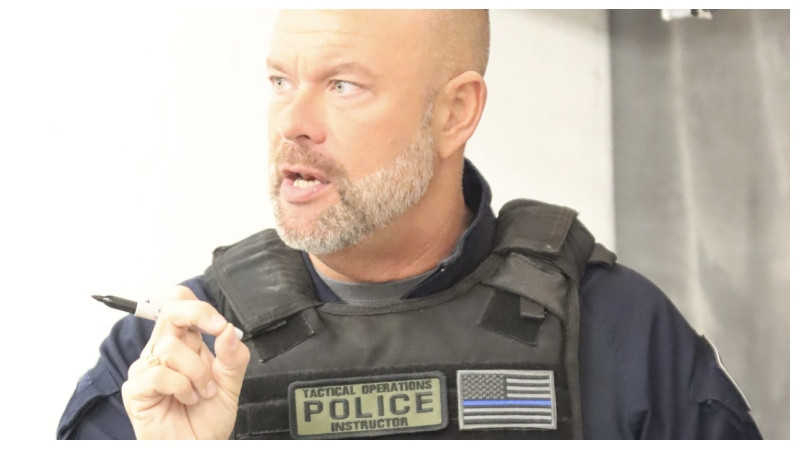
Guest writer K. Alan Hanson is a small arms master trainer, active attack response and tactical counterterrorism instructor, and high-liability training curriculum developer with more than two decades of experience training law enforcement, select military units, professional security contractors, and responsible armed citizens.
A lead instructor and program architect of the NeuralTac™ training system, his work integrates operational expertise with modern learning science to bridge the gap between traditional firearms instruction and real-world human performance under pressure.
References and Additional Reading
1. Hawley, J. A. (2008). Specificity of training adaptation: time for a rethink? The Journal of Physiology, 586(1), 1–2. https://doi.org/10.1113/jphysiol.2007.147397 2. NIJ Standard-0112.03: Autoloading Pistols for Police Officers, Revision A. https://www.ojp.gov/pdfiles1/nij/249929.pdf
3. O’Neill, J., O’Neill, D. A., Weed, K., Hartman, M. E., Spence, W., & Lewinski, W. J. (2018, December 18). Police Academy Training, Performance, and Learning. Behavior Analysis in Practice. https://doi.org/10.1007/s40617-018-00317-2
4. Bledsoe, E. (2023). Answering: What Percentage of The Military Sees Combat? The Soldiers Project. https://www.thesoldiersproject.org/what-percentage-of-the military-sees-combat/
5. Georgia Peace Officer Standards and Training Council 408 Hour Basic Law Enforcement Training Course, 12th edition
6. https://services.petsmart.com/content/grooming-process
Comments