
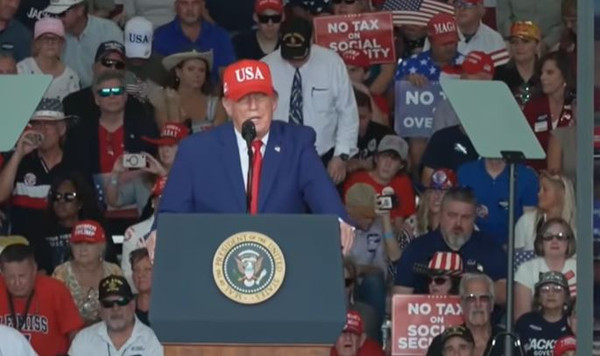
NEW YORK CITY, NY – The Trump administration was dealt another blow in their legal fight against sanctuary policies and laws earlier in October after a Biden-appointed district judge shot down the administration’s lawsuit aimed at New York City’s sanctuary laws, finding the Trump administration lacked “standing” in the endeavor.
Since the onset of President Donald Trump’s second term in office, the Justice Department under his administration has been embroiled in numerous legal battles targeting sanctuary cities and jurisdictions, with the legal outcomes largely not favoring the administration since the effort was launched.
U.S. District Judge Ramón E. Reyes Jr., who was appointed by former President Joe Biden in November of 2023, serves as the latest judge to issue a ruling in conflict with the federal government’s interests to address and upend some of these sanctuary policies and laws, specifically regarding the Justice Department’s lawsuit against New York City that was launched in July of 2025.
According to the Justice Department’s original complaint, New York City’s adopted sanctuary policies and laws effectively hindered federal authorities from carrying out their duties by way of restricting local law enforcement’s ability to meaningfully cooperate with immigration authorities.
In Judge Reyes Jr. ruling issued earlier in October, he noted that even if the court were to side with the federal government regarding their complaint pertaining to policies and laws adopted in New York City, it wouldn’t address the broader laws passed within the state.
Furthermore, Judge Reyes Jr. ruled that the Justice Department’s claims of “preemption” were unfounded, citing both the inability to command the actions of “private actors” as well as the 10th Amendment’s anti-commandeering doctrine.
“Even if the United States has standing - and it does not - its preemption claims fail. All of the United States’ preemption claims - express, conflict and field - fail because the relevant federal statutes do not regulate private actors,” Judge Reyes Jr. noted in his decision.
With respect to the 10th Amendment, Judge Reyes Jr. wrote, “If states cannot remain free to control their agencies and employees to resist federal immigration enforcement, which is within states’ constitutional prerogatives, the Tenth Amendment anticommandeering doctrine means nothing.”
Former federal prosecutor Abhishek Kambli, who currently works as a partner at Holtzman Vogel, spoke with Fox News regarding the judge’s ruling, taking issue with both the lack of standing claim as well as the interpretation of the 10th Amendment.
“The sovereign harm is done just by the fact that New York City has the law (on) the books, no matter what other factors prevent practical application of the United States's position,” Kambli said of the judge’s mentioning of New York State having superseding laws that mirror New York City’s.
“Really what the 10th Amendment anti-commandeering means is you can't force states to go from doing nothing to affirmatively assisting,” Kambli stated, adding, “What these statutes are doing is basically preventing states from actively obstructing federal immigration enforcement. That's different from the federal government saying a state or a city is required to actively assist ICE in operations.”

Comments