
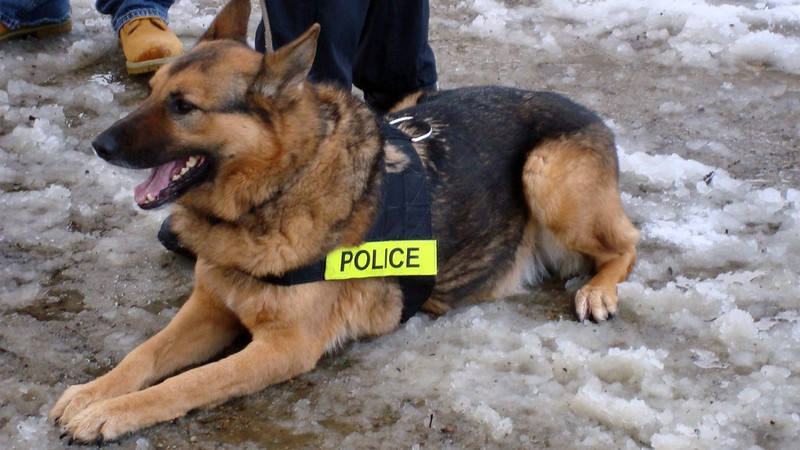
By N.C. Jacobs
The line went tight and stayed tight. Three in the morning, wet grass, cold enough that the radio battery had started to complain. The driver had bailed out of a car maybe fifteen minutes before we rolled up, and the last anybody saw of him he was running down the road toward the only lit intersection for a mile. That was the smart play. Roads mean cars. Cars mean a ride out.
Enzo didn't care about the smart play. He hit the start, cast once left, once right, and drove straight off the shoulder into a tree line nobody had mentioned. Head down. Breathing in those long pulls I can hear from ten feet back. The lead humming in my hand. He was on it, and everything in my head said he was wrong. The road was right there.
The Fork
I've stood at that spot more times than I'd like to admit. The dog says one thing. Your gut says another. And your gut has help. The perimeter officer who swears the guy went toward the apartments. The sergeant on the radio asking for an update you don't have. A print in the mud, a fence that looks climbed, pointing one way while the dog pulls the other. And you've been up since yesterday afternoon.
Reading the dog and second-guessing the dog feel almost the same from the inside. Reading him is asking what he's doing. Is his nose down, is he committed, is his body telling me he has odor. Second-guessing him is asking what I'd do if I were the suspect. I can answer the first one. The second is a guess about a man who already made a choice I wouldn't have, starting with running.
That night I fed him line and shut up. It's harder than it sounds.
What the Nose Is Doing
Patrol asks me sometimes how he knows. Nobody fully does, but a few pieces are solid. A dog carries up to 300 million scent receptors against roughly 5 or 6 million in us, and his two nostrils pull separate samples of air, which is probably part of how he tells which side the odor is stronger on. In one small study, dogs could tell which direction a person had walked after five footsteps. When the researchers kept the ground disturbance but removed the person's scent, the dogs lost the direction. He isn't reading the ground. He's reading the person.
That's the version I give a rookie on the perimeter. Five steps and he knows which way they went. You and I would need a trail camera.
I've watched Enzo take a corner in a dark parking lot with nothing to see, no scuff, no dropped glove, and hold it like somebody had painted the line. I used to want to call him off those. I don't anymore.
What it Costs to Overrule Him
I have pulled him off. Early on, I took him off a track because the sign said one thing and he said another, and I believed the sign. We walked the way I wanted and found nothing. I went back to where I'd pulled him, put him back on, and he took me down the line he'd wanted in the first place, to a spot where somebody had sat in the dark and waited us out. By then he was gone. That one cost a suspect, an hour of five officers' time, and a quiet drive home.
A study this year put the same moment in print. A Malinois tracking poachers in a Malaysian jungle reached a split in the trail. The visible sign went left. The dog kept pulling right. The team went left and came up empty, and the authors wrote that overruling the dog may have been a missed chance. Nobody ever checked the right-hand path.
Pull a dog off odor he's committed to enough times and he learns the odor isn't what gets him paid. You are. He starts checking back with you at every turn, and a dog checking back isn't tracking.
Enzo has been wrong. A track that ends on a road isn't wrong, that's where the guy got picked up. Wrong is committing to odor that isn't there. When it happens I don't argue with him in the field. I go find out why in training, and most times it was me. My line pressure, my pace, where my feet were pointed before his nose was.
Built Long Before the Call
Enzo was a bad tracker when I got him. In handler school our master trainer watched him flail through a few and said, carefully, that he might not be a tracking dog. He wasn't being cruel, and I was close to agreeing. What we did instead was treat it like a problem. Different starts, different line handling, different ways of paying him at the end, and we kept whatever he answered to. More reps on easy ground had done nothing. Harder ground did. Asphalt instead of grass. Wind from the wrong direction. Tracks aged for hours. Tracks somebody else laid so I didn't know the route either. Night work, because that's when the calls come.
The track I think of as the turn was a half mile across a wet parking lot into a field, two hours old, laid by another handler. A month earlier he'd have quit it at the curb. He took the pavement with his nose an inch off it, lost it where the asphalt ended, cast twice, picked it up in the grass and ran it to the man like he was on rails.
I used the e-collar in that stretch, but not to teach tracking. You can't. The nose does the teaching. Where it earned its place was as a gas pedal on a dog who already knew the work and was coasting through it. One rep looked like this. He's on a track he's run before, nose up, drifting. Not lost, just loafing. Low tap, the level he barely notices, with the same word I use when he's working well. His head drops, he drives in, and the tap is gone before he's taken two steps. A few of those and the word alone did it. I haven't needed the collar on a track in a long time.
Certification is the floor. Enzo and I are certified as a trailing team through the International Police Work Dog Association. Under IPWDA's standard that's a trail an hour old and at least a mile and a half, with the dog and me kept out of sight until it starts, at least five hundred feet of pavement, two fresh human trails crossing it, three turns and a suspect waiting at the end. Lose it and you get five minutes to pick it back up. A master trainer who isn't me decides whether we passed, and it's good for two years. The rest of the time is the sixteen hours a month the working-dog guidelines call for as a minimum, plus a full unit day every other week with a master trainer. I've watched him work through confusion a few hundred times with nothing riding on it. So when there's a felon on the other end of the track, I can hold the line and keep my mouth shut.
When the Handler Is the Problem
The hardest part of trusting the dog is admitting how much of what he does comes from me. Researchers at UC Davis ran eighteen detection teams through rooms with no drugs and no explosives in them at all. Every handler was told any room might hold odor. The teams called 225 alerts anyway, every one of them wrong, and the alerts piled up wherever the handlers had been led to believe the odor was. Those were detection teams, not trailing teams. I don't think that lets me off. If I think the guy went left, I lean left, and the dog feels it in the line.
So I guard against it. Blind tracks. Blank searches where the right answer is nothing. And records. In Florida v. Harris, a unanimous Supreme Court said training and certification records are the better measure of a dog's reliability, and that a handler cueing the dog, "consciously or not," is a fair line of attack. I'd rather hand over a stack of records that show I checked myself than be asked under oath whether I did.
Back to the Track
Enzo took us through forty yards of briars, across a drainage cut, and up the back side of a storage lot I didn't know was there. The suspect was under a trailer, soaked through, waiting for us to give up on the road the way I'd wanted to.
If you're on the perimeter, hold your spot and let the dog finish. Don't tell the handler where you think the guy went unless you saw him go. If you're the supervisor, let the track run before you ask for the update. If you're a new handler, every time you overrule a committed dog you had better be able to explain why to a judge.
I can't, so I don't.
N.C. Jacobs is a working police K9 handler in North Carolina with more than twelve years in law enforcement across three agencies, including assignments as a patrol officer, narcotics detective and sergeant. He and his partner, Enzo, are certified through the International Police Work Dog Association as a trailing, narcotics detection and police service dog team. He is the author of Your Dog Isn't Stubborn. You're Unclear.: Field Lessons From a Police K9 Handler.

Comments