
By Mathew Silverman, National President for the Federal Law Enforcement Officers Association / Board Member for Law Enforcement Today and Kyle Reyes, owner of The 1776 Project (Law Enforcement Today / Blue Lives Matter)
--Dramatic Leadership Transforms Everything
The Office of the Director of National Intelligence has undergone a dramatic transformation over the past year under the leadership of Director of National Intelligence Tulsi Gabbard.
From restoring focus to the Intelligence Community, to advancing transparency, strengthening border and counterterrorism operations, eliminating wasteful spending, and rebuilding trust in America’s intelligence apparatus, the ODNI has reasserted itself as a mission-driven organization centered on protecting the American people and supporting national security priorities.
From the moment Director Gabbard was sworn in, her actions signaled a clear shift in direction. Within days, she represented the United States at the Munich Security Conference, engaged foreign leaders including Indian Prime Minister Narendra Modi, and addressed the Intelligence Community workforce directly with a promise to empower the patriots serving this nation.
Her message was simple but powerful: intelligence operations must be focused on national security, free from political influence, and dedicated to delivering timely and accurate information to decision-makers.
Throughout the year, ODNI took aggressive steps to restore accountability and professionalism across the Intelligence Community. Director Gabbard launched investigations into intelligence leaks and misconduct, revoked security clearances for officials involved in improper communications and politicized activities and established a whistleblower hotline to encourage transparency.
These actions demonstrated a commitment to ensuring the Intelligence Community operates with integrity and remains focused on its core mission rather than political agendas.
Safety, Security and the American People
One of the most significant accomplishments during the year was the renewed emphasis on counterterrorism, border security, and transnational criminal threats. ODNI worked closely with the National Counterterrorism Center, the FBI, DHS, CENTCOM, and state and local law enforcement partners to identify individuals tied to terrorist organizations, support cartel-related operations, and disrupt narcotics trafficking networks.
The results were substantial. By the start of the second year, NCTC had helped prevent more than 10,000 terror-linked cartel or gang members from entering the United States and expanded terrorist screening databases by more than 85,000 individuals.
Director Gabbard also prioritized strengthening partnerships between federal intelligence agencies and frontline law enforcement.
She met with the National Sheriffs’ Association, spoke at the National Fusion Center Association Conference and the Texas Tactical Police Officers Association Conference, and launched an ODNI-led interagency fusion cell designed to improve two-way information sharing between intelligence agencies and law enforcement.
These efforts reflect a broader understanding that national security increasingly depends on strong coordination between intelligence professionals and the officers and agents protecting communities every day.
International Engagement and Intelligence Sharing
International engagement also played a key role throughout the year. ODNI strengthened relationships with allies and strategic partners across the globe, including India, the Philippines, Israel, Bahrain, Singapore, and the United Kingdom.
Director Gabbard participated in major international security dialogues, reinforced intelligence-sharing partnerships, and supported operations aimed at countering regional instability, terrorism, and transnational crime.
These efforts helped position the United States to better respond to emerging global threats while strengthening alliances critical to long-term stability.
Another hallmark of the year was a renewed commitment to transparency and declassification. ODNI released significant records related to the JFK assassination, RFK assassination, MLK files, Amelia Earhart, and multiple intelligence-related controversies that had fueled public distrust for years. These declassification efforts reflected an understanding that transparency strengthens public confidence and reinforces democratic accountability.
Internally, ODNI also underwent significant modernization and reform. Director Gabbard launched ODNI 2.0, reducing bureaucratic overhead, eliminating politicized offices, and cutting unnecessary spending. The agency reportedly saved tens of millions of dollars by eliminating DEI offices, reducing excess licenses and conferences, and streamlining operations.
At the same time, ODNI announced the largest cybersecurity modernization investment in Intelligence Community history, recognizing the evolving technological threats facing the nation.
Operationally, the Intelligence Community supported a wide range of high-impact missions over the year. ODNI and NCTC contributed to the arrests of cartel leaders, narcotics traffickers, gang members, human traffickers, and terrorist suspects.
They coordinated intelligence products to deter potential Al-Qa’ida attacks, supported international detainee transfers involving ISIS operatives, and assisted federal law enforcement in responding to targeted terror attacks inside the United States.
Director Gabbard also emphasized morale, patriotism, and engagement with the workforce. From leadership town halls and Constitution Day oath renewals to meeting directly with service members, Marines, Special Forces soldiers, sailors, Coast Guard personnel, and intelligence professionals, she consistently highlighted the importance of supporting those serving on the front lines of national security.
The past year represented a major recalibration of the Office of the Director of National Intelligence. Rather than operating as a distant bureaucracy, ODNI reemerged as an active, operationally engaged, and accountability-focused organization aligned with counterterrorism, border security, counternarcotics, and public safety priorities.
Whether through strengthening international intelligence cooperation, dismantling cartel networks, modernizing cybersecurity infrastructure, improving intelligence-sharing with law enforcement, or restoring transparency and accountability within the Intelligence Community, ODNI demonstrated a renewed commitment to protecting the nation and rebuilding trust in America’s intelligence institutions.
As new threats continue to emerge both at home and abroad, the accomplishments of the past year suggest an Intelligence Community increasingly focused on mission execution, operational effectiveness, and delivering real results for the American people.
On A Personal Note
Now that Mathew Silverman has weighed in above on the accomplishments of Director Gabbard and the ODNI, I wanted to share some personal thoughts as the owner of the largest police news outlet in the world.Since the news came to light that she's leaving the agency to focus on helping her husband Abraham battle cancer, I've watched the liberal media and pundits say the most atrocious things about the very woman who was once a part of their party. I've watched attack after attack by "unbiased journalists" desperate for relevancy, attention and ratings. And there's a certain irony to it all.
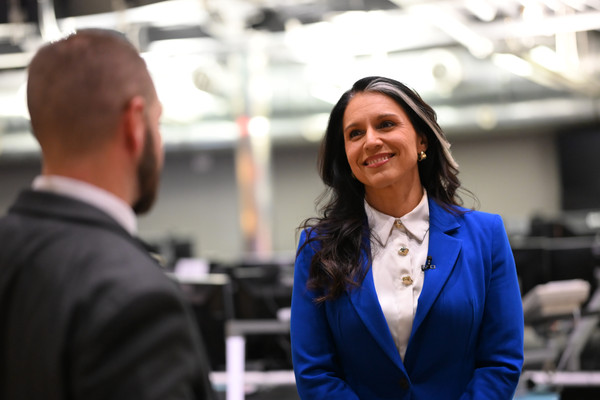
Less than two weeks ago, I stood at ODNI with Tulsi and her entire family and we had a conversation on camera about the fake news, extremist members of Congress always searching for a soundbite and how the media manipulates EVERYTHING. The woman showed no anger. She knew it was part of the job she signed up for. I don't think either of us could have imagined just how brutal the attacks would get within days.
Decades ago, Tulsi signed a blank check to our nation payable up to and including her life. She's sacrificed relationships, money, experiences and family time to serve our nation again and again. And now she's fighting a bigger and more important battle - one for the life of a man who has stood by her side through it all. So allow me to speak directly to Tulsi and Abraham for a second.
Tulsi - in your interview, you spoke of who we REALLY all serve - and that's God. In a nation where many believe in Him and others don't (yet)... in a country where people call Him by different names... I have no doubt that His hand has been on both of your shoulders since day one. I know that our God is still in the miracle business - and I have no doubt He is walking before you both in this next battle you face.
The impact your service and sacrifices have had is GENERATIONAL. We'll never know how many lives were SAVED because of your actions. We'll never know how many generations of children and grandchildren will be born because of YOUR leadership. Don't ever let that be lost on you. As a husband and father of four little girls - my family will always be in your debt.
Abraham... your name is fitting, brother. In the Bible, we're offered a glimpse of Abraham and his son Isaac, whom God calls him to sacrifice. In a blind walk of faith and obedience, Abraham lays it all on the line. And at the moment when he's about to slay his son... God intervenes. I believe God has seen your sacrifice and your walk in obedience... and that he's witnessed you standing alongside such an incredible woman. I pray to Jesus that our Heavenly Father heels you quickly... and continues to help you and Tulsi grow in your love for one another. You both deserve it.
To my fellow Americans - you've chosen your party lines... but don't let it come at the expense of our humanity. Regardless of who you vote for, I'd encourage you to put hatred and anger aside and pray for this incredible couple - and EVERYONE who serves our nation.

Comments