
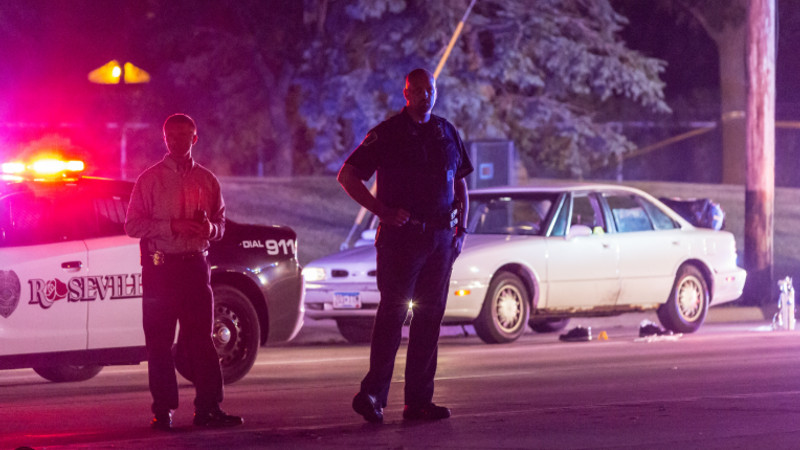
Whenever there is an officer-involved shooting, the less-educated among the population often pose questions such as “why didn’t they shoot the (weapon) out of his hand?” or “why couldn’t they shoot him in the leg?” as once suggested by former President Joe Biden. Of course, such scenarios work in old Hollywood westerns or cop movies, but what is the reality?
First off, let's debunk a common myth: police officers are NOT trained to “shoot to kill.” Police are trained to shoot to “stop the threat.” And in many cases, shooting someone once in the chest or abdomen does not stop them. There are numerous cases where someone under the influence of drugs, such as PCP, requires multiple shots to stop them. Even then, they sometimes survive for several minutes, if not longer, after sustaining multiple gunshots.
Why then are police trained to shoot at the center of mass? The explanation is really quite simple. During a shoot/don’t shoot scenario, things are moving quite fast. Most police officers are trained to shoot at static paper targets, shooting standard PPC courses. Many departments have transitioned to more reality-based training, including moving targets, night shooting, shooting with sirens sounding and emergency lights on, and running an obstacle course. All of that is intended to simulate what officers might encounter during a real shooting scenario.
In such a situation, stress levels are high, the heart rate is increased, and the “fight or flight” instinct takes over. All of this makes the ability to aim for and strike a small target, such as a hand or leg, virtually impossible.
A blog posted by Alien Gear Holsters explains:
“Center of mass (COM) in shooting and firearms refers to the torso’s central vital zone–roughly the chest and upper abdomen (sternum/navel level)--targeted for defensive or tactical shots because it presents the largest hittable area under stress, houses critical organs (heart, lungs spine) for maximum threat-stopping potential, and boosts hit probability even with suboptimal aim or movement.
“This ‘point of aim’ strategy prioritizes rapid incapacitation over smaller targets like the head, making it standard for law enforcement, military, and self-defense training where precision degrades in high-adrenaline scenarios.”
In other words, the best chance for a police officer to stop a threat lies in shooting at the center mass, which benefits not only the police officer but potentially innocent citizens as well. Police officers are more likely to stop a threat by shooting at the center mass than by trying to aim for smaller body parts.
There is also the physiology of being involved in a life-or-death scenario where it’s the police officer against the bad guy. A National Institute of Justice study showed that officers involved in a shooting event experience diminished sound in 82 percent of the cases. Officers experienced “tunnel” vision in 51 percent of the cases, and had a heightened sense of visual detail in 56 percent of the cases. Officers experienced slow motion in 56 percent of the shootings and fast motion in 23 percent. The frequency of visual and time distortions varied only slightly from those observed prior to firing and once firing began.
The study found that “it is evident that reasonable officers on the scene of police shootings are subject to experiencing substantial levels of perceptual distortion both prior to pulling the trigger and as they fire.”
It is therefore impossible to expect a police officer undergoing this amount of stress to focus his firearm on a target only inches in diameter. Having officers focus on the center mass of the target is a much more reasonable expectation.
An internal review of NYPD shootings in the 1990’s found that motor skills declined up to 30 percent during a firefight, according to the Atlanta Journal-Constitution. Expecting officers to use fine motor skills to aim at a small target is simply unrealistic.
Yet, even shooting at center mass is no guarantee that the threat will be stopped, as addressed above with someone under the influence of drugs.
Allied Gear’s blog noted a case in Skokie, Illinois, in 2007 where a police officer, Tim Gramins, got into a shootout with an armed assailant. Gramins fired 33 rounds, striking the suspect 14 times, including six shots to vital organs in the center of mass. It was only when Gramins delivered three shots to the suspect’s head that he was killed, as reported in Police1. And Gramins was well-trained, serving as a master firearms instructor and a sniper on the department’s Tactical Intervention Unit. Gramins said despite being struck multiple times in the center of mass, the suspect “wasn’t even close to slowing down.” The whole shootout lasted 56 seconds.
If you want to know why police officers shoot at a suspect’s center mass, Gramins’ incident explains it to a “T.” Had he attempted to shoot him in the arm or leg, chances are he wouldn’t be here to speak about his ordeal. People often question why police keep shooting even when a suspect has been hit. The bad guy Gramins got in the shootout with was hit with eleven rounds, yet he was still in the fight until the final three fatal shots to the head, made possible only because Gramins was a highly-trained marksman.
When budgets are cut, one of the first things to go is training, despite the fact that having poorly or inadequately trained officers significantly increases the liability for police departments and municipalities. My former police department had us qualify only once every six months, and for most of my career, that was at stationary paper targets. Fortunately, that is no longer the case, but sadly, some police departments still operate that way.
The only way to give officers a fighting chance is to have them practice shooting at center mass, even if it is only at paper targets. And as was evident in the Gramins case, having officers trained for head shots has become more common. The so-called “Failure Drill” or “Mozambique Drill” has officers firing two shots to the center mass, then one to the head.
The law of averages says officers are much more likely to stop the threat while eliminating the possibility of missing completely by shooting center mass. Shooting at hands and feet increases the risk of missing and getting a ricochet, possibly injuring or killing an innocent bystander.
As the blog said, “it [center mass shot] has the greatest probability of doing vital damage or stopping your enemy AND the highest chance for you to be able to deliver the shot on target under stress.”


Comments