
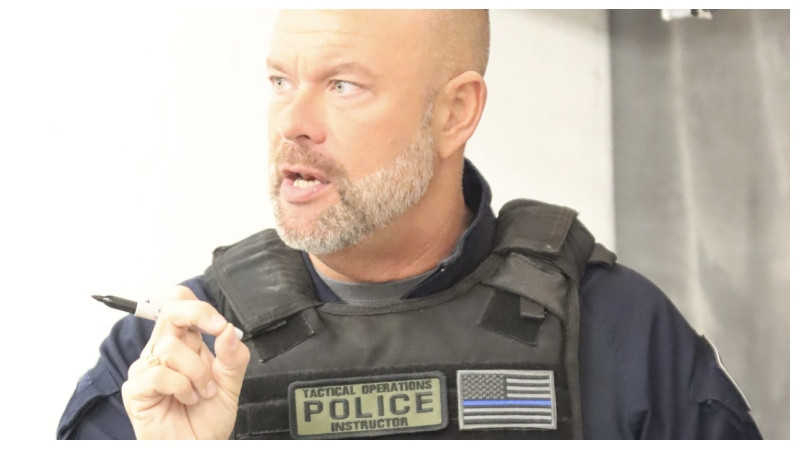
A lead instructor and program architect of the NeuralTac™ training system, his work integrates operational expertise with modern learning science to bridge the gap between traditional firearms instruction and real-world human performance under pressure.
Known for translating complex neuroscience and human performance research into practical training insight, Hanson has influenced training programs nationwide. He also serves as an expert witness and case analyst in use-of-force and training liability matters, providing scientifically grounded clarity on decision-making and performance in critical incidents.
The Value of Being a Contrarian in a Conformist Training Culture
I can trace my identity as a contrarian back to a moment that occurred long before I had any understanding of what the word actually meant. The year was early in the Reagan administration, and I was a first-grade student sitting in a classroom run by a habit-clad nun named Sister Helen John. Like many teachers confronted with a young student who asked too many questions, challenged assumptions, or resisted simplistic answers, she eventually reached the end of her patience. In a moment of visible frustration, she looked directly at me and declared, loudly and definitively, “Mr. Hanson, you are a contrarian.”
At the time, I had no framework for understanding the term, but I instinctively recognized it as an accusation rather than a compliment. My response was immediate and reflexive, and in hindsight, almost comically validating of her claim.
“No, I am not.”
Only years later did I come to understand that this moment was not an indictment of poor behavior or defiance for its own sake. It was an early indicator of a cognitive orientation that would come to define both my professional life and the direction of my work. Today, I embrace the label of contrarian openly and unapologetically. More than that, I recognize it as a necessary posture for anyone serious about truth, effectiveness, and meaningful progress in complex, high-liability domains.
Understanding the Contrarian Mindset
Modern society places a high premium on conformity. In many professional and institutional settings, agreement is equated with competence, and compliance is often mistaken for professionalism. We are encouraged, implicitly and explicitly, to go along in order to get along. We are warned not to question authority too aggressively, not to disrupt established systems, and not to challenge ideas that are widely accepted or institutionally protected. Over time, this pressure creates cultures where questioning becomes uncomfortable and dissent is subtly discouraged.
Within such environments, phrases like “this is how it has always been done” or “the science is settled” become conversational dead ends rather than starting points for inquiry. These expressions function not as conclusions reached through rigorous analysis, but as social signals intended to halt further discussion. They reward intellectual passivity and penalize curiosity.
Contrarians, by their nature, resist this gravitational pull toward unexamined, unchallenged consensus. They are driven not by a desire to be oppositional, but by an insistence on understanding. They ask questions not to provoke conflict, but to uncover mechanisms. They are less interested in what is popular or traditional and more concerned with what is valid, effective, and demonstrably true.
A common misconception is that contrarians are reflexively argumentative or dismissive of expertise. In reality, the opposite is true. Effective contrarians tend to be deeply invested in their fields. They study extensively, observe carefully, and test ideas against evidence and experience. Their skepticism is not born of ignorance, but of familiarity. They understand enough to recognize when explanations are incomplete, when methods are inefficient, or when outcomes are being mistaken for causes.
Being a contrarian requires comfort with discomfort. It demands the willingness to stand apart from prevailing opinion and to tolerate misunderstanding or criticism in the short term in pursuit of long-term improvement. It also requires intellectual humility. A true contrarian must be willing to revise or abandon a position when evidence warrants it. There is no value in challenging orthodoxy if one simply replaces it with a new, equally unexamined belief system. Similarly, contrarians must be aware of biases, and how those biases can cripple their own development and growth.
At its core, the contrarian mindset is rooted in accountability to reality. It is driven by the belief that systems should be judged by their outcomes, that explanations should align with observable behavior, and that tradition alone is an insufficient justification for practice.
Why Firearms Training Demands Contrarian Thinking
It is precisely this mindset that draws me to challenge the standardized paradigms of firearms and tactical training.
Several years ago, I opened a keynote address to a room full of law enforcement trainers and high-liability instructors with a statement that immediately captured their attention.
“I hate the firearms training industry.”
I waited until the murmur in the room settled down. Then, I repeated it for emphasis.
“I HATE the firearms training industry.”
Predictably, this declaration was met with confusion, discomfort, and more than a few raised eyebrows. After all, I have built my career within this space. I have devoted decades to training shooters, developing instructors, and working in environments where the consequences of failure are severe. Why, then, would I express such open disdain for the very field that has given me purpose?
The answer is both simple and complex.
I cannot imagine doing anything else. I love working with students across the full spectrum of experience, from absolute beginners to seasoned professionals. I find deep satisfaction in developing instructors and watching them evolve from competent presenters into thoughtful educators and coaches. Few things are more rewarding than witnessing a genuine moment of insight when a learner suddenly understands not just what to do, but why it works.
This work has been a privilege, and I remain deeply committed to it.
And yet, I stand by the statement.
I hate the firearms training industry.
The Problem with Treating Training as an Industry
The discomfort many people feel when hearing that statement often stems from an unexamined assumption about what training should be. Firearms instruction is frequently described as an “industry,” a term that carries specific implications. According to standard definitions, an industry is concerned with the processing of raw materials and the manufacture of goods. It emphasizes efficiency, standardization, throughput, and uniformity.
When applied to manufacturing, these priorities make sense. When applied to human learning, especially in high-liability contexts, they are deeply problematic.
Much of what passes for firearms training today resembles an assembly line more than an educational process. Students are processed through curricula at predetermined speeds, exposed to standardized blocks of siloed instruction, evaluated through narrow performance snapshots (often to administrative standards of minimum adequacy), and then released. The system rewards completion rather than comprehension and favors short-term performance over long-term capability.
In this model, students are treated as interchangeable inputs rather than individual learners. Variability in prior experience, cognitive processing, stress response, and motor learning is acknowledged superficially, if at all. Instruction is delivered in dense, siloed segments that prioritize coverage over integration. The emphasis is on delivering information, not on ensuring that information is meaningfully encoded, retained, and retrievable under pressure.
This approach is especially evident in professional settings. Law enforcement officers, security personnel, and other duty carriers are often familiarized with techniques, tested shortly thereafter, and then required to qualify according to minimal standards. Little attention is paid to whether the skills demonstrated during qualification persist beyond the training environment or transfer effectively to real-world conditions.
The cycle repeats predictably. Familiarize. Test. Qualify. Move on.
Familiarization Is Not Training
The distinction between familiarization and true instruction is critical, and it is one that is frequently overlooked. Familiarization introduces concepts or techniques without ensuring ownership. It creates recognition without competence and exposure without durability.
In many training programs, students are not taught so much as temporarily entrusted with information. They are shown how to perform a task, given opportunities to mimic it, and then evaluated shortly thereafter. If performance meets a predetermined threshold, the assumption is that learning has occurred.
In reality, what has occurred is often little more than short-term performance supported by context, repetition, and immediate feedback. Once those supports are removed, the apparent learning collapses. Skills degrade rapidly. Decision-making becomes inconsistent. Under stress or novel conditions, performance fails to materialize.
This is not a failure of the student.
It is a failure of the instructional model.
True learning requires that students actively integrate new information into existing cognitive and motor frameworks. It requires that they understand underlying principles, not just surface techniques. It requires variability, spacing, and meaningful challenge. Most importantly, it requires time and intentional design.
There are well-established, scientifically supported methods for facilitating this process. Human performance research has repeatedly demonstrated how memory formation, consolidation, and retrieval function under both normal and stressful conditions. Yet these insights are rarely reflected in how firearms training programs are structured or delivered.
The result is an environment where instructors are rewarded for presenting material rather than developing capability, and where students are led to believe that exposure equals proficiency.
The Cost of Unexamined Paradigms
The persistence of these models is not accidental. Standardized training paradigms are comfortable. They are predictable, scalable, and easy to replicate. They align neatly with certification requirements, administrative oversight, and budgetary constraints. They allow organizations to demonstrate compliance without confronting the harder question of effectiveness.
However, comfort comes at a cost.
When training fails to produce durable learning, the burden shifts to the individual. Officers are told they need to practice more. Shooters are advised to seek additional classes. Performance failures are attributed to motivation, discipline, or attitude rather than to instructional design.
This narrative obscures systemic deficiencies and protects existing structures from scrutiny. It also creates a culture where questioning methodology is perceived as personal criticism rather than professional responsibility.
From a contrarian perspective, this is unacceptable. High-liability training demands rigorous accountability, not to policy or tradition, and not merely to outcomes, but to the processes that reliably produce them. If a training model yields short-lived gains followed by predictable skill decay, or collapses under real-world performance conditions, it must be examined and revised regardless of how entrenched it has become. Any system that performs well only in controlled training environments warrants scrutiny and deliberate overhaul.
Challenging Without Attacking
Challenging established paradigms does not require hostility. It requires clarity.
As I continue to question and critique prevailing approaches to firearms training, I do so with two guiding principles. First, the critique is never personal. Instructors operate within systems they did not create, often doing the best they can with the tools they have been given. Second, any challenge must be defensible. Assertions must be grounded in logic, research, and observable outcomes rather than opinion or anecdote alone.
Critique without explanation is noise. Meaningful challenge includes a clear articulation of why a problem exists, how it is perpetuated, and what principles can be applied to address it. This approach transforms disagreement into dialogue and defensiveness into opportunity.
The goal is not to tear down the profession, but to elevate it. Firearms instruction occupies a critical role in public safety and personal defense. It deserves the same level of intellectual rigor and evidence-based refinement that we expect in other high-stakes disciplines.
Toward a More Honest Training Culture
Creating meaningful change requires more than new techniques or equipment. It requires a shift in how we think about learning, performance, and responsibility. It requires instructors to move beyond the comfort of familiarity and to engage with the underlying mechanics of skill development.
This does not mean abandoning existing programs or certifications. Those systems serve important functions. Rather, it means acknowledging their limitations and supplementing them with a deeper understanding of how humans actually learn, retain, transfer, and apply complex motor and cognitive skills.
It also requires humility. No single instructor, program, or methodology has all the answers. Progress emerges through open exchange, critical evaluation, and a willingness to revise long-held assumptions.
As a contrarian, my role is not to provide easy answers or to reinforce comfortable narratives. It is to ask uncomfortable questions, to challenge unexamined beliefs, and to insist that effectiveness matters more than tradition. Then, I have to apply what I have learned and let that shape the direction of my work.
If that approach ruffles feathers, so be it. Discomfort is often a prerequisite for growth.
The firearms training community has the potential to become something far more than an industry. It can become a profession defined by intellectual honesty, continuous improvement, and genuine commitment to human performance. Achieving that transformation begins with the courage to question and the discipline to listen.
In that sense, being a contrarian is not a liability. It is a responsibility.

Comments
2025-12-20T07:32-0500 | Comment by: David
Any amount of training in any field of discipline needs to be applied but in a series of strategies which are determined by the trainee's performance. I train from the base premise that success begins with the opportunity to examine and explore identified failure. This process produces a strategy specific to each trainee. Controlling the failure rate introduced is the key for the trainer's success with that individual trainee. A relationship is formed within the mutual agreement that "failure" is the objective until it is not. We fail; we succeed, we repeat.