
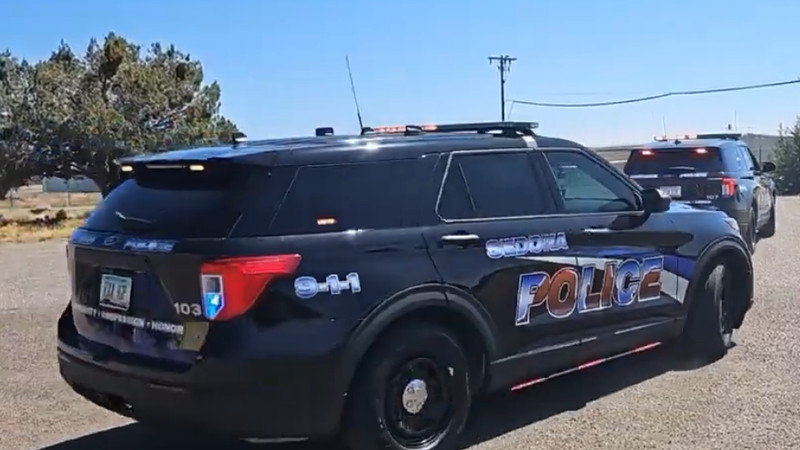
SEDONA, AZ- In 2025, it is difficult to find a police agency that doesn’t have some type of guidelines on police pursuits, that allows civilian volunteers to transport prisoners, or that allows warning shots. As to the latter, warning shots have been outlawed in many states, and for departments accredited through the Commission on Accreditation for Law Enforcement Agencies (CALEA), they are expressly prohibited. In Sedona, Arizona, however, no such prohibition existed until very recently.
Law Enforcement Today (LET) was contacted by the former deputy chief of the Sedona Police Department, Ryan Kwitkin. Kwitkin joined the Sedona Police Department, which has about 30 officers, as deputy chief after a distinguished career with the Boca Raton Police Department in Florida, retiring after 24 years as a lieutenant and watch commander.
Kwitkin told LET he was concerned about what was happening in Sedona, particularly in the area of warning shots and the lack of a substantive police pursuit policy. Kwitkin told us that when he began working in Sedona, he was basically “thrown to the wolves” and received minimal orientation from the department.
Kwitkin said he raised concerns about the warning shots and police pursuit “policies,” or lack thereof, and shared them with Sedona Police Chief Stephanie Foley. His concerns were dismissed, and thus began, according to Kwitkin, a series of retaliatory actions by Foley against him.
Sedona’s warning shot policy drew the attention of Judicial Watch, which called on the city to “review and revise” the policy, according to Arizona Free News. Judicial Watch believed that the policy put Sedona officers “at risk of inadvertently committing criminal acts under state law,” the outlet wrote.
Shannon’s Law (A.R.S. §13-3107) makes it a felony to discharge a firearm with criminal negligence within or into the limits of a municipality.” The law was passed in response to the 1999 death of Shannon Smith, a 14-year-old girl killed by a stray bullet fired into the air during a celebration, according to the Grand Canyon Law Group.
Sedona’s warning shot policy, which LET has been told has finally been resolved, permitted officers to discharge their weapons as a cautionary measure in potentially volatile situations. Internal emails obtained by Judicial Watch showed that warning shots are included in the department’s training curriculum and are considered an option alongside non-deadly and deadly force. The Sedona Police Department was unable to provide training records or curriculum for the use of warning shots. This raised concerns for Kwitkin, since warning shots have been eliminated in most departments nationwide and are prohibited explicitly by CALEA.
Judicial Watch found, through examining emails, that Sedona’s policy deserved close examination, noting that, on April 18, 2023, an email revealed that a revised policy manual was under consideration and that warning shots were included in that revised manual. Later communications indicated that the use of warning shots was still under consideration, though discussions had begun about excluding them. Finally, the emails had a common theme with uncertainty about whether warning shots ran counter to state law, particularly Shannon’s Law.
The most obvious concern with warning shots is something called gravity. Whatever goes up must come down. And since a police officer would have no ability to know where it would happen, it is a tremendous liability —a concern rightfully expressed by Kwitkin.
Arizona Free News identified several problems with the academy's training on the use of warning shots. Those included:
- Ambiguity in instruction: there is inconsistency in instructions, sometimes suggesting warning shots be allowed and other times recommending stricter guidelines, however, leaving it up to the officer’s discretion. That leaves uncertainty about when a warning shot would be appropriate.
- Potential legal conflict: allowing warning shots appears inconsistent with Shannon’s Law, potentially leading to legal action against an officer.
- Need for uniformity: the narrow distinctions between acceptable practices based on internal memos vs. state law could create sporadic enforcement of what is considered proper procedure. “Uniform standards are essential for maintaining both public accountability and officer safety.”
Kwitkin’s responsibilities included overseeing volunteers, policy and procedures, and internal affairs.
“Everything flowed through me to the chief,” Kwitkin told US.
Kwitkin said that despite the department starting at around 1988, it “hadn’t evolved since then.”
Kwitkin said that Chief Foley came up through the department, starting as a dispatcher in 2005. In 2018, she was anointed the position of lieutenant, then in 2020, was promoted to deputy chief. She was then sent to the FBI National Academy and the Northwestern School of Police Staff & Command, and in 2022 was promoted to chief. He told us that the department is a chief mill, with a significant amount of turnover at the top of the department.
One of his first tasks from Foley was to review the high-liability policies first and get them “cleaned up.” Kwitkin said the department doesn’t have a policy management system; instead, it uses Word documents and uploads them as .pdfs into a policy book. He further said that no one signs the policies. They just received an email telling them to read the new policy.
“I went to her [Foley] and I’m treading lightly because I’m on probation. I just moved my family there, and I didn’t want to rock the boat,” Kwitkin said.
“A couple of weeks go by, and I go to her about the warning shot policy. She’s like, ‘Yeah, there’s no problem with that.’”
“So I’m like, ‘Chief, I can’t think of one time when a warning shot would be applicable.’ I’ve been in police work for 26, 27 years, and I’ve never…and I told her we can’t just allow it, we have to ban it. It has to be specific. Warning shots are not permitted. I want to add that to policy. She’s like, ‘no.’”
Kwitkin said that the Boca Raton Police Department was CALEA-certified, so he was aware that warning shots were a no-no.
Part of his responsibilities was also managing the fleet. Unlike most agencies that have a dedicated repair shop, Sedona uses whoever is available.
“They take these vehicles to random shops around Verde Valley. So I went to the chief and expressed my concerns.”
Again, Foley blew off his concerns.
“So, Sedona is a small city. They run with three officers and a supervisor at night. They can go down to two, which is another story in itself,” Kwitkin said. “Here’s the best part, and it’s still going on. If an officer makes an arrest, they call in volunteers, elderly volunteers with an average age of 70, to transport these prisoners to the county jail in marked cars.”
Kwitkin again expressed his concerns to Foley about allowing unarmed volunteers to transport prisoners, to which she issued a snarky reply:
“This isn’t Boca Raton. We don’t have the staffing,” she said.
Also, the use of “manpower” is prohibited by Foley,
“I was admonished for saying manpower,” he said of Foley, who preferred the word “staffing.”
Kwitkin told LET that using unarmed civilians to transport prisoners to jail is actually a violation of state law.
While LET wasn’t able to locate a specific Arizona statute outlawing the transport of prisoners by civilians, Arizona statute 13-3898 specifies that any “person arrested [is] to be taken to a magistrate ‘without unnecessary delay.’” Having to call in a civilian to carry out transport appears to contradict that law. That statute does not explicitly authorize a private civilian to transport an arrestee.
Kwitkin said Foley told him that there wasn’t anything in the statutes saying civilians “can’t” transport prisoners. Kwitkin said that “may be the case,” however law said if a police officer makes an arrest, a police officer must transport the person to the county jail in order to fulfill the “without unnecessary delay” requirement.
Kwitkin said that “everyone is non-violent until their violent,” and that he told Foley he thought it was a bad idea and was leaving the department open to liability.
Indeed, without any type of authorizing authority, either a state statute or policy, using civilians to transport would not align with statutory framework.
He continued that he spoke to the volunteer prisoner transporters, many in their 80s and 70s who were “all up in arms when he told them it was unsafe, to which they said prisoners “are handcuffed in the back” and there is a divider between the front and the back.
Kwitkin said Arizona case law and statutes treat custody and transport as functions of law enforcement/detention authorities. He noted that where non-officers transport prisoners, it is done by authorized/contracted transport personnel. The argument could be made that civilians conducting prisoner transport operations could face civil penalties for actions such as unlawful restraint, impersonation, etc.
It was after Kwitkin began questioning some of the operational procedures of the Sedona Police Department that Foley began a pattern of what he believed to be micro-managing him and undermining his authority.
He said Foley came into his office and questioned him why his computer monitors were facing the door (in a position where the back of the monitors would be facing toward the door and the screen inward). He told her it was so when people walked by his office, he could engage with them. It was also so information on his computer screen that may have been sensitive in nature could not be viewed from the hallway.
“Is it because you don’t want people to see what you’re doing?” she asked Kwitkin, intimating that he was trying to hide something.
“I told her I always face the back toward the door so I can engage with people. She made me change my office, made me rearrange my office.
“Little by little I knew things were bad,” Kwitkin told us.
Kwitkin said there were other employees with Sedona and they said they’d had problems with Foley as well. They said they had gone to HR numerous times to file a complaint. The HR manager would go to the city manager, who would then tell Foley about the complainant, and she would retaliate against the employees.
“I spoke to an attorney with AZ Cops and he told me that if I put in a complaint, they would find in favor of the chief and I would be terminated,” Kwitkin said.
Things came to a head between Kwitkin and Foley during the planning of a Halloween event. Foley confronted him about the event and wanted to know why neither of them were mentioned in the briefing report. Kwitkin told her that he didn’t believe it was necessary. Foley then shut his door and asked him, “Why don’t you tell me what’s on your mind?” Kwitkin told her that he believed it was time for her to find a new deputy chief. Foley asked him why, and he told her that he couldn’t do it anymore, he couldn’t speak his mind because of how he was treated. Foley then said he “wasn’t the same person” she hired and told him to “be yourself.”
Things went good for a couple of weeks up until the department’s Christmas party, which was being held in an Elks Lodge. Kwitkin said that he believed that was taking the cheap way out and they should have reached out to a local hotel which would have happily provided a venue.
Foley then asked Kwitkin if he had brought the podium, and he said he had not personally but had delegated it to one of the other officers. At that point, Foley asked to speak to him outside and when they got outside, Foley “ripped into” him.
“I lost my shit and blew up on her. I said this is ridiculous, you treat me like a kid, everything I do is micro-managed,” Kwitkin said. The incident was not mentioned again for a while.
All of this is to establish background on how the department is run.
Sedona’s pursuit policy allows officers and supervisors wide latitude to determine when pursuits can take place. There is no written criteria for when pursuits should take place and when they should be broken off. Kwitkin told Foley he believed the current non-policy left the department and both he and Foley open to civil litigation.
The Arizona Department of Public Safety, as the leading law enforcement agency in the state, allows pursuits, however there are criteria that must be followed. Part of that criteria reads:
“All personnel involved in a pursuit shall continually evaluate the nature and seriousness of the offense(s) against the risk of initiating and continuing emergency vehicle operations and shall recognize the safety of the public is a primary concern. Concerns regarding an ongoing pursuit shall be immediately communicated to the chain of command and the pursuit commander.”
The primary pursuit vehicle, according to the policy, must notify the communications center of the following: location and direction of travel, description of pursued vehicle, speed of the pursued vehicle, reason for the initial contact, the number of occupants known to be in the vehicle, hazards to sworn personnel, traffic conditions, criminal/traffic violations.
There are also a number of considerations, including: “danger to live and property; necessity to immediately apprehend the suspect; whether the identity of the suspect is known or unknown; the nature of the crime or infraction prior to the initiation of the pursuit; the trooper’s training, abilities, and experience; the suspect’s and trooper’s vehicle capabilities; the location, terrain, population, traffic congestion, weather, and the presence of intersections; the trooper’s familiarity with the area; the presence of law enforcement aircraft to assist with the pursuit; the presence of unmarked, canine, or tactical units to assist in the apprehension; and the availability of law enforcement personnel to provide assistance.”
Kwitkin said that Judicial Watch has made numerous public records requests, and the city says that those policies “don’t apply” to them. Judicial Watch made four specific public records requests and specified any records pertaining to any communications containing the following phrases:
- “Swept under the rug”
- “Poor judgment”
- “Ineptitude”
- “Lack of knowledge”
- “Litigation”
- “Inferior chief”
- “Inadequacies”
- “Info for council”
- “Ask questions.”
Correspondence received from Judicial Watch already had documents from outside sources that match the requested documents containing the above phrases, which appeared to have been purposefully omitted from the public records requests made by Judicial Watch.
Judicial Watch also received an audio copy of an interview with Chris Dowell, a commander at the Sedona Police Department, however the transcript provided to JW did not have the following included:
Investigator: “Okay. And you expressed before we got on that you were concerned about retaliation. Who do you think may retaliate against you?”
Dowell: “The chief.”
Investigator: “Not by the mayor? Just the chief?”
Dowell: “Yeah, just by the chief.”
Investigator: “And what causes you to say that?”
Dowell: “Over the last year, my experiences with the chief, and then as of recently, I spoke out against a situation that the chief was involved outside of this, and I strongly disagreed with her position on it. And then shortly after I was drug into HR, and she was in there and another employee was in there. And the other employee alleged like five pages of notes against me, which were ridiculous things like me kidding about somebody’s shirt and stuff like that. So it was nothing that was worthwhile, but I just felt like, wow, this is kind of crazy. All of a sudden, I speak out against [her], and here we are, and I’m in HR and keep getting asked by her, do I want to be here? And I said I absolutely want to be here. I said I just don’t want to be part of the drama. And then on Tuesday, she said, you’re coming to lunch with me. Lemme buy you lunch.”
According to Kwitkin, Dowell was upset when it came out that Foley was allegedly having an affair with an employee in the city manager’s office. Dowell was concerned about retaliation because he was brought to Human Resources after he disagreed with Foley’s decision-making over the incident. Foley is aware he went to HR.
Kwitkin provided to Law Enforcement Today correspondence between he and the mayor sent after he resigned, who then involved the city council that showed a pattern of Foley using her position as chief of police to curry favor.
In one incident, she asked him to respond to her “mentor’s” home to move a large area rug left at her mentor’s home, while on duty, inside the garage. Kwitkin rightfully questioned using Sedona police personnel to take care of personal business for a friend of the chief while on duty and in uniform.
Foley also allegedly engaged in a history of favoritism toward certain officers in the department. Kwitkin outlined one incident where a Sedona officer responded to a SWAT callout four hours away in Tucson, Arizona. This officer responded lights and siren the entire way at over 100 mph as confirmed by the in-car camera. He even had to stop for gas ½ way, then continue the trip Code 3. On his return trip, this officer again used lights and siren in violation of Arizona state law. The officer did receive discipline, but according to Kwitkin, it was “light” for such an “egregious offense.” In fact, the officer thought so lightly of the discipline that he used to make jokes about the incident and the minor discipline he received.
This is yet another example of how lax enforcement of policies, or the lack of any policies, puts the residents of Sedona at risk.
Possibly one of the most egregious acts Foley allegedly covered up was when a now-former Sedona police officer, while wearing a body-worn camera, used a coat hanger to retrieve an evidence key from the evidence locker. Kwitkin asked Foley to conduct an internal investigation to determine whether the incident was a one-off or an ongoing issue. Foley refused. Kwitkin told her that such an incident could call into question all evidence held by the department and asked for an immediate audit of the evidence room. Foley said she would “handle it” and refused an official audit.
To confirm some of what Kwitkin told us, Law Enforcement Today also spoke to Scott Jablow, former mayor of Sedona. Due to his involvement in the Sedona Police Department situation, he was asked to resign by the city council. He initially refused to resign, but did so three weeks later. He said he did it on his terms. Jablow emphasized that his comments are his opinion only and he spoke to Kwitkin after his resignation as mayor.
Jablow told me that in addition to Kwitkin, the department also hired a lieutenant from the Mesa, Arizona police department. He said that when Kwitkin and the Mesa lieutenant were hired, Sedona didn’t have a leadership team because everyone left and they told him it was because of the chief of police.
“In my opinion, she [Foley] hired some very smart people. Hiring someone from Boca Raton, Florida to a small town, and I thought maybe it wasn’t a great fit,” Jablow said, “but the knowledge base was there.”
Jablow said that instead of taking advantage of the knowledge base of those she brought in to be on the leadership team,
“If she would have sat back and said, ‘You know, this guy’s really sharp. He’s missing a couple of issues but he’s really smart. Let me take all this knowledge and sit back and I’ll be the chief.’”
“She made it very difficult. I didn’t talk to him because of his lawsuit, so it was about a year and a half before I spoke with him,” Jablow continued.
Jablow said Kwitkin was sending the city council emails with complaints. And he was accused of talking to Kwitkin, although it was from the emails he had received.
He said that the city council treated the chief of police and the numerous complaints received about her far differently than they had with a former finance director, who had similar complaints filed by her staff. The city manager, Anette Spickard, conducted the removal, took her off campus out of city hall, and conducted a full top-to-bottom investigation. They ended up firing her.
Conversely, when Kwitkin filed a complaint against Foley, they let her stay there.
“That bothered me. Treat people the same,” Jablow said. “And they didn’t.”
Jablow approached Spickard and said he believed something was wrong, however, Spickard refused. He told her that police officers were willing to speak, however, they would not while she was working.
Even those who supported Foley used terms such as “toxic work environment,” “fear of retaliation,” “micromanaging,” “disciplining to retain,” and “retention discipline.”
Spickard told Jablow that wasn’t a “direction they were going to go in.” She refused to dig for the truth.
Jablow said that the former chief, in place before Foley was handed the job, told an interviewer that she “was not ready” for the job. He said she did move through the ranks “quickly.”
He further said that at least ten police officers had left Sedona because of Foley.
As another example of what appears to be a hostile work environment, Foley promoted an officer to the rank of sergeant. During his interview, the subject of Kwitkin came up, and the sergeant said that he thought he would have been a “good guy” but he didn’t “know him long enough, didn’t work with him long enough. Foley promoted him, but took away ten vacation days the day before he was going on vacation. That officer left soon afterward for an entry-level cop position in Florida.
The apparent incompetence in Sedona appears to include both the chief of police and the city manager. According to Jablow, Foley keeps a black-and-white book in which she takes notes. He said in his case, she went back five years to bring up an incident. Yet, when a public records request was made for the composition book, she allegedly denied having it.
Jablow is also a retired police officer who relocated to Sedona. He told us that until Kwitkin sent an email to the city council, he was unaware that the police department allowed the use of warning shots. He also told me they use elderly individuals to conduct house checks for people on vacation. He said that one of them was actually injured when he fell. Again, this is another source of liability. Foley again claimed that there wasn’t sufficient manpower to have police officers conduct such checks.
Law Enforcement Today will follow up on this situation as conditions arise.

Comments