
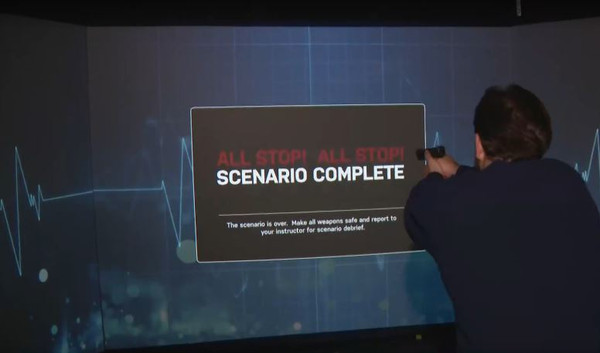
The Bakersfield Police Department (BPD) afforded an inside look into the officer training simulator earlier in October, giving residents and area locals an opportunity to see first-hand the training that goes into helping keep their community safe.
BPD Officer Matt Williams gave local news outlet KBAK/KBFX an inside look at their interactive training simulator, telling reporter Jake Shriner what he’ll be in store for regarding the simulations.
“Yeah, you are in our Force Options Simulator. We're gonna be running through some scenarios, working on threat recognition, looking on like human factors we'll touch on, decision making, just a way we could train officers a little bit actually,” Officer Williams stated.
Shriner was outfitted with a mock sidearm, pepper spray, and Taser in preparation for the exercises, saying that his past experience as an Army infantryman affords him some background on hostile situations, but admitted he hasn’t quite experienced such an immersive training simulator.
“So we're gonna see exactly how difficult this is and whether or not I make the right decision. So hopefully I don't embarrass myself,” Shriner said before the training simulations kicked off.
Shriner’s initial comments were seemingly prophetic, as Officer Williams explained the first scenario would involve a “suspicious person” at a tennis court and the simulated incident escalated faster than what the reporter was expecting. During the scenario, the suspicious person produced a knife almost instantly and began running toward Shriner, with Shriner pulling out his Taser in response.
“Hey man, put it down,” Shriner said before the suspicious person closed the distance, defeatedly adding, “Oh well, that one didn’t go too well.”
Officer Williams explained to the reporter the real dangers associated with certain calls and how split-second decisions where lethal force would be justified could be a matter of life or death for officers.
“Okay, first thing we train our officers, look at the hands, because that's what could kill you. If we see a deadly weapon, we would teach deadly force,” Officer Williams stated.
The police instructor then went on to detail how quickly seemingly long gaps can be closed, saying, “Another thing we're teaching here, if you look on this screen, he starts at 21 feet away from you. Did that feel like an incredibly short amount of time… it takes about 1.6 seconds for someone to cover 21 feet, and that's why distance is key.”
By the time Shriner was put through a second scenario involving the same circumstances, he was quick to draw the sidearm and simulate a “shots fired” call, to which Officer Williams gave accolades to the journalist for an improved performance.
“Really good,” Officer Williams said while admitting that engaging in deadly force is difficult for most people, but that officer safety is key, adding, “Your life is in danger. It's a very, very hard thing, but when you train particular things, threat recognition, hands, it helps speed up that decision making.”

Comments