
STOCKTON, CA - When one thinks of criminal foreign actors, Central or South American gangs typically come to mind. However, that landscape could be changing.
A Northern California man’s attempt to bring over participants for an international tournament of the ancient Indian sport of Kabaddi has hit a roadblock in the form of criminal Indian gangsters, causing potential athletes to drop out of the tournament in droves, the San Francisco Chronicle reports.
Harsimran Singh, president of the American Kabaddi Federation, said athletes began making excuses to avoid playing in the tournament, prompting him to press for answers.
What he found out from athletes and then law enforcement officials was that someone was threatening players in an attempt to manufacture the outcome of the event. They said they received phone calls from criminal gangsters, some locked up in Indian prisons, who told them not to participate and warned them of what would happen to them if they did.
“The players were very afraid; if they got a call, they didn’t want to go against gangsters. They were unwilling to play because they didn’t want to compromise their own safety and their family’s security,” Singh said.
Unknown to Singh, such intimidation wasn’t an isolated event. He soon learned that it was part of a much larger wave of international threats, extortion, and violence targeting Indian and Punjabi Sikhs across the state of California.
The process is simple: a criminal gang member calls a victim demanding money; if they refuse, a criminal network threatens or actually carries out attacks against their relatives, families, or businesses, both in the United States and back home in India.
The largest Sikh population lives in California, where they number over 250,000 and retain strong ties to their home country. Many regularly travel home to visit their families or ancestral homes, the Chronicle reported.
Golden State law enforcement officials say the combination of wealth, tight relationships, and cross-border movement makes Sikhs attractive targets for criminal networks with roots in India’s northern and western states, including Punjab, Haryana, New Delhi, and Rajasthan.
Indian police told CalMatters that gangs like to target “real estate developers, liquor contractors, transporters, and local businessmen,” people with higher incomes or assets.
“One of the primary reasons is the large Indian diaspora in California, which provides a degree of anonymity and social cover,” a spokesperson for an organized crime task force in India’s Haryana state said in a written statement.
The FBI’s Sacramento field office began notifying members of the Central Valley’s Indian community back in 2024 to report these types of shakedowns.
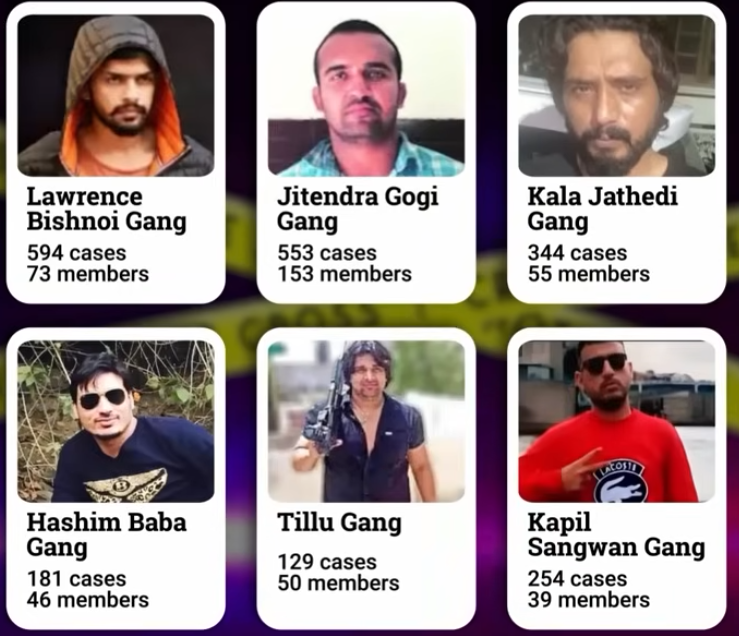
Two homicides in California have been connected to the criminal networks targeting people from the Indian diaspora. Two suspected members of the Lawrence Bishnoi gang–which the FBI describes as India’s most wanted criminal organization–were killed in Stockton and Fresno, local police agencies reported.
According to San Joaquin County Sheriff Patrick Withrow, the pattern among Indian gangs was unlike a network emanating strictly from the U.S.
“Most of them have an international type link to them, where it stretches back to India because the threats are being made to family members and businesses back there,” he said.
He explained that initial demands are designed so as not to attract a police response.
“They usually start with amounts between $4,000 and $7,000; they figure that’s a range that somebody might pay and still not contact the police,” Withrow said. “The victim families sometimes paid, with a calculation that a single payment would protect their family and business in India and the United States as well.”
Withrow added that his office has received roughly two extortion-related cases per month over the past couple of years. In July, his office arrested eight alleged members of a gang led by Pavittar Preet Singh, who faces charges in India related to firearms violations, assaults, and homicides.
The Lawrence Bishnoi gang, commonly known as the Bishnoi gang, has members in India, the United States, and Canada.
Lawrence Bishnoi, leader of the gang, is currently incarcerated in an Indian prison. Still, federal investigators said he continues to direct his global network of extortion and target killings using encrypted messaging applications, cross-border coordination, and U.S.-based associates to extort victims in both countries.
Bishnoi continues to access some type of communication device, likely a contraband cellphone, to direct criminal activity.
In December 2023, Bishnoi contacted an extortion victim via audio call despite being locked up, according to the FBI, and turned on the camera to confirm his identity to the victim. The victim took a screenshot of the interaction linking Bishnoi to an extortion threat.
Bishnoi-affiliated gang members and associates use encrypted apps like WhatsApp and Signal to relay threats and demands to victims in India, according to the FBI.
“If the victims do not pay, Bishnoi gang members and associates arrange to have members in India conduct shootings of the victims, their associates, their residences, and their businesses,” the FBI said in a November indictment against an alleged gang member.
In November 2024, Immigration and Customs Enforcement (ICE) arrested Anmol Bishnoi, Lawrence Bishnoi’s younger brother, in Nebraska, the FBI said.
Indian authorities believe he was heavily involved in two of India’s “most sensational homicides,” the Chronicle reported. Those were the killing of Punjabi rapper Sidhu Moose Wala in May 2022 in Punjab, and Baba Saddique, a prominent politician and former Maharashtra state minister.
Only weeks after Anmol Bishnoi’s arrest, Sundil Yadav, an Indian national and suspected member of the Bishnoi gang, was killed in Stockton. In Fresno, Banwari Godara, a suspected Bishnoi gang associate, was fatally shot on Oct. 18, 2022.
In January, Indian authorities announced the arrest of four suspects believed responsible for the two killings. Indian investigators believe the suspects are members of a rival gang to Bishnoi’s. They believe the suspects fled the U.S. after the killings. Meanwhile, law enforcement authorities in California have not yet announced arrests or suspects in the two homicides.
Police in Sacramento County believe at least 20 shootings in the past four years are tied to Indian-based gangs, Sheriff’s Detective Steve Hernandez said.
Enforcement action against the gang continued throughout 2025 by both the FBI and the California Highway Patrol. In April 2025, FBI Director Kash Patel announced the FBI’s Sacramento Field Office arrested Harpeet Singh, whom he described as an alleged terrorist responsible for attacks in Punjab, who is also linked to two international terrorist groups.
The Indian gangs are also not restricted by international borders. A victim who had relocated to Canada from India received numerous threats from Jasmeet Singh, an Indian national living in the Stockton and Fresno areas, according to a December indictment in federal court.
The victim retained his Indian phone number after moving to Canada and several months later was contacted by Singh, who unloaded a series of threats via phone calls and voice messages. He then became irate when he learned the victim had cooperated with Indian authorities, the indictment read.
Singh told the victim he knew he drove a white Range Rover.
‘You’re going to die in Canada. I won’t even leave you capable of going to India,” Singh told the victim.
“Go complain to whoever you want to complain to, go complain over there too. We’ll kill you over there too,” Singh said in a voice message.
While Singh didn’t mention the Lawrence Bishnoi gang’s name during the alleged phone calls, the FBI believed the nature and context of the threats, namely the references to the victim’s cooperation with law enforcement, tied Singh to the gang.
Meanwhile, despite the threats against the Kabaddi tournament, it went ahead. The sport, part tag and part wrestling, has been victimized in recent years by a series of murders in India involving players and various organized crime entities. It has grown in popularity in California.
Harsimran Singh believes the Jaggu Bhagwanpuria gang targeted his tournament, despite its leader, Jaggu Bhagwanpura, being locked up in India.
“The law enforcement officials also wanted us to be careful, and we had to hire a lot of security and make sure everything went smoothly," he said.
Despite never receiving a formal complaint from Singh, police and the FBI showed up at the event to supplement the private guards.
“We do not want to engage in any of these activities that could harm our property or our lives. We would want to avoid that,” Harsimran Singh said.

Comments