

My first domestic violence call involved a man beating his wife with a frying pan. For someone raised in a family where my parents hardly raised their voices to one another, it was a shocking event. We arrested him for aggravated assault.
The article below includes new FBI data supplemented by previous FBI numbers and figures from the Bureau of Justice Statistics (BJS) of the US Department of Justice.
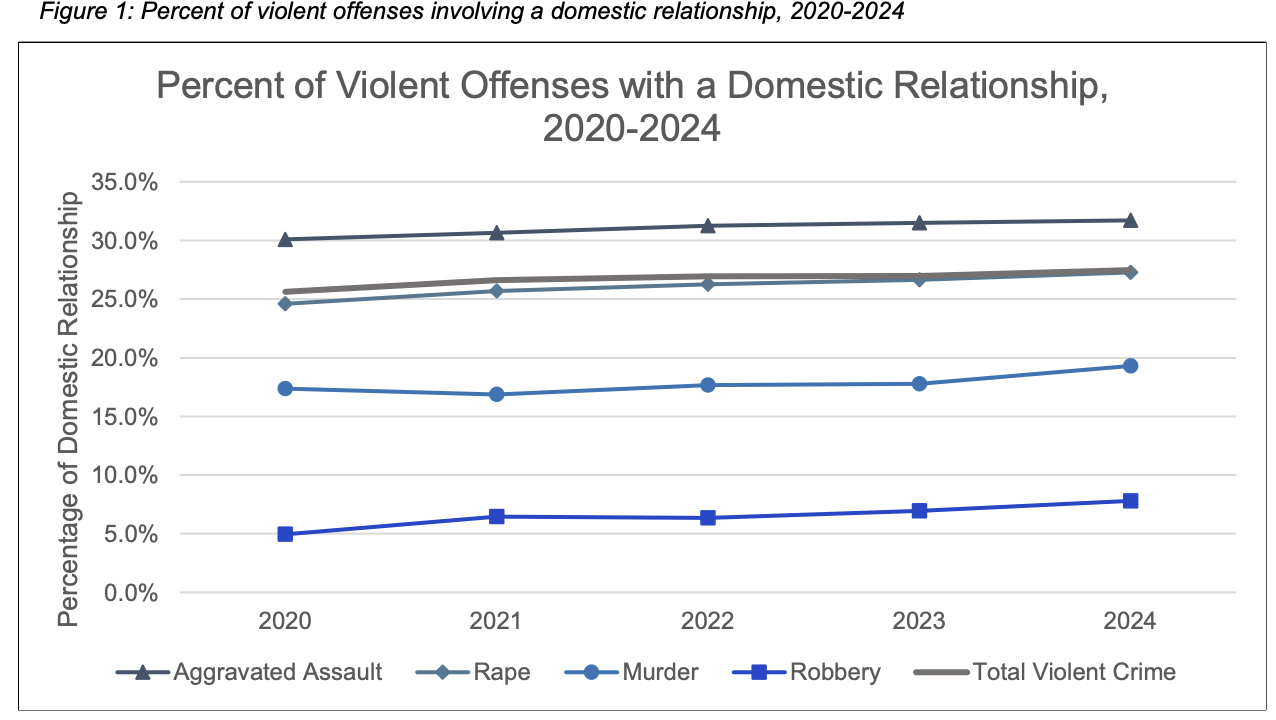
The FBI states that from 2020 through 2024, the percentage of violent crimes involving domestic relationships slightly increased every year, while total national reported violent crime decreased (report below).
Latest Data On Overall Stranger Violence-FBI-2024
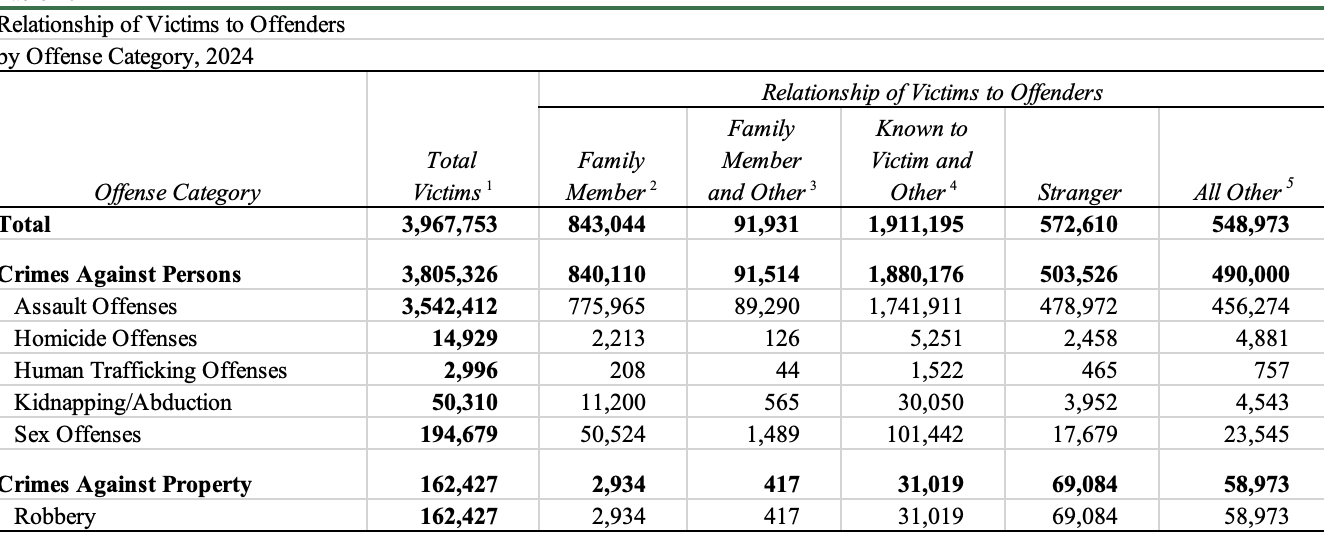
Out of close to four million total victims in 2024 (latest full report), strangers committed close to 573,000, or about 14 percent. The data is available for download here. Because the FBI’s incident-based system can count multiple offenses within a single criminal event, this percentage is not directly comparable to victimization surveys that measure individual victimizations.
The chart above is from the FBI’s National Incident-Based Reporting System. Please note that most crime is not reported to law enforcement.
The “All Other” category includes victims who were mutual combatants (victim was offender) or had an unknown relationship with a single offender. In the case of multiple offenders, victims’ relationships were combinations of strangers, mutual combatants, and/or unknown offenders.
From an older FBI document (2020) on victim-offender relationships using the National Incident-Based Reporting System, about 50% of victims knew the offender but were not related, about 25% involved family members, and roughly 25% involved strangers, mutual combatants, or unknown relationships. Unknown relationships are common in police reports, which makes precise estimates difficult.
FBI homicide data indicate that roughly one-quarter of murders are committed by strangers when the victim-offender relationship is known, meaning that most homicide victims are killed by someone they know.
Context-Explanation Of FBI Data
The chart above from the FBI indicates that the vast majority of violent crimes involve someone known to the victim, and excluding the “All Other” category, only 14 percent involve strangers.
The 2020 FBI document tells a different story by stating that about 50% of victims knew the offender but were not related, about 25% involved family members, and roughly 25% involved strangers, mutual combatants, or unknown relationships.
Different FBI datasets measure crime in different ways. Some tables count individual offenses within incidents, which can produce millions of recorded crimes and a lower percentage of stranger offenses.
The 2020 FBI summary examines victim-offender relationships, where roughly half of victims know their attacker as an acquaintance, about one-quarter involve family members, and roughly one-quarter involve strangers or unknown offenders.
Because the datasets count crime differently, the exact percentage of stranger crime can vary depending on the method used.
I will continue to use the findings of the 2020 report from the FBI as a more realistic appraisal of stranger crime. Large datasets usually withstand the test of time.
National Crime Victimization Survey
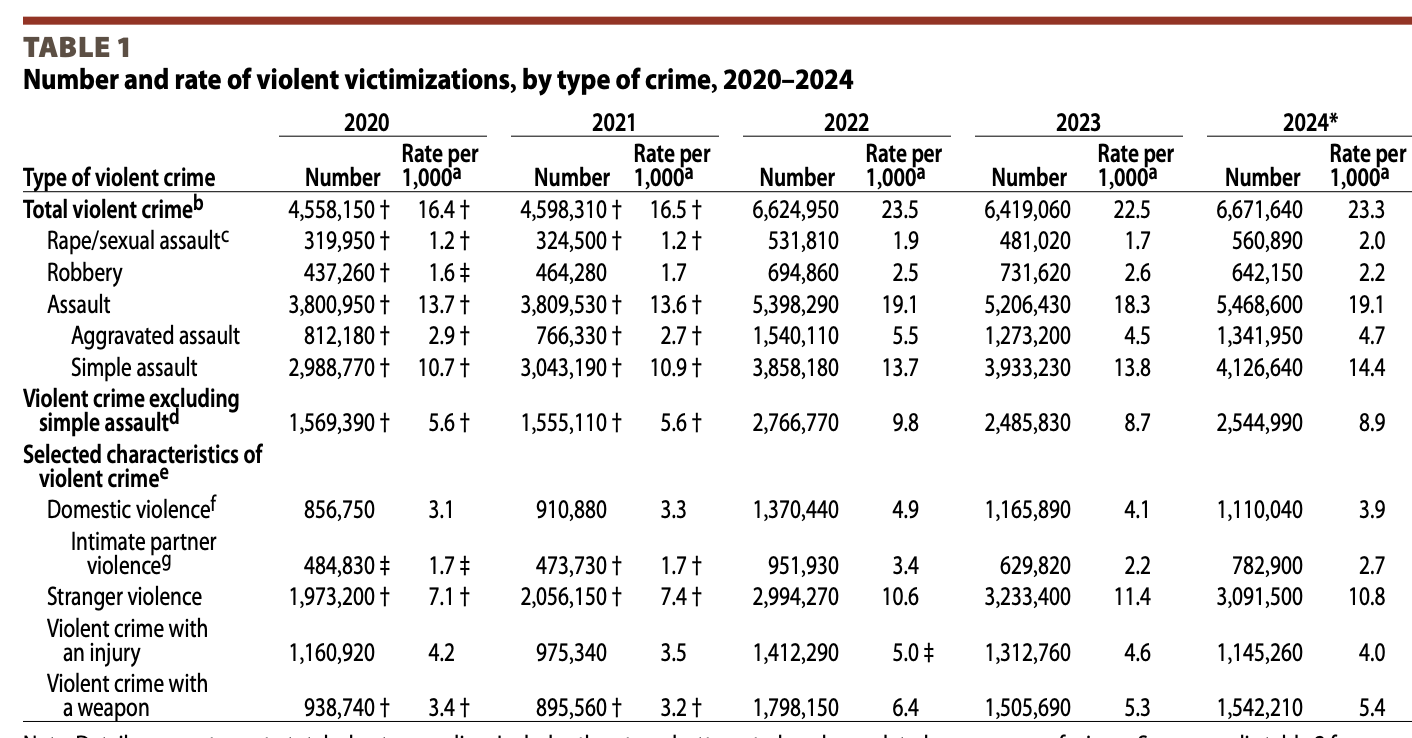
According to the latest data from the Bureau of Justice Statistics, strangers accounted for approximately 3,091,500 of the 6,671,640 violent victimizations (about 46 percent) in 2024 (latest full report).
The stranger percentage will be different from FBI figures because the National Crime Victimization Survey includes far more crimes than the FBI. It counts reported and unreported crime, and the majority of crime is not reported to law enforcement or the FBI.
Additional Research
The data above is substantiated by the fact that 76 percent of female murders were perpetrated by someone known to the victim.
Regarding burglaries, many offenders remain unknown; however, when identified, they accounted for nearly 30 percent of burglars in occupied dwellings.
Females knew their offenders in almost 70% of violent crimes committed against them (they are relatives, friends, or acquaintances).
Females can lead males in terms of “serious” violent criminal victimization rates for recent years.
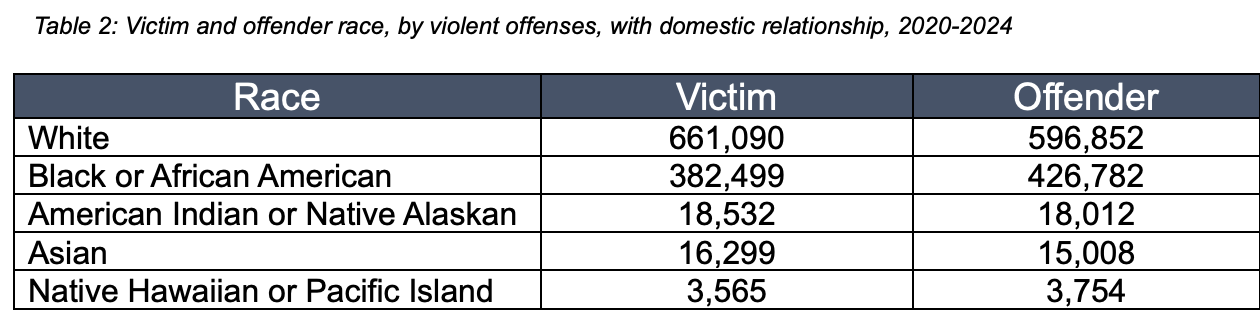
Domestic Relationships and Violent Crimes, 2020-2024-FBI
From 2020 through 2024, aggravated assault was the violent crime with the highest percentage of domestic relationships reported as the victim-to-offender relationship. During that timeframe, an average of 31.0% of aggravated assaults were domestic in nature.
The most common victim age range for both domestic and non-domestic relationships for rape was 13 to 16 years old. These victims were most commonly a current or ex-boyfriend/girlfriend (54.4%) or a child (42.7%) in domestic relationships. However, for non-domestic relationships, the victims and offenders were most commonly acquaintances (32.7%).
From 2020 through 2024, the percentage of violent crimes involving domestic relationships slightly increased every year (emphasis added) from 25.6% in 2020 to 27.5% in 2024, except in 2022 and 2023, where it stayed at 27.0% both years.
Among violent crime offenses in domestic relationships, aggravated assault (31.0%) had the highest average percentage of reported offenses, while robbery (6.5%) had the lowest average percentage reported.
Charts-FBI
Societal Crime: Do We Need a New Classification For Non-Stranger Crime?
So what’s the value of reports from the Bureau of Justice Statistics’s National Crime Victimization Survey beyond a difference in the numbers and results when compared to FBI data?
The FBI states that crime is decreasing, especially in cities, and the other (from BJS) states that rates of violent crime have massive increases, 44 percent from 2022 to 2024 (the latest full report). BJS also states that violence increased in urban areas in their latest 2024 full report.
Domestic violence and stranger crime fall into the category of a societal crime, meaning that law enforcement has little involvement from a prevention point of view.
What happens in residences or in private places between people who know each other is not going to be affected by most of law enforcement’s preventive strategies.
You could have a cop sitting outside of a residence in a patrol car, yet the officer would be completely unaware of what’s happening inside.
It’s up to society to demand that people behave themselves in much the same way we told people that drinking and driving or hard drug use was not acceptable, and both declined. Domestic violence (and violence in general) remains in need of societal involvement.
If 30 percent of aggravated assaults have a domestic violence connection, and if the majority of other assaults involve people who know each other, per the FBI, then official records from the FBI and BJS should offer non-stranger events in private places separately from stranger-to-stranger violent crime.
For example, the FBI report on domestic violence states that the most common victim age range for both domestic and non-domestic relationships for rape was 13 to 16 years old, which partially explains why only 13 percent of urban rapes and sexual assaults are reported to law enforcement.
To combine interpersonal violence with all crime statistics skews our understanding of violent crime and impedes a rational discussion as to crime prevention strategies.
Conclusion
We need to understand that most violent crime happens between people who know each other (approximately 75 percent), according to data from the FBI based on reported crime.
The Bureau of Justice Statistics’ National Crime Victimization Survey finding is a bit less than half involving strangers.
Regardless of the method used, the federal data point to the same conclusion: a lot of violent crime occurs between people who know each other, while stranger violence represents a much smaller share of total crime, approximately half of which involves strangers according to the National Crime Victimization Survey, whereas 25 percent involve strangers per the FBI.
Holding law enforcement responsible for violent acts between non-strangers behind closed doors or in private places seems unhelpful as a policy.
Societal crime should be a new category, separate from stranger-to-stranger violent crimes, where society itself could be held responsible for bad or criminal behavior.
The modern expectation that government is responsible for preventing and prosecuting crime is largely a 19th-century development. Throughout most of modern history, communities were responsible for crime control.

Comments