
WASHINGTON, DC- In the past week, Director of National Intelligence Tulsi Gabbard released bombshell information implicating former President Barack Obama for orchestrating the Russia collusion hoax.
However, if a top Republican senator gets his way, Gabbard and future DNI directors would have their authority significantly curtailed, NBC News reports.
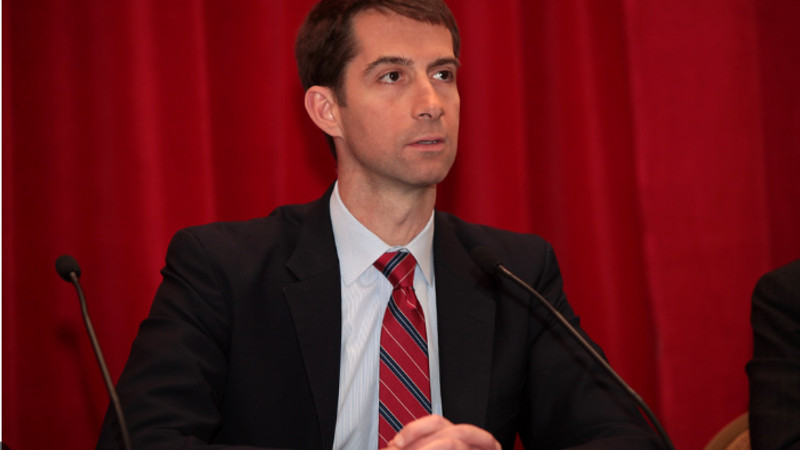
A bill proposed by Sen. Tom Cotton (R-Ark.), chair of the Senate Intelligence Committee, would slash the workforce of the National Intelligence Agency that has grown to 1,600 people down to 650, according to a senior Senate aide familiar with Cotton’s proposed legislation.
While ODNI had a workforce of around 2,000 in January before the Trump administration and Gabbard took a hatchet to the agency, Cotton seeks to downsize the agency even further.
The reduction in staff was part of the administration’s goal of cutting the size of the federal government.
The staffer, who asked to remain anonymous, said that Cotton and other Republican senators have been working on the proposal since before Gabbard's appointment.
While Gabbard previously appeared to be having a fallout with President Trump and Trump insiders a month or so ago over Iran, those tensions seemed to have eased and taken a backseat as Gabbard released previously classified documents that implicated Obama and senior cabinet officials of trying to undermine President Trump during his first term.
NBC News reached out to Cotton for comment, however he declined the invitation.
Meanwhile, an ODNI official stated that Gabbard and her staff have already been holding discussions with congressional staffers regarding plans to implement extensive reforms and cuts at ODNI.
“All parties are interested in advancing reforms that refocus ODNI on its core, national security mission,” the official said.
While the official didn’t directly comment on Cotton’s proposed legislation, they wrote in a message that Gabbard is already engaged in discussions to make the office more efficient and that “there will be more announcements to this effect coming soon.”
“Find another agency who has reduced 25% of their workforce in 4 months on the job, saved millions of dollars in taxpayer money, and developed organization wide reform plans that set the example for all IC [intelligence community] elements to emulate,” the official said.
Gabbard received praise from Cotton in April after she announced a 25% cut in staffing.
While a bipartisan group of lawmakers seeks to reform the ODNI, it is unclear whether Cotton’s bill has enough support to proceed, and if it does, whether the Trump administration will endorse the proposal.
Last month, senior Trump administration officials held a classified briefing for senators regarding the U.S. airstrikes on Iran’s nuclear facilities.
During that briefing, CIA Director John Ratcliffe, Secretary of State Marco Rubio, Defense Secretary Pete Hegseth, and the chairman of the Joint Chiefs of Staff, Gen. Dan Caine, briefed the lawmakers.
Gabbard did not take part in that briefing.
At that time, a senior administration official stated that Gabbard was focusing on her role as director of national intelligence and downplayed the fact that she wasn’t present at the briefing.
ODNI was established after the 9/11 terrorist attacks, which exposed a failure to share information across various governmental agencies, which led to the worst terrorist attack in U.S. history. ODNI was tasked with overseeing the country’s 18 intelligence services, including the CIA.
What started as a relatively small agency in 2005 has expanded significantly over the past 20 years, now featuring in-house analysis teams and centers focused on counterterrorism and counterintelligence.
Cotton has defined the agency as a “bloated bureaucracy” that should return to its roots, coordinating the work of other spy agencies instead of producing its own reports and duplicating the efforts of other agencies.
“Congress in no way wanted yet another unruly bureaucracy layered on top of an already bureaucratic intelligence community,” Cotton said during Gabbard’s confirmation hearing earlier this year.
“Unfortunately, 20 years later, that’s exactly what the ODNI has become.”
In response, Gabbard expressed support for downsizing the agency’s workforce and said she would work with Cotton and other lawmakers to eliminate “redundancies and bloating.”
Under Cotton’s bill, the Intelligence Community Efficiency and Effectiveness Act, it would shift a counterterrorism center to the FBI and a center on proliferation and biosecurity to the CIA.
In addition, the ODNI’s National Intelligence Council, which oversees analyses across U.S. spy agencies, would no longer draft intelligence analyses; instead, it would “coordinate the reports created by other elements of the intelligence community,” NBC News reported.
Other cuts would be to the Foreign Malign Influence Center, which has overseen government efforts to track efforts by Russia and other bad actors to try to interfere in U.S. elections and decision making.
Employees who would be cut would be allowed to return to their home agencies in the intelligence community, the Senate staffer said. Those who remain, numbering around 650, would be considered ODNI’s “top performers.”

Comments