
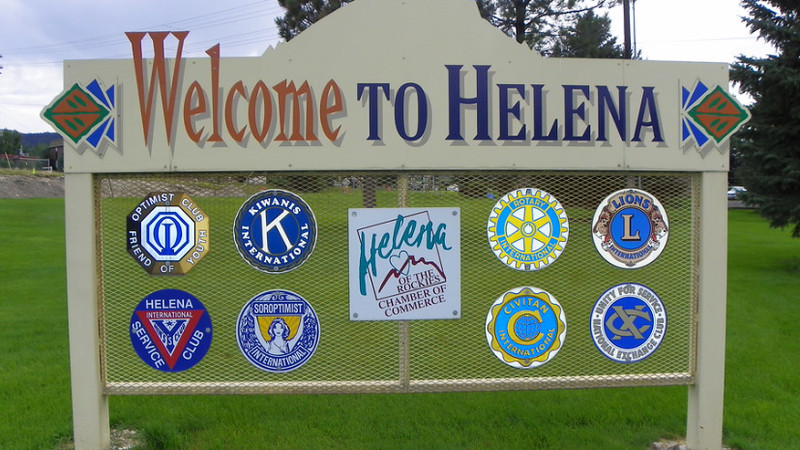
HELENA, MT- The capital city of Montana is under fire after the state’s governor and attorney general announced a formal investigation into Helena to determine whether a recently passed resolution violates a state law banning sanctuary cities, the Daily Montanan reports.
The resolution says the city will limit its cooperation with federal law enforcement, which appears to violate a state law banning sanctuary cities in the state.
Montana Gov. Greg Gianforte spoke at a joint press conference with Attorney General Austin Knudsen, calling the resolution “potentially a direct violation” of a state law he signed in 2021 that prohibits local governments from creating sanctuary cities in the state.
Gianforte and Knudsen said they are examining whether the city should be penalized if it is found to be breaking state law, with Knudsen explaining that if cities don’t like the law, they should try to change it.
“This is clearly the city council of Helena thumbing its nose at the Montana Legislature,” Knudsen said. “If the city of Helena does not like state law, I encourage it to retain counsel, get a lobbyist, come up here to the Capitol during the ‘27 legislative session, and take its best shot at changing the law.”
According to city officials, the resolution complies with local, state, and federal law. Republican lawmakers say that the city and other municipalities should focus on issues under their purview, however, a Democrat from Helena painted the investigation as a PR stunt.
“We still have rights and freedoms in our country, and that includes people of color,” State Sen. Mary Ann Dunwell dramatically told the Montanan. “That’s the issue here, not whether the city of Helena is violating a stupid, hate-filled, racist law.”
Dunwell didn’t expound on why the law is “stupid, hate-filled,” or “racist.”
Montana’s law, House Bill 200, says that state agencies or local governments “may not enact, adopt, implement, enforce, or refer to the electorate a policy that restricts government employees from sending to, receiving from, exchanging with, or maintaining for a federal, state, or local government entity information regarding a person’s citizenship or immigration status for a lawful purpose.”
The Helena City Commission signed a resolution on Jan. 26 as concerns about “aggressive” federal immigration enforcement around the country increased, fulfilling a campaign promise made by President Trump in the 2024 presidential campaign.
In a statement, the City of Helena said it was aware of the announcement from Gianforte’s office regarding a state investigation into the city policy:
“At this time, the City has not received any official notice or formal communication from the Governor’s Office or the Montana Attorney General’s Office regarding this matter. As a general practice, the City does not provide comment on pending or potential litigation matters,” the statement reads. It continues that the city is committed to “upholding all applicable federal and state laws.”
Helena’s resolution states that the city “shall not disclose” so-called “sensitive” information about any person to outside agencies or individuals, including a person’s immigration status or national origin, except as required by local laws or with a valid court order.
Under Montana state law, any violation of the sanctuary city law could result in a $10,000 fine for each five-day period a local government is out of compliance, withholding of state funds from the Montana coal board and the coal board endowment program.
The Montana Coal Endowment Program reports that Helena has received only one grant for public infrastructure upgrades in the past 20 years: a $750,000 grant in 2019.
“Today we send a clear message to all local governments across the state: If you are found in violation of state law, there will be penalties,” Gov. Gianforte said. “In Montana, we don’t tolerate defiance, and we support our local law enforcement.”
Neither Gianforte nor Knudsen has informed Helena city officials or the chief of police about the apparent violation of state law; instead, they are basing the investigation on public actions taken at the January meeting.
The Helena resolution also supports a Helena Police Department policy to “not, independently or assisting other law enforcement agencies, stop, pursue, interrogate, investigate, arrest, or otherwise detain a person solely based on their immigration status or suspected violations of immigration law.”
Knudsen added that part of the state investigation will be whether existing city or police department policies violate state law and noted that “the penalties could be much more severe.”
Knudsen said that, to his knowledge, Helena is the only municipal government that has taken action in a way that runs afoul of state law. He addressed some “concern” about Missoula, however a cursory investigation found that no official policies have been implemented by Missoula city officials.
That said, Missoula Mayor Andrea Davis has spoken out about immigration enforcement nationwide and said the role of Missoula’s police department is to “uphold our public safety here in our community, regardless of whether you’re a resident or whether you’re a guest,” code word for illegal alien.
“We are not in the business of immigration enforcement. We have not been deputized as such, and we have not signed federal agreements to do as such,” Davis said. “That said, we do carry forth justice. And if there is a judicial warrant that is issued for somebody that does have a criminal sanction against them, no matter their immigration status, no matter if they’re a long-time resident here or not, we will…move forward with justice for a judicial warrant.”
Missoula Police Chief Mike Colyer shared the department’s policy on immigration and officer conduct last month, including wearing clearly identifiable name tags, not wearing masks except in safety situations such as extreme weather or pandemics, and generally avoiding the use of unmarked vehicles.
During his press conference, Gianforte warned other cities against taking similar actions to Helena’s.
“Local municipalities need to cooperate with federal authorities so that we do not harbor illegal immigrants in our communities,” Gianforte said. “We’ve seen Montanans suffer from the inflow of fentanyl. We’ve seen crime in our local communities. We’ve seen gang members apprehended in local communities. Local jurisdictions cannot protect these criminals.”
Republican legislative leaders voiced support for Gianforte’s tough stance.
“Sanctuary city policies put ideology ahead of public safety, and Montana made it clear years ago that we are not going down the road,” said Republican Brandon Ler, Speaker of the House. “Cities don’t get to declare themselves above state law or decide they know better than the people’s representatives.”
Republican Senate President Matt Regier also spoke in support of the investigation.
“The Legislature expects the executive branch to enforce the laws we pass,” he said in a statement. “Helena property taxpayers should be outraged at their local government for jeopardizing their hard-earned tax dollars for leftist ideology instead of putting the people’s money toward fixing potholes and shoring up local infrastructure.”
The Helena resolution includes an absurd provision that the city supports police officers requesting ID from federal officers and asking them to remove masks “at the officer’s sole discretion.” In other words, the resolution attempts to pit local police officers against federal immigration officials, which appears to be a clear violation of the Supremacy Clause.
Knudsen unloaded on that portion of the resolution, saying it has “no effect,” but will be part of the investigation.
“The city of Helena has absolutely no authority to tell federal law enforcement how they can dress or what kind of apparel they can wear,” Knudsen said.

Comments
2026-02-14T15:46-0500 | Comment by: Mike
I thought people in Montana had more sense than that. These idiots must be Calimexifornia rejects.
2026-02-14T16:38-0500 | Comment by: Robert
Another state the DEMOCRAT COMMUNIST SWINE, have taken over. I thought CATTLE were WHELPED in Montana, not SWINE (pigs). B.L.M. = "BLUE LIVES MATTER".
2026-02-16T17:57-0500 | Comment by: James
Jail time for the city council!