
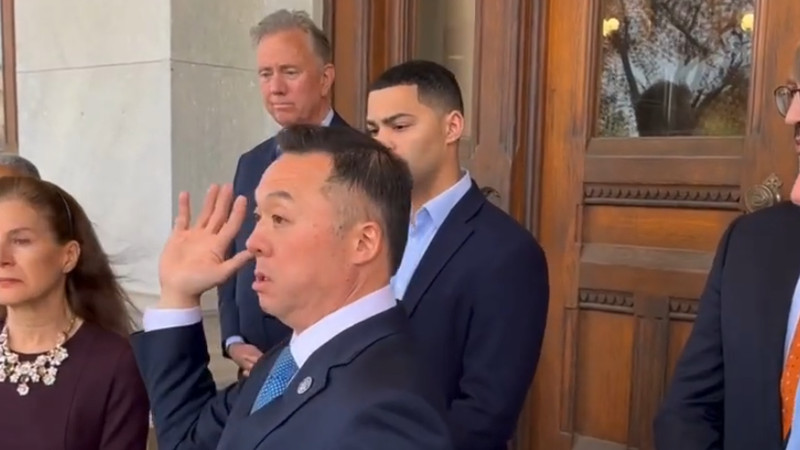
HARTFORD, CT - Connecticut Gov. Ned Lamont (D) and lawsuit-happy Attorney General William Tong (D) may deny that the poorly-named Constitution State is a “sanctuary state,” but facts say otherwise, according to CT Insider.
Lamont and Tong may want to check with the mayor of their capital city, Arunan Arulampalam, who has referred to Hartford as a sanctuary city in the past few weeks.
Lamont and Tong’s denial comes as President Donald Trump has threatened to pull federal funding from states that have sanctuary cities or are themselves sanctuary jurisdictions.
While there isn’t a legal definition for “sanctuary city,” determining what qualifies as one is fairly simple — municipalities that refuse to work with federal immigration agencies, or worse yet, openly defy those agencies. The reasoning is quite simple: sanctuary cities are overwhelmingly blue cities located in blue states, and they want illegal aliens in the country for two reasons.
First, Democrats believe that illegal aliens will overwhelmingly vote for them, which is why Democrats oppose photo ID as a requirement to vote. Secondly, the larger the population, the more Congressional seats are apportioned. If they are located in Democratic areas, that means more Democratic seats. It’s as simple as that. It’s all about power.
Connecticut Democrats passed a law called the Trust Act, which limits the ability of state or local law enforcement to cooperate with federal immigration agencies such as Immigration and Customs Enforcement (ICE) and Customs and Border Protection (CBP). Some Connecticut lawmakers, however, claim that officials in the state do provide information, but only when a violent crime is under investigation.
Most Connecticut municipal leaders are smart enough to avoid the term “sanctuary city,” but not Arulampalam, who used the term at a gathering of malcontents protesting ICE in Hartford a couple of weeks ago.
“This is a sanctuary city,” the astute mayor said. “This is a city that is meant to be safe for all residents.” Except for those who are victimized by illegal alien criminals.
On Jan. 8, demonstrators desperately in need of attention gathered at the federal courthouse in Hartford to protest the killing of Renee Good, an anti-ICE radical, by an ICE agent in Minneapolis as she struck him with her car.
In the back of the courthouse, two protesters were sprayed with pepper spray, while two vehicles allegedly made contact with radical protesters attempting to block vehicles as they left a parking garage at the rear of the courthouse, according to Arulampalam. The “peaceful” protesters threw projectiles at vehicles, shattering the back window of a van possibly being driven by a federal employee, Hartford officials said. Police are currently investigating the circumstances surrounding the above incidents.
Other cities deliberately avoid using the term “sanctuary city,” such as Hamden, which last year passed an ordinance protecting residents without full documentation and ensuring equal access to town services, CT Insider reported.
The “welcoming city” ordinance in Hamden prohibits police from asking about someone’s immigration status or detaining people for the enforcement of federal immigration law except under specific circumstances. Ironically, Hamden has been in the news frequently in recent months due to several serious criminal incidents. Probably just a coincidence.
During President Trump’s first term, New Haven Mayor Justin Elicker signed an executive order that protects “all residents regardless of their background,” he said at the time.
That order prohibits New Haven police from asking about a person’s immigration status unless required by state or federal law, or detaining someone based on ICE detainer requests or administrative orders.
While some Connecticut cities and towns purposely avoid using the term sanctuary city, the U.S. Department of Justice has published a list of sanctuary jurisdictions. Connecticut sits on that list. The list was published after an April executive order issued by President Trump targeted states and municipalities that “violate, obstruct, and defy the enforcement of federal immigration laws.”
Tong claims Connecticut isn’t a sanctuary state, saying, “...there’s nothing in our laws or statutes that says Connecticut is a ‘sanctuary’ state. We are not.”
Perhaps not in a legal sense, but certainly in practice.
“Nothing has changed to alter that certification,” Tong said, referring to the first Trump administration certifying Connecticut’s compliance with federal law. “Any claim or suggestion that Connecticut has violated or is not in compliance with federal law would be false.”
Tong, who has filed somewhere in excess of 40 frivolous lawsuits against the Trump administration, said the term sanctuary city has no legal definition and said the state is complying with federal immigration laws. He called such claims “unfounded.”
President Trump has vowed to cut off funding to sanctuary jurisdictions on Feb. 1, although he hasn’t said what specific funding he’s talking about.
Reporters asked the president what kind of funding would be affected, according to the Associated Press, and he responded, “You’ll see…it’ll be significant.
If it walks like a duck, and quacks like a duck, it’s a duck…or a sanctuary jurisdiction.

Comments
2026-02-02T17:56-0500 | Comment by: Robert
It appears the Governor, should be charged with "MALFEASANCE IN OFFICE", which in fact a CRIME.
2026-02-04T10:10-0500 | Comment by: Laurence
CT is yet another one of the Communist Coalition of New England, along with New York, Massachusetts, Rhode Island, and New Jersey - all of which are anti-Constitutional states, with huge taxes. They violate Federal law, yet the Supreme Court does nothing.