
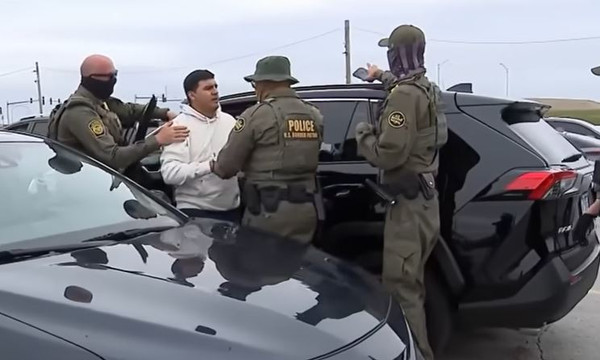
CHICAGO, IL – An immigration enforcement operation conducted at a parking lot near Chicago’s O’Hare International Airport earlier in October resulted in 12 arrests, with some locals alleging the illegal aliens had their “due process rights” violated during their arrests.
On October 10, federal agents carried out a “targeted immigration enforcement operation,” according to Homeland Security Assistant Secretary Tricia McLaughlin, at a parking lot near O’Hare International Airport, which is known locally as a hub for rideshare drivers looking to capitalize on travelers.
While it’s unclear what kind of intel federal agents were operating off of in targeting the exact parking lot, a total of 12 arrests were made, with McLaughlin stating the suspects were in “violation of our nation’s immigration laws.”
Despite there being no evidence of misconduct by agents during the operation, the Illinois Drivers Alliance issued a statement condemning the actions of the federal government and baselessly suggested the “due process rights” of those arrested during the operation were violated.
“We are deeply concerned that the drivers’ due process rights were violated at O’Hare today. This is part of a broader pattern of attacks on immigrant families by an administration that continues to weaponize fear and division instead of investing in solutions that strengthen our communities,” the statement from the Illinois Drivers Alliance noted.
The Illinois Drivers Alliance’s statement went on to assert that the operation conducted at the parking lot was one of a series of “unconstitutional raids,” adding that the organization will continue to “stand shoulder to shoulder with all hard-working immigrant drivers, families, and essential workers targeted by these unjust actions.”
Although the Illinois Drivers Alliance didn’t expand upon what exactly they believe was unconstitutional about the immigration enforcement operation, areas like parking lots generally fall under the open field doctrine defined in the 1924 Supreme Court case of Hester v. United States, which found that Fourth Amendment protections do not extend to literal open areas which are easily observable to any and all passersby.
On October 10, federal agents carried out a “targeted immigration enforcement operation,” according to Homeland Security Assistant Secretary Tricia McLaughlin, at a parking lot near O’Hare International Airport, which is known locally as a hub for rideshare drivers looking to capitalize on travelers.
While it’s unclear what kind of intel federal agents were operating off of in targeting the exact parking lot, a total of 12 arrests were made, with McLaughlin stating the suspects were in “violation of our nation’s immigration laws.”
Despite there being no evidence of misconduct by agents during the operation, the Illinois Drivers Alliance issued a statement condemning the actions of the federal government and baselessly suggested the “due process rights” of those arrested during the operation were violated.
“We are deeply concerned that the drivers’ due process rights were violated at O’Hare today. This is part of a broader pattern of attacks on immigrant families by an administration that continues to weaponize fear and division instead of investing in solutions that strengthen our communities,” the statement from the Illinois Drivers Alliance noted.
The Illinois Drivers Alliance’s statement went on to assert that the operation conducted at the parking lot was one of a series of “unconstitutional raids,” adding that the organization will continue to “stand shoulder to shoulder with all hard-working immigrant drivers, families, and essential workers targeted by these unjust actions.”
Although the Illinois Drivers Alliance didn’t expand upon what exactly they believe was unconstitutional about the immigration enforcement operation, areas like parking lots generally fall under the open field doctrine defined in the 1924 Supreme Court case of Hester v. United States, which found that Fourth Amendment protections do not extend to literal open areas which are easily observable to any and all passersby.
For corrections or revisions, click here.
The opinions reflected in this article are not necessarily the opinions of LET

Comments