
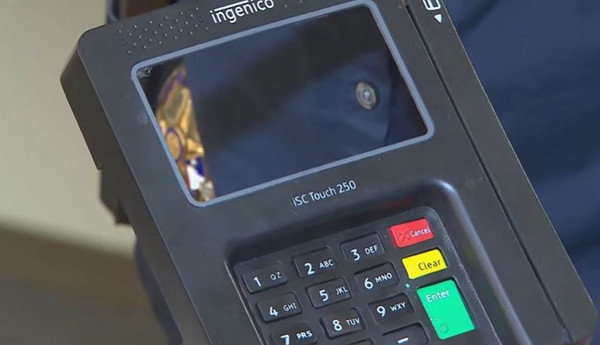
PHILADELPHIA, PA - Video captured by a Dollar Tree shopper in Philadelphia earlier in April caught a suspected debit card skimmer attached to one of the card readers at a point-of-sale terminal, leading to concerns that customers’ debit cards and PINs were being intercepted by bad actors.
The incident reportedly occurred at the Dollar Tree located at 4424 N. Broad Street in Philadelphia on April 25, where a woman who happened upon a suspicious-looking card reader at the point of sale inside the establishment decided to activate her Meta glasses and alert staff to her concerns.
Instagram user “sharon_rbt_cna” was the individual behind the camera who happened to stumble upon what appears to be a card skimmer discreetly overlaid on the original keypad of the card reader at the register, immediately informing employees and nearby customers. A male employee of the location seemed skeptical of the woman’s concerns, asserting there weren’t multiple keypads on the card reader.
However, while the suspicious woman was picking at the base of the display, a faux keypad with an underlying ribbon cable and a small motherboard began to slide off the original keypad of the card reader.
After the discovery of what appeared to be a malicious device attached to the point of sale, the male employee retrieved the device and moved toward the rear of the store while the woman exclaimed that she intended to contact the police.
According to the FBI, these sorts of devices “are generally designed as overlays to the POS terminal and have wireless transmission capabilities,” and “only take seconds to install.” Apparently, the agency warns that a mere distraction like “requesting items from behind the counter” can afford would-be fraudsters an opportunity to install one of these card skimmers.
Some of the comments featured on the original Instagram post highlighted the unsettling nature of bad actors attempting to sneakily funnel funds from shoppers at establishments like Dollar Tree, who may already be on the lower end of the economic spectrum.
Dollar Tree has yet to issue a public statement on the incident depicted in the video as of this writing.
The incident reportedly occurred at the Dollar Tree located at 4424 N. Broad Street in Philadelphia on April 25, where a woman who happened upon a suspicious-looking card reader at the point of sale inside the establishment decided to activate her Meta glasses and alert staff to her concerns.
Instagram user “sharon_rbt_cna” was the individual behind the camera who happened to stumble upon what appears to be a card skimmer discreetly overlaid on the original keypad of the card reader at the register, immediately informing employees and nearby customers. A male employee of the location seemed skeptical of the woman’s concerns, asserting there weren’t multiple keypads on the card reader.
However, while the suspicious woman was picking at the base of the display, a faux keypad with an underlying ribbon cable and a small motherboard began to slide off the original keypad of the card reader.
After the discovery of what appeared to be a malicious device attached to the point of sale, the male employee retrieved the device and moved toward the rear of the store while the woman exclaimed that she intended to contact the police.
According to the FBI, these sorts of devices “are generally designed as overlays to the POS terminal and have wireless transmission capabilities,” and “only take seconds to install.” Apparently, the agency warns that a mere distraction like “requesting items from behind the counter” can afford would-be fraudsters an opportunity to install one of these card skimmers.
Some of the comments featured on the original Instagram post highlighted the unsettling nature of bad actors attempting to sneakily funnel funds from shoppers at establishments like Dollar Tree, who may already be on the lower end of the economic spectrum.
Dollar Tree has yet to issue a public statement on the incident depicted in the video as of this writing.
For corrections or revisions, click here.
The opinions reflected in this article are not necessarily the opinions of LET

Comments