
BALTIMORE, MD – This past January, Immigration and Customs Enforcement (ICE) apprehended a criminal illegal alien previously charged with attempted murder who’d been released from custody from a sanctuary jurisdiction in Maryland despite the issuance of an immigration detainer.
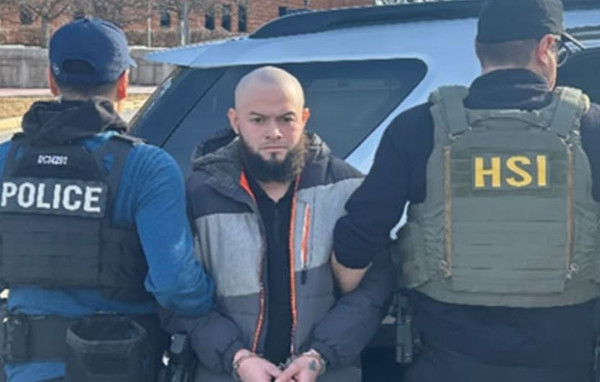
On January 13th, officers and agents with ICE Baltimore apprehended Rafael Aguilar, a criminal illegal alien from Honduras who was once charged with attempted murder out of Prince George’s County regarding a near-fatal stabbing only to have those charges reduced to second-degree assault.
Back in April of 2025, Aguilar reportedly stabbed their victim in the back as they were walking home, with the seriousness of the incident initially seeing Aguilar appropriately charged with attempted second-degree murder. However, prosecutors out of Prince George’s County reduced the charges, leading to Aguilar being sentenced to 10 years in prison for second-degree assault.
Regardless of the 10 year sentence rendered in Aguilar’s case, he’d wind up serving nothing close to the aforementioned, as he was released on probation on January 6th after serving 141 days at the Prince George’s County Adult Detention Center. Back in August of 2025, while Aguilar was still in custody, ICE issued a detainer for the individual that was ignored by facility staff housing the convicted felon.
Despite the hindrances imposed by the sanctuary jurisdiction, ICE was able to apprehend Aguilar within a week of his release back into the community, with ICE Baltimore acting Field Office Director Vernon Liggins issuing a statement highlighting the dangers created by sanctuary policies.
“When sanctuary jurisdictions refuse to honor ICE immigration detainers for egregious criminal illegal aliens, they are knowingly endangering the public,” Liggins stated, adding, “By releasing Aguilar instead of cooperating with federal law enforcement, local officials in Prince George’s County chose politics over public safety. These reckless policies fail the law-abiding residents who expect their communities to be kept safe. ICE will continue to step in and do the job sanctuary jurisdictions refuse to do.”
On January 13th, officers and agents with ICE Baltimore apprehended Rafael Aguilar, a criminal illegal alien from Honduras who was once charged with attempted murder out of Prince George’s County regarding a near-fatal stabbing only to have those charges reduced to second-degree assault.
Back in April of 2025, Aguilar reportedly stabbed their victim in the back as they were walking home, with the seriousness of the incident initially seeing Aguilar appropriately charged with attempted second-degree murder. However, prosecutors out of Prince George’s County reduced the charges, leading to Aguilar being sentenced to 10 years in prison for second-degree assault.
Regardless of the 10 year sentence rendered in Aguilar’s case, he’d wind up serving nothing close to the aforementioned, as he was released on probation on January 6th after serving 141 days at the Prince George’s County Adult Detention Center. Back in August of 2025, while Aguilar was still in custody, ICE issued a detainer for the individual that was ignored by facility staff housing the convicted felon.
Despite the hindrances imposed by the sanctuary jurisdiction, ICE was able to apprehend Aguilar within a week of his release back into the community, with ICE Baltimore acting Field Office Director Vernon Liggins issuing a statement highlighting the dangers created by sanctuary policies.
“When sanctuary jurisdictions refuse to honor ICE immigration detainers for egregious criminal illegal aliens, they are knowingly endangering the public,” Liggins stated, adding, “By releasing Aguilar instead of cooperating with federal law enforcement, local officials in Prince George’s County chose politics over public safety. These reckless policies fail the law-abiding residents who expect their communities to be kept safe. ICE will continue to step in and do the job sanctuary jurisdictions refuse to do.”
For corrections or revisions, click here.
The opinions reflected in this article are not necessarily the opinions of LET

Comments
2026-02-10T17:18-0500 | Comment by: arthur
What I don't understand is why, why, WHY do these people allow them to commit these crimes, and then just let them get away with it? What is the point to this? You can be from anywhere, or be any color, but if you are an actual American, you will get the full on book tossed at you in hardcover, and that without hesitation. I don't get it. This makes no sense to me at all.
2026-02-13T16:43-0500 | Comment by: James
Thank God and Mr. Trump for ICE! God bless them!!!