
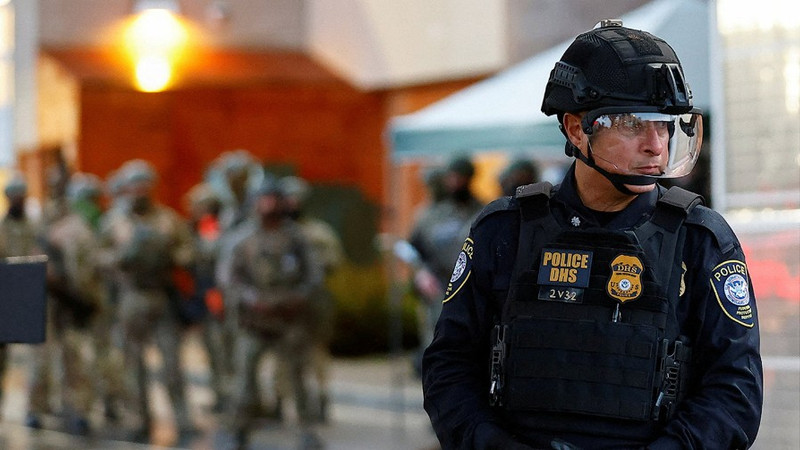
The Department of Homeland Security remains in limbo more than a month into a partial government shutdown, as Senate Democrats and Republicans continue to negotiate funding tied to immigration enforcement policy changes. While political leaders debate, the consequences are being felt in real time across the homeland security enterprise.
This is not just a budget dispute. This is a national security issue.
Agencies such as TSA, FEMA, ICE, and the Coast Guard remain caught in uncertainty. While many federal law enforcement officers continue working and receiving pay, a significant portion of the DHS workforce, particularly administrative and mission support personnel, are not. That gap has immediate operational consequences.
When administrative professionals are furloughed or unpaid, cases slow down, intelligence processing is delayed, and critical investigative and enforcement functions become less efficient.
Law enforcement officers are forced to divert from frontline operations to cover administrative shortfalls, pulling resources away from the very missions that protect the American people.
At the same time, threats to our homeland are not slowing down. They are accelerating.
Recent attacks underscore the volatile environment we are operating in. A deadly shooting at Old Dominion University, carried out by a radicalized individual with ties to ISIS ideology, left one dead and others injured. In Michigan, a vehicle-ramming attack targeted a synagogue filled with families and children, shaking an entire community.
These incidents are not isolated. They reflect a broader and growing threat landscape that demands a fully resourced and fully supported homeland security apparatus.
Additionally, just weeks ago, a suspect breached the security perimeter at Mar-a-Lago, armed and posing a significant threat before being neutralized by the United States Secret Service. These are the kinds of incidents that remind us how quickly danger can materialize and how critical it is to have highly trained, fully supported personnel standing watch.
Layer onto this an increasingly unstable global environment, including rising tensions with Iran and elevated threat levels, and the stakes become even clearer. This is not the time to weaken the operational readiness of DHS.
Yet that is exactly what prolonged political gridlock is doing.
More than 300 TSA officers have reportedly left their positions amid missed paychecks. These are trained professionals walking away from critical security roles because they cannot sustain their livelihoods without reliable income. While many federal employees may eventually receive back pay, that does not help them pay mortgages, buy groceries, or cover basic expenses today.
We are asking these men and women to continue protecting the nation while simultaneously placing financial strain on their families. That is not just unsustainable. It is unacceptable.
I have said this before and I will say it again, politics should never dictate public safety. When funding lapses force law enforcement professionals to operate under uncertainty or without full support, it is not Washington that feels the impact first. It is the American people.
The ongoing standoff centers largely around disagreements over immigration enforcement policy. Democrats have pushed for changes following controversial enforcement incidents, while Republicans have rejected proposals that would scale back or restructure enforcement authorities. Meanwhile, attempts to pass temporary funding measures have repeatedly failed.
This cycle of negotiation without resolution is not governance. It is paralysis.
There is, however, a path forward.
President Donald J. Trump has nominated Senator Markwayne Mullin to serve as the next Secretary of Homeland Security, a move that has generated strong bipartisan support. Senator Mullin brings a reputation as a pragmatic leader, a strong advocate for border security, and someone willing to engage across the aisle on complex national security issues.
Combined with the current leadership team, including Border Czar Tom Homan, CBP Commissioner Rodney Scott, ICE Director Todd Lyons, Secret Service Director Sean Curran, Attorney General Pam Bondi, and Deputy Attorney General Todd Blanche, there is a clear framework in place to strengthen homeland security operations and restore confidence across the workforce.
These leaders are not in place for politics. They are in place to confront real threats, dismantle transnational criminal organizations, combat fentanyl trafficking, and secure our borders.
Last week, I had the opportunity to meet with several of these leaders. The discussions were focused, solutions-oriented, and centered on one shared objective: keeping the American people safe. These are professionals committed to mission over politics, and they deserve the full support of Congress.
Now Congress must do its part.
Funding the Department of Homeland Security should not be a partisan bargaining chip. It should be a baseline responsibility. Every day this impasse continues, operational strain increases, workforce morale declines, and national security risks grow.
The American people should not be less safe because elected officials cannot reach an agreement.
Our law enforcement officers and homeland security professionals show up every day, regardless of the circumstances. They put their lives on the line without hesitation. The least we can do is ensure they have the resources, support, and stability they need to do their jobs.
It is time to end the political stalemate. Fund DHS. Support our workforce. Protect this nation.

Comments