
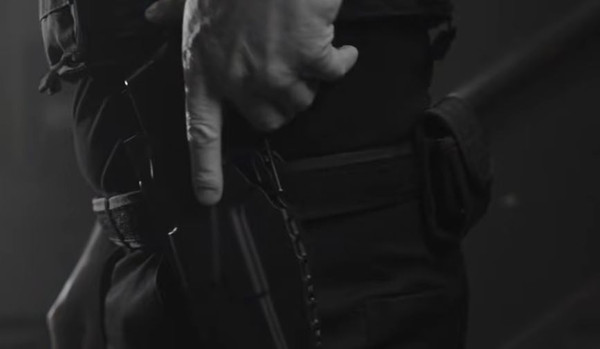
Police officers resting their hands on the holster can, at times, cause unease during interactions between the public and officers. While this discomfort isn’t completely warrantless, it’s simultaneously something that the general public shouldn’t take offense to personally – because it’s not a direct assertion that someone is a threat to public safety, but rather a culmination training and tactical readiness.
Whenever there’s a pattern of shared behaviors between police officers across numerous agencies in differing cities, counties, and states, then there’s a high likelihood those behaviors are more training-driven rather than some ubiquitous happenstance.
While questionable or contentious instances of use-of-force or drawing of a police officer’s weapon are worthy of reasonable scrutiny, an officer’s hand merely resting on or near their service weapon is something that shouldn’t attract ire from the public – yet the solitary act is still perceived by some as an intimidation tactic.
Not to be misconstrued with an intentional act of brandishing a firearm; when it comes to an officer’s hand placement on or near their holster, it typically serves two purposes during interactions with the public: situational readiness if things turn awry and general comfort.
As noted by a retired police officer in a Quora forum pertaining to this very topic, it’s nothing personal against anyone who may be taken aback at the posture/gesture at hand. Instead, resting one’s hand on their service weapon is a mere practical behavior considering the unpredictability of police interactions in tandem with an array of worn equipment making normal posturing of the arms improbable.
This sort of hand-at-the-ready officer behavior is ostensibly most common during the onset of traffic stops, as even the most innocuous reasoning behind a stop – whether for an equipment or simple moving violation – can potentially devolve into a life-threatening scenario for the officer involved.
So the next time you find yourself armchair quarterbacking a viral police encounter video, or you’re perhaps the subject of a police encounter where hand-to-holster posturing is involved, take a moment to remind yourself that it’s not that the officer believes a specific person is a threat but rather that they don’t know if said person is a threat or not.
Whenever there’s a pattern of shared behaviors between police officers across numerous agencies in differing cities, counties, and states, then there’s a high likelihood those behaviors are more training-driven rather than some ubiquitous happenstance.
While questionable or contentious instances of use-of-force or drawing of a police officer’s weapon are worthy of reasonable scrutiny, an officer’s hand merely resting on or near their service weapon is something that shouldn’t attract ire from the public – yet the solitary act is still perceived by some as an intimidation tactic.
Not to be misconstrued with an intentional act of brandishing a firearm; when it comes to an officer’s hand placement on or near their holster, it typically serves two purposes during interactions with the public: situational readiness if things turn awry and general comfort.
As noted by a retired police officer in a Quora forum pertaining to this very topic, it’s nothing personal against anyone who may be taken aback at the posture/gesture at hand. Instead, resting one’s hand on their service weapon is a mere practical behavior considering the unpredictability of police interactions in tandem with an array of worn equipment making normal posturing of the arms improbable.
This sort of hand-at-the-ready officer behavior is ostensibly most common during the onset of traffic stops, as even the most innocuous reasoning behind a stop – whether for an equipment or simple moving violation – can potentially devolve into a life-threatening scenario for the officer involved.
So the next time you find yourself armchair quarterbacking a viral police encounter video, or you’re perhaps the subject of a police encounter where hand-to-holster posturing is involved, take a moment to remind yourself that it’s not that the officer believes a specific person is a threat but rather that they don’t know if said person is a threat or not.
For corrections or revisions, click here.
The opinions reflected in this article are not necessarily the opinions of LET

Comments