
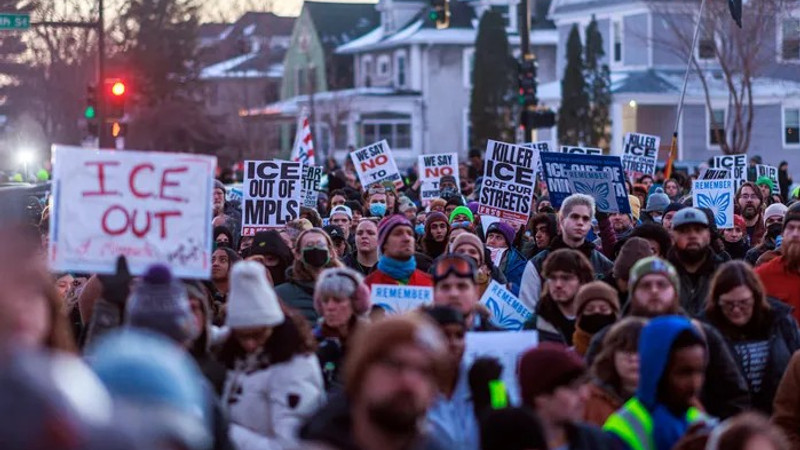
A pattern is emerging — and it’s no longer subtle.
Money flows into the cities with the most chaos, not despite the disorder, but because of it. These are the cities where politicians virtue-signal, undermine law enforcement, and sell decarceration as empathy.
This isn’t random.
It’s funded.
And it’s been building since 2016.
You can see it on the ground.
In Minneapolis, anti-ICE protests didn’t look spontaneous. Marchers carried professionally printed signs and oversized, coordinated banners — the kind you’d expect at a national corporate conference, not a grassroots rally.
They wore police-grade gas masks. They used encrypted apps and coordinated technology to track ICE agents in real time — sharing locations, vehicle descriptions, and alerts as operations unfolded. This has been widely reported as a tactic used by organized activist networks responding to federal enforcement.
So ask the obvious questions.
Who paid for the banners?
Who paid for the gear?
Los Angeles followed the same script this past summer.
Pallets of bricks were neatly packaged and placed across the city — positioned near overpasses where police were stationed below. Officers were suddenly attacked from above as bricks were hurled down, forcing them to retreat to their vehicles to avoid serious injury or death.
That does not happen by accident. Yet portions of the media rushed to offer cover, suggesting the pallets were merely coincidental — the result of nearby construction. The explanation strained credibility. When the press chooses a side, it often abandons scrutiny, recasting organized violence as happenstance and behaving less like a free press and more like a defense team.
Police cars were destroyed.
Businesses were looted and windows shattered.
Entire neighborhoods were surrendered to mob rule.
We’ve seen this model before.
Not models — one.
During the 2020 Black Lives Matter “summer of love,” cities burned under the banner of racial justice while corporate donors and foundations poured in millions of dollars. In the years that followed, serious questions emerged about where that money went. Several BLM leaders came under investigation, and at least one was federally indicted on charges related to the misuse of donor funds.
That didn’t look like justice.
It looked like money.
Grant-funded chaos.
Billions of dollars flow through foundations and political networks into city governments willing to play along. When they don’t, that same money is used to install district attorneys whose policies mirror those of radical public defenders — regardless of the consequences for public safety.
In New Jersey, Governor Mikie Sherrill demanded ICE agents be taken “off the streets immediately,” calling them “unaccountable” and “lawless” — not as a protester, but as a sitting governor attacking federal law enforcement on record.
In Philadelphia, District Attorney Larry Krasner went further. On video, he claimed he would “hunt down” ICE agents — despite having no jurisdiction over them.
He outranks no one.
He has no authority.
This is first-year law school material.
In New York City, Mayor Zohran Mamdani has aligned himself with figures who promoted defunding-the-police policies and used dehumanizing rhetoric toward law enforcement, while advancing taxpayer-funded ideological initiatives. During a recent winter blast, ten homeless New Yorkers froze to death even as city leadership staged public photo-ops highlighting political priorities rather than emergency response. Families were left to grieve without answers.
What do you say to those families?
Or do deaths only matter when there’s a grant attached?
At this point, the question isn’t whether this is happening.
It’s why.
The answer’s not complicated.
It’s financial.
Donald Trump didn’t enter politics to get rich. He already was.
Members of Congress are different. They are public servants — and public service was never meant to be a pathway to personal enrichment.
Yet questions persist about how some lawmakers amass fortunes far beyond what a congressional salary supports. That scrutiny has recently focused on Ilhan Omar, whose financial disclosures and reported rise in net worth have fueled public debate about how such wealth is accumulated while in office.
Alexandria Ocasio-Cortez built a brand around “Tax the Rich,” then attended the Met Gala in a designer gown bearing the slogan. In 2025, the House Ethics Committee ordered her to repay more than $2,700 for improperly accepted gifts tied to the event — even while finding no intent to violate the rules.
Public servants are not supposed to live like elites.
I don’t say this as a pundit.
I say it as someone who was one.
When I worked at Allegheny County Pretrial Services in Pittsburgh, millions of dollars began flowing in under the banner of “bail reform.” Eventually, that funding approached $20 million.
The condition was simple: downplay risk — meaning erase it entirely.
We were expected to tell magistrates that violent offenders were not dangerous. That a man who nearly beat someone to death — even with dozens of prior arrests — posed no threat to the community.
We recommended release.
They walked out.
Many returned — some just hours later — charged with attempted homicide or worse.
Criminal history is the strongest predictor of future violence.
We were instructed to argue the opposite.
This was the cost of the funding.
Meanwhile, police were exhausted.
Battered.
Demoralized.
Two years after the funding began pouring in, my director — a woman in her 50s with two college-aged children — built a home worth over one million dollars. Luxury vacations followed: Disney, Colorado, Hawaii — bragged about openly while innocent people were attacked by offenders who never should have been released.
Every time the jail population dropped, another large check arrived.
Now the fraud is coming into view: fake daycares in Minnesota. A winery that never existed. Taxpayer money funneled into ideological programs while basic public safety collapsed.
Lawlessness was the distraction.
Paid chaos.
Bullhorns.
Banners.
Gas masks.
Bricks.
Ask yourself the only question that matters:
Where do you think they came from?

Comments
2026-02-08T20:50-0500 | Comment by: Mark
Also during the 2020 riots pallets of bricks were placed in the riot areas in Houston and other cities and the bricks were traced to have come from a Pritzker family company. J B Pritzker being the leftist illegal alien loving democrat governor of Illinois who inherited all his billions through the family's Hyatt Hotel Brand.