
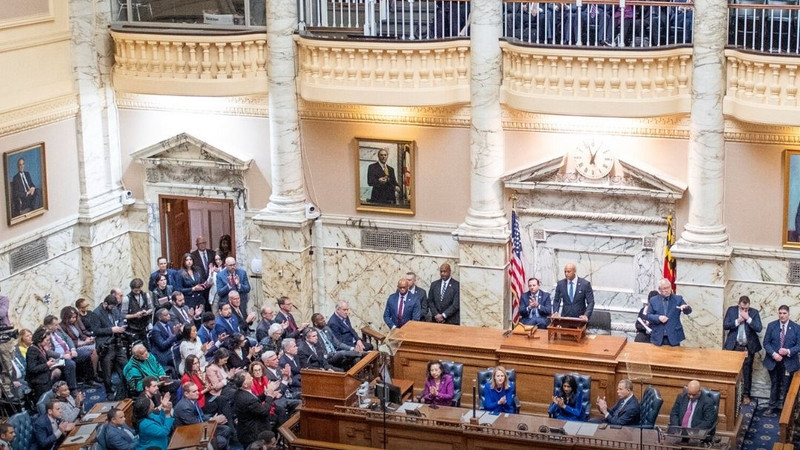
ANNAPOLIS, MD - One day after the Maryland Senate approved legislation to limit cooperation with Immigration and Customs Enforcement (ICE), the House of Delegates approved the bill as an emergency measure Saturday night, April 11.
The 92-37 vote in support of Senate Bill 791 came shortly before midnight, capping a 13-hour day in the House and putting the bill one step away from the governor's desk, according to Maryland Matters.
The Senate was scheduled to meet on Monday, April 13, the final day of the 90-day legislative session. Senate Bill 791 was only voted out of committee late Thursday night, April 9.
"We are making a real promise that immigration enforcement is focused on violent criminals,” House Majority Leader David Moon (D-Montgomery) said before he cast his vote in favor of the measure. “I do believe this is a balanced bill that will do that in everything going on."
House Republicans said the bill would not only make Maryland a sanctuary state for criminals, but would also eliminate partnerships between local law enforcement and federal agencies.
"These policies are going to have repercussions. Making Maryland a sanctuary state will further bankrupt us, if we’re not bankrupt already,” said House Minority Whip Jesse Pippy (R-Frederick). The approval in the House came one day after the Senate voted 29-13 for the bill that would close a loophole that lets local law enforcement agencies and jails detain individuals based on their immigration status and requests from ICE.
The House took its turn to amend the bill Saturday, starting with a 12-6 party-line vote in the Judiciary Committee to move the bill to the floor.
The biggest change by the House was to make Senate Bill 791 an emergency measure, meaning it will take effect immediately upon the governor's signature instead of on October 1. Emergency legislation requires three-fifths of each chamber to approve, or at least 85 delegates and 29 senators.
Supporters of the bill, labeled the Community Trust Act, said that it complements legislation signed into law earlier in the year that bans the so-called 287(g) agreements between ICE and local law enforcement agencies. Under the Community Trust Act, ICE would need a judicial warrant to compel action from the state.
Another House amendment changed one word for an individual from "covered" to "convicted." The person who would be detained in a local or state correctional facility can be notified by ICE in four situations, if the person is:
Convicted of a felony in the United States; A registered sex offender; Served between 12 to 18 months in a state prison; or committed an offense in another state and served at least five years in prison "and the individual completed at least five years of incarceration of that sentence.
The House added one other sentence to the bill Saturday: “A state or local correctional facility may not coerce, intimidate, or threaten an individual based on the actual or perceived citizenship or immigration status of the individual or any other person.”
Sen. Charles Sydnor III (D-Baltimore County) said it is unclear if any other amendments would keep the Senate from giving the bill final approval the last day of the session on Monday.
House Republicans would end up offering hours of amendments, starting with an opening salvo from Del. Kathy Szeliga (R-Baltimore County) to change the title of the bill ot the "Maryland Sanctuary State Act of 2026."
"So that everybody knows when they look at the bill, they know exactly what it does,” she said. While Republicans argued that the bill does not improve public safety, Democrats such as House Majority Whip Ashanti Martinez (D-Prince George's) said it will ensure that all Marylanders are protected.
"What this bill does is to ensure we have one system around how we deal with corrections, how we deal with folks that are convicted of the most heinous of crimes,” he said. “This bill builds trust. This bill puts us on a pathway for us to be able to really get our communities together."
The 92-37 vote in support of Senate Bill 791 came shortly before midnight, capping a 13-hour day in the House and putting the bill one step away from the governor's desk, according to Maryland Matters.
The Senate was scheduled to meet on Monday, April 13, the final day of the 90-day legislative session. Senate Bill 791 was only voted out of committee late Thursday night, April 9.
"We are making a real promise that immigration enforcement is focused on violent criminals,” House Majority Leader David Moon (D-Montgomery) said before he cast his vote in favor of the measure. “I do believe this is a balanced bill that will do that in everything going on."
House Republicans said the bill would not only make Maryland a sanctuary state for criminals, but would also eliminate partnerships between local law enforcement and federal agencies.
"These policies are going to have repercussions. Making Maryland a sanctuary state will further bankrupt us, if we’re not bankrupt already,” said House Minority Whip Jesse Pippy (R-Frederick). The approval in the House came one day after the Senate voted 29-13 for the bill that would close a loophole that lets local law enforcement agencies and jails detain individuals based on their immigration status and requests from ICE.
The House took its turn to amend the bill Saturday, starting with a 12-6 party-line vote in the Judiciary Committee to move the bill to the floor.
The biggest change by the House was to make Senate Bill 791 an emergency measure, meaning it will take effect immediately upon the governor's signature instead of on October 1. Emergency legislation requires three-fifths of each chamber to approve, or at least 85 delegates and 29 senators.
Supporters of the bill, labeled the Community Trust Act, said that it complements legislation signed into law earlier in the year that bans the so-called 287(g) agreements between ICE and local law enforcement agencies. Under the Community Trust Act, ICE would need a judicial warrant to compel action from the state.
Another House amendment changed one word for an individual from "covered" to "convicted." The person who would be detained in a local or state correctional facility can be notified by ICE in four situations, if the person is:
Convicted of a felony in the United States; A registered sex offender; Served between 12 to 18 months in a state prison; or committed an offense in another state and served at least five years in prison "and the individual completed at least five years of incarceration of that sentence.
The House added one other sentence to the bill Saturday: “A state or local correctional facility may not coerce, intimidate, or threaten an individual based on the actual or perceived citizenship or immigration status of the individual or any other person.”
Sen. Charles Sydnor III (D-Baltimore County) said it is unclear if any other amendments would keep the Senate from giving the bill final approval the last day of the session on Monday.
House Republicans would end up offering hours of amendments, starting with an opening salvo from Del. Kathy Szeliga (R-Baltimore County) to change the title of the bill ot the "Maryland Sanctuary State Act of 2026."
"So that everybody knows when they look at the bill, they know exactly what it does,” she said. While Republicans argued that the bill does not improve public safety, Democrats such as House Majority Whip Ashanti Martinez (D-Prince George's) said it will ensure that all Marylanders are protected.
"What this bill does is to ensure we have one system around how we deal with corrections, how we deal with folks that are convicted of the most heinous of crimes,” he said. “This bill builds trust. This bill puts us on a pathway for us to be able to really get our communities together."
For corrections or revisions, click here.
The opinions reflected in this article are not necessarily the opinions of LET

Comments