
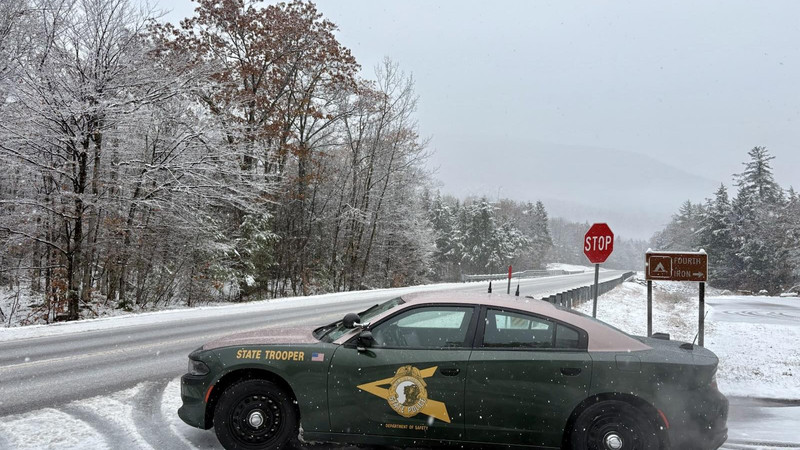
MANCHESTER, NH - As the number of police vehicle pursuits in the state of New Hampshire and across the country rises, a handful of police departments in the state are examining their pursuit policies.
Police vehicle pursuits are often a split-second decision and can have deadly consequences if it is carried out in areas that are heavily populated. News 9 Investigates obtained data from New Hampshire State Police showing that in 2019, the agency was involved in 77 police pursuits.
That number remained relatively stable between 2020 and 2022 before increasing to 103 pursuits in 2023 and 130 pursuits in 2024. Former Lebanon Police Chief Richard Melo said there could be a reason for the increase. "There are probably several different factors," Melo said.
"Over the past 10 years, maybe a little bit longer, we've seen a reduction in consequences for motor vehicle offenses, for offenses overall." He said the numbers show that the likelihood of a suspect being caught by police during a chase is going down.
"When an offender decides they're going to run from the police, they're weighing several different factors, just like the police departments are weighing factors and whether they're going to pursue," Melo said. "It's the likelihood of being caught. It's the consequence if they are caught in the eventual punishment. First of all, data shows that the likelihood of being caught is down."
Claremont Police Chief Brent Wilmot said that a lot of communication goes into deciding if an officer should pursue a vehicle or not. "There's a lot of communication you need on the front end to very quickly make a decision," he said.
Chief Wilmot said there is a lot that goes into the decision to pursue a suspect. "If I'm going to be stopping a car for [an expired] inspection sticker or something like that, and then it just takes off, and it's this time of day where there's heavy traffic, that's going to get terminated almost immediately," Wilmot said.
"But now, if I'm stuck with the car because of some sort of finite encounter, maybe it's armed robbery or violent assault or something even more serious like that, the calculus changes." Because of the risk pursuits carry, Chuck Wexler, executive director of the Police Executive Research Forum, said law enforcement agencies across the country are taking a second look at their policies.
"Is whatever action the person is taking, is that proportionate to police engaging in the pursuit? Does it justify it?" he said. "Does engaging in a high-speed pursuit justify whatever offense this person has committed?"
Wexler and his team were asked by the U.S. Department of Justice and National Highway Traffic Safety Administration to develop best practices in police pursuits and figure out under what circumstances police should pursue. "The sanctity of human life is considered the number one principle that many police departments are adopting," Wexler said.
In October, a police pursuit in New Hampshire turned deadly. State police said they started pursuing a speeding car on I-93 near Exit 12, reaching speeds of 120 mph. Police said the driver tried to take an off-ramp near Exit 18 but lost control, went down an embankment, and hit a tree. The driver, a 20-year-old from Massachusetts, died at the scene of the crash.
"I used to have conversations with my officers to say, 'Alright, you chase this person. They start going 120 mph. You have to go 120-plus to chase them to keep up with them. You get into an accident, or you hit somebody. What's going to happen?" Melo said. "Someone's going to lose their life. That's not worth it."
State police declined an interview request by News9 Investigates, but released a statement that said, in part, "Pursuits involve complex and sensitive tactical considerations. As each situation is unique, troopers respond as appropriate to ensure the safety of all roadway users."
Police vehicle pursuits are often a split-second decision and can have deadly consequences if it is carried out in areas that are heavily populated. News 9 Investigates obtained data from New Hampshire State Police showing that in 2019, the agency was involved in 77 police pursuits.
That number remained relatively stable between 2020 and 2022 before increasing to 103 pursuits in 2023 and 130 pursuits in 2024. Former Lebanon Police Chief Richard Melo said there could be a reason for the increase. "There are probably several different factors," Melo said.
"Over the past 10 years, maybe a little bit longer, we've seen a reduction in consequences for motor vehicle offenses, for offenses overall." He said the numbers show that the likelihood of a suspect being caught by police during a chase is going down.
"When an offender decides they're going to run from the police, they're weighing several different factors, just like the police departments are weighing factors and whether they're going to pursue," Melo said. "It's the likelihood of being caught. It's the consequence if they are caught in the eventual punishment. First of all, data shows that the likelihood of being caught is down."
Claremont Police Chief Brent Wilmot said that a lot of communication goes into deciding if an officer should pursue a vehicle or not. "There's a lot of communication you need on the front end to very quickly make a decision," he said.
Chief Wilmot said there is a lot that goes into the decision to pursue a suspect. "If I'm going to be stopping a car for [an expired] inspection sticker or something like that, and then it just takes off, and it's this time of day where there's heavy traffic, that's going to get terminated almost immediately," Wilmot said.
"But now, if I'm stuck with the car because of some sort of finite encounter, maybe it's armed robbery or violent assault or something even more serious like that, the calculus changes." Because of the risk pursuits carry, Chuck Wexler, executive director of the Police Executive Research Forum, said law enforcement agencies across the country are taking a second look at their policies.
"Is whatever action the person is taking, is that proportionate to police engaging in the pursuit? Does it justify it?" he said. "Does engaging in a high-speed pursuit justify whatever offense this person has committed?"
Wexler and his team were asked by the U.S. Department of Justice and National Highway Traffic Safety Administration to develop best practices in police pursuits and figure out under what circumstances police should pursue. "The sanctity of human life is considered the number one principle that many police departments are adopting," Wexler said.
In October, a police pursuit in New Hampshire turned deadly. State police said they started pursuing a speeding car on I-93 near Exit 12, reaching speeds of 120 mph. Police said the driver tried to take an off-ramp near Exit 18 but lost control, went down an embankment, and hit a tree. The driver, a 20-year-old from Massachusetts, died at the scene of the crash.
"I used to have conversations with my officers to say, 'Alright, you chase this person. They start going 120 mph. You have to go 120-plus to chase them to keep up with them. You get into an accident, or you hit somebody. What's going to happen?" Melo said. "Someone's going to lose their life. That's not worth it."
State police declined an interview request by News9 Investigates, but released a statement that said, in part, "Pursuits involve complex and sensitive tactical considerations. As each situation is unique, troopers respond as appropriate to ensure the safety of all roadway users."
For corrections or revisions, click here.
The opinions reflected in this article are not necessarily the opinions of LET

Comments