
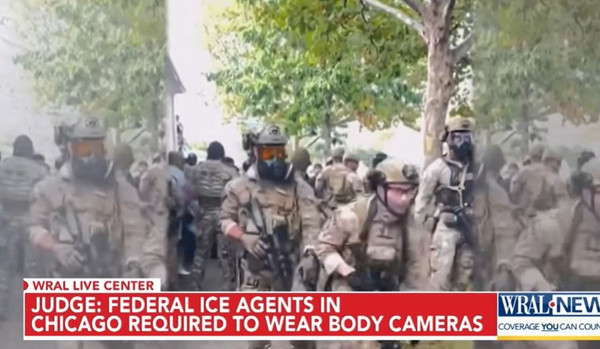
CHICAGO, IL – A federal judge for the U.S. District Court Northern District of Illinois ordered that federal agents operating in the Chicago area as part of Operation Midway Blitz must wear and have running, bodycams while engaged in “law enforcement activities.” The judge’s order relating to bodycams served as a reiteration of a prior order she delivered earlier in October.
U.S. District Judge Sara Ellis, appointed by former President Barack Obama back in 2013, made her initial ruling pertaining to bodycam use by federal agents operating in Chicago back on October 16th.
Judge Ellis framed the initial order under the apparent influence of sensationalized coverage regarding interactions between Immigration and Customs Enforcement (ICE) agents and anti-ICE rioters outside the Broadview facility, saying at the time she was a “little startled” at the use of riot control munitions like tear gas as she’d already issued a temporary restraining order (TRO) on October 9th prohibiting federal agents from using said tactics against journalists and alleged peaceful protesters.
During the October 16th hearing, Judge Ellis’ bodycam directive had yet to officially be entered into court records at the time, with Homeland Security confirming such an order was yet to be formalized as well. A spokesperson for the agency noted at the time that if said order were formalized, it would be “an extreme act of judicial activism.”
However, come October 17th, Judge Ellis seemingly clarified her stance on bodycam usage during a follow-up hearing, telling the federal government that her bodycam demands were “not a suggestion.”
During the aforementioned hearing, Judge Ellis said to attorneys representing the current administration, “Maybe I wasn't clear yesterday; that wasn't a suggestion. I am modifying the temporary restraining order to include body-worn cameras,” adding, “It’s not up for debate.”
The Obama appointee continued her diatribe from the bench, saying, “This was not a suggestion. It wasn't a hint. It wasn't a topic of discussion or conversation. It was an order. So, I will enter it today and then I will expect that it will be followed.”
The legal complexities surrounding TROs and what would constitute an extrajudicial imposition has been a topic of discussion regarding Judge Ellis’ order pertaining to bodycams, as TROs are typically a tool used by judges to enforce a de facto preliminary prohibitory injunction rather than mandatory injunctions.
Even CNN’s legal analyst Elie Honig found Judge Ellis’ order to be teetering on extrajudicial territory, calling the ruling an “overstep” and saying Judge Ellis is acting like she’s the “Chief of ICE.”
“I don't know where this judge thinks she gets off, essentially becoming the Chief of ICE operations. I mean, she cannot micromanage, tell them you have to wear body cameras. I mean, that might be a good idea, but that's an overstep,” Honig said amongst a CNN panel.
Honig pointed out that the way Judge Ellis is crafting her rulings in the case would create a conundrum where agency supervisors and leadership become meaningless in the hierarchical sense, as ground-level agents and officers would seemingly have to report to Judge Ellis for all matters trivial and otherwise.
“She's going to get reversed by a court of appeals eventually. Maybe the Supreme Court, maybe the circuit court,” Honig stated, adding, “Because what are these, they're cops essentially, right? They're immigration cops. Are they supposed to go to her and say, ‘Well, your honor, we want to take a door, do we have your permission? Your honor, uh, when should we have our body cameras on? Do we need it during breaks,’ I mean, this is the kind of stuff that the chief of police or the ASAC would do federally.”
It's unclear whether the Trump administration is willing, or even able, to comply with the rendered order due to the massive scale of operations ongoing in Chicago as bodycams are not actively available to all agents and officers within the agency.
U.S. District Judge Sara Ellis, appointed by former President Barack Obama back in 2013, made her initial ruling pertaining to bodycam use by federal agents operating in Chicago back on October 16th.
Judge Ellis framed the initial order under the apparent influence of sensationalized coverage regarding interactions between Immigration and Customs Enforcement (ICE) agents and anti-ICE rioters outside the Broadview facility, saying at the time she was a “little startled” at the use of riot control munitions like tear gas as she’d already issued a temporary restraining order (TRO) on October 9th prohibiting federal agents from using said tactics against journalists and alleged peaceful protesters.
During the October 16th hearing, Judge Ellis’ bodycam directive had yet to officially be entered into court records at the time, with Homeland Security confirming such an order was yet to be formalized as well. A spokesperson for the agency noted at the time that if said order were formalized, it would be “an extreme act of judicial activism.”
However, come October 17th, Judge Ellis seemingly clarified her stance on bodycam usage during a follow-up hearing, telling the federal government that her bodycam demands were “not a suggestion.”
During the aforementioned hearing, Judge Ellis said to attorneys representing the current administration, “Maybe I wasn't clear yesterday; that wasn't a suggestion. I am modifying the temporary restraining order to include body-worn cameras,” adding, “It’s not up for debate.”
The Obama appointee continued her diatribe from the bench, saying, “This was not a suggestion. It wasn't a hint. It wasn't a topic of discussion or conversation. It was an order. So, I will enter it today and then I will expect that it will be followed.”
The legal complexities surrounding TROs and what would constitute an extrajudicial imposition has been a topic of discussion regarding Judge Ellis’ order pertaining to bodycams, as TROs are typically a tool used by judges to enforce a de facto preliminary prohibitory injunction rather than mandatory injunctions.
Even CNN’s legal analyst Elie Honig found Judge Ellis’ order to be teetering on extrajudicial territory, calling the ruling an “overstep” and saying Judge Ellis is acting like she’s the “Chief of ICE.”
“I don't know where this judge thinks she gets off, essentially becoming the Chief of ICE operations. I mean, she cannot micromanage, tell them you have to wear body cameras. I mean, that might be a good idea, but that's an overstep,” Honig said amongst a CNN panel.
Honig pointed out that the way Judge Ellis is crafting her rulings in the case would create a conundrum where agency supervisors and leadership become meaningless in the hierarchical sense, as ground-level agents and officers would seemingly have to report to Judge Ellis for all matters trivial and otherwise.
“She's going to get reversed by a court of appeals eventually. Maybe the Supreme Court, maybe the circuit court,” Honig stated, adding, “Because what are these, they're cops essentially, right? They're immigration cops. Are they supposed to go to her and say, ‘Well, your honor, we want to take a door, do we have your permission? Your honor, uh, when should we have our body cameras on? Do we need it during breaks,’ I mean, this is the kind of stuff that the chief of police or the ASAC would do federally.”
It's unclear whether the Trump administration is willing, or even able, to comply with the rendered order due to the massive scale of operations ongoing in Chicago as bodycams are not actively available to all agents and officers within the agency.
For corrections or revisions, click here.
The opinions reflected in this article are not necessarily the opinions of LET

Comments
2025-10-23T16:47-0400 | Comment by: Rick
The P.O.S. can order all he wants. There is ABSOLUTELY no authority for the federal government to follow the order. Legislatures pass laws not idiots sitting on judicial benches they are more equipped to stand in front of than sit at.